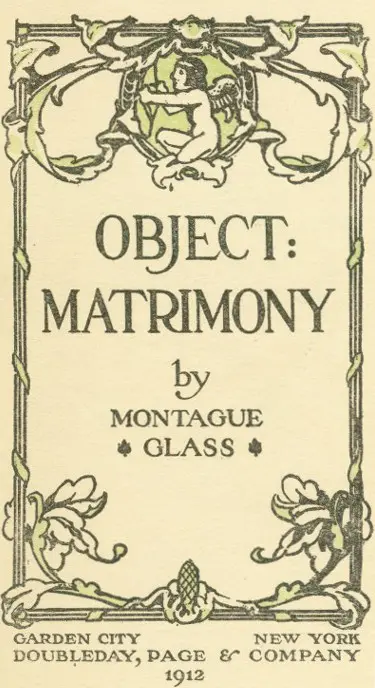
Object: matrimony
Montague Glass

THE CLASSIC COLLECTION · 1911
"Elkan Lubliner, American" by Montague Glass is a novel written in the early 20th century. The story revolves around the character Elkan Lubliner and his experiences as he navigates life as an immigrant in America. The narrative explores themes of family, cultural challenges, and the dynamics of business relationships in a humorous and engaging manner. The opening of the book introduces us to Marcus Polatkin and Philip Scheikowitz, partners in a clothing business, as they discuss family matters related to Philip's brother-in-law, who is trying to emigrate from Russia. Their conversation is filled with humor and cultural references that illustrate their backgrounds and the immigrant experience. The focus soon shifts to the arrival of Philip's nephew, Elkan Lubliner, who is expected to come work at their store. However, complications arise when it is revealed that Elkan's father has gambled away the money sent for his passage, prompting questions about family honor and trust. This sets the tone for the unfolding drama, highlighting family ties, identity challenges, and the comedic misunderstandings of immigrant life in America.
Introduction adapted from the source catalogue; source summaries may be automatically generated.
Free to read · English · 69,088 words · No account needed
MAKE TIME FOR A GOOD BOOK
On by default. Untick to stop anonymous reading totals. Each page counts after 10 seconds in view. How this works.
Anonymous counting is on unless you have switched it off.
He led the protesting Shadchen through the lobby, and when they entered the Moorish Room an impressive scene awaited them. On a divan, beneath some elaborate plush draperies, sat Kent J. Goldenfein, flanked on each side by Polatkin and Scheikowitz respectively, while spread on the table in front of them were the drafts of Flixman's will and the engrossed, unsigned copy, together with such other formidable-looking documents as Goldenfein happened to find in his pockets. He rose majestically as Fischko entered and turned on him a beetling frown.
"Is this the fellow?" he demanded sepulchrally, and Kapfer nodded.
"Mr. Fischko," Goldenfein went on, "I am an officer of the Supreme Court and I have been retained to investigate the affairs of Mr. Julius Flixman."
"Say, lookyhere, Kapfer," Fischko cried. "What is all this?"
Kapfer drew forward a chair.
"Sit down, Fischko," he said, "and answer the questions that he is
asking you."
"But----" Fischko began.
"Come, come, Mr. Fischko," Goldenfein boomed, "you are wasting our time here. Raise your right hand!"
Fischko glanced despairingly at Kapfer and then obeyed.
"Do you solemnly swear," said Goldenfein, who, besides being an attorney-at-law was also a notary public, "that the affidavit you will hereafter sign will be the truth, the whole truth and nothing but the truth, so help you God?"
"But----" Fischko began again.
"Do you?" Goldenfein roared, and Fischko nodded. Forthwith Goldenfein plied him with such ingeniously fashioned questions concerning the Flixman family that the answers presented a complete history of all its branches. Furthermore, the affidavit which Goldenfein immediately drew up lacked only such confirmatory evidence as could easily be supplied to establish the identity of Miss Yetta Silbermacher as Julius Flixman's only heir-at-law; and, after Fischko had meekly signed the jurat, Goldenfein rose ponderously to his feet.
"I congratulate you, Mr. Polatkin," he said. "I think there is no doubt that your nephew's fiancee will inherit Flixman's estate, thanks to my professional integrity."
"What d'ye mean your professional integrity?" Kapfer asked.
"Why, if I hadn't refused to accept twenty-two dollars for drawing the will and insisted on the twenty-five we had agreed upon," Goldenfein explained, "he would never have suffered the heart attack which prevented his signing the will before he died."
"Died!" Fischko exclaimed. "Is Julius Flixman dead?"
"Koosh, Fischko!" Polatkin commanded. "You would think you was one of the family the way you are acting. Come down to our store to-morrow and we would arrange things with you." He turned to Kapfer.
"Let's go upstairs and see Elkan--and Yetta," he said.
Immediately they trooped to the elevator and ascended to the seventh
floor.
Your reading position is saved on this browser. Take it to another device with a library code. Reading pages adapt to text, rather than matching a printed edition.
Montague Glass
Montague Glass
Montague Glass
Montague Glass
BEHIND THE BOOK
This eBook is for the use of anyone anywhere in the United States and most other parts of the world at no cost and with almost no restrictions whatsoever. You may copy it, give it away or re-use it under the terms of the Project Gutenberg License included with this eBook or online at www.gutenberg.org. If you are not located in the United States, you will have to check the laws of the country where you are located before using this eBook. Read the source licence.
The original source file, including credits and licence, is retained by this library. Request an original-format copy at no charge. Please include the book title and Project Gutenberg identifier #27423.
KEEP YOUR CURIOSITY GOING
Coulson Kernahan

Maurice Baring
Frances Wright
Cécile Tormay

Frederic Jesup Stimson

W. H. P. (William Henry Pope) Jarvis