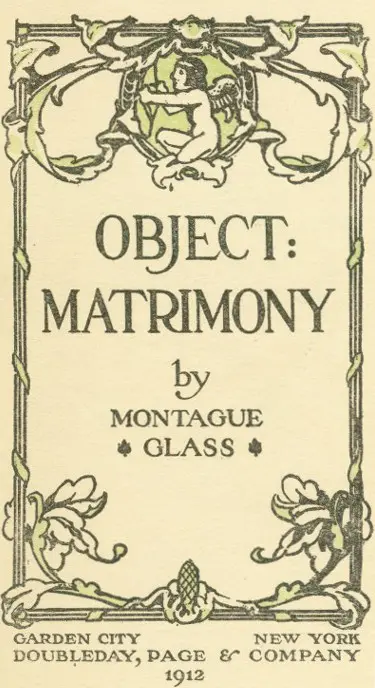
Object: matrimony
Montague Glass

THE CLASSIC COLLECTION · 1911
"Elkan Lubliner, American" by Montague Glass is a novel written in the early 20th century. The story revolves around the character Elkan Lubliner and his experiences as he navigates life as an immigrant in America. The narrative explores themes of family, cultural challenges, and the dynamics of business relationships in a humorous and engaging manner. The opening of the book introduces us to Marcus Polatkin and Philip Scheikowitz, partners in a clothing business, as they discuss family matters related to Philip's brother-in-law, who is trying to emigrate from Russia. Their conversation is filled with humor and cultural references that illustrate their backgrounds and the immigrant experience. The focus soon shifts to the arrival of Philip's nephew, Elkan Lubliner, who is expected to come work at their store. However, complications arise when it is revealed that Elkan's father has gambled away the money sent for his passage, prompting questions about family honor and trust. This sets the tone for the unfolding drama, highlighting family ties, identity challenges, and the comedic misunderstandings of immigrant life in America.
Introduction adapted from the source catalogue; source summaries may be automatically generated.
Free to read · English · 69,088 words · No account needed
MAKE TIME FOR A GOOD BOOK
On by default. Untick to stop anonymous reading totals. Each page counts after 10 seconds in view. How this works.
Anonymous counting is on unless you have switched it off.
At first he held out his hand in greeting; but the two little dimples that accompanied Yetta's smile overpowered his sense of propriety, and he embraced her affectionately.
"Where's Fischko?" he asked.
Both Kapfer and Miss Silbermacher looked toward the street entrance.
"He was here a minute ago," Kapfer said.
"Did you tell him that I wasn't Ury Shemansky at all?" Elkan inquired.
"Sure I did," Miss Silbermacher replied, "and he goes on something terrible, on account he says Mr. Kapfer told him last night you was already engaged; so I told him I know you was engaged because I am the party you are engaged to."
She squeezed Elkan's hand.
"And he says then," she continued, "that if that's the case what do we want him down here for? So I told him we are going to meet Mr. Polatkin and Mr. Scheikowitz, and----"
"And they'll be right here in a minute," Kapfer interrupted; "so you go upstairs to my room and I'll find Fischko and bring him up also."
He conducted them to the elevator, and even as the door closed behind them Fischko came running up the hall.
"Kapfer," he said, "who was that feller which he was just here talking
to you?"
"What d'ye want to know for?" Kapfer asked.
"Never mind what I want to know for!" Fischko retorted. "Who is he?"
"Well, if you must got to know," Kapfer said, "he's a feller by the name
Julius Flixman."
"What?" Fischko shouted.
"Fischko," Kapfer protested, "you ain't in no Canal Street coffee house here. This is a first-class hotel."
Fischko nodded distractedly.
"Sure, I know," he said. "Is there a place we could sit down here? I want to ask you something a few questions."
Kapfer led the way to the cafe and they sat down at a table near the
door.
"Go ahead, Fischko," he said. "Polatkin and Scheikowitz will be here any
minute."
"Well," Fischko began falteringly, "if this here feller is Julius Flixman, which he is coming from Bessarabia schon thirty years ago already, I don't want to do nothing in a hurry, Mr. Kapfer, on account I want to investigate first how things stand."
"What d'ye mean?" Kapfer demanded.
"Why, I mean this," Fischko cried: "If this here Flixman is well fixed, Kapfer, I want to know it, on account Miss Yetta Silbermacher is from Flixman's sister a daughter, understand me!"
Kapfer lit a cigar deliberately before replying. He was thinking hard.
"Do you mean to tell me," he said at last, "that this here Miss Silbermacher is Julius Flixman's a niece?"
Your reading position is saved on this browser. Take it to another device with a library code. Reading pages adapt to text, rather than matching a printed edition.
Montague Glass
Montague Glass
Montague Glass
Montague Glass
BEHIND THE BOOK
This eBook is for the use of anyone anywhere in the United States and most other parts of the world at no cost and with almost no restrictions whatsoever. You may copy it, give it away or re-use it under the terms of the Project Gutenberg License included with this eBook or online at www.gutenberg.org. If you are not located in the United States, you will have to check the laws of the country where you are located before using this eBook. Read the source licence.
The original source file, including credits and licence, is retained by this library. Request an original-format copy at no charge. Please include the book title and Project Gutenberg identifier #27423.
KEEP YOUR CURIOSITY GOING
Coulson Kernahan

Maurice Baring
Frances Wright
Cécile Tormay

Frederic Jesup Stimson

W. H. P. (William Henry Pope) Jarvis