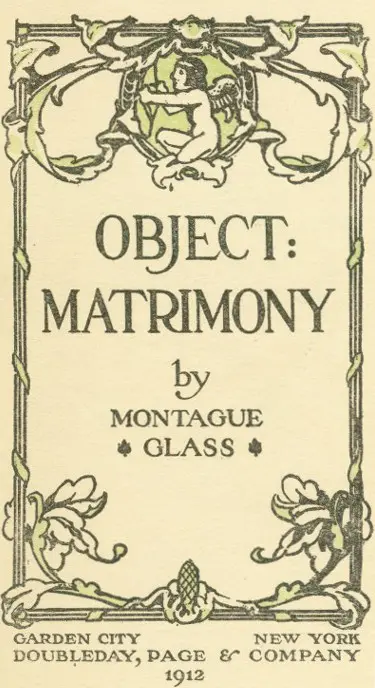
Object: matrimony
Montague Glass

THE CLASSIC COLLECTION · 1911
"Elkan Lubliner, American" by Montague Glass is a novel written in the early 20th century. The story revolves around the character Elkan Lubliner and his experiences as he navigates life as an immigrant in America. The narrative explores themes of family, cultural challenges, and the dynamics of business relationships in a humorous and engaging manner. The opening of the book introduces us to Marcus Polatkin and Philip Scheikowitz, partners in a clothing business, as they discuss family matters related to Philip's brother-in-law, who is trying to emigrate from Russia. Their conversation is filled with humor and cultural references that illustrate their backgrounds and the immigrant experience. The focus soon shifts to the arrival of Philip's nephew, Elkan Lubliner, who is expected to come work at their store. However, complications arise when it is revealed that Elkan's father has gambled away the money sent for his passage, prompting questions about family honor and trust. This sets the tone for the unfolding drama, highlighting family ties, identity challenges, and the comedic misunderstandings of immigrant life in America.
Introduction adapted from the source catalogue; source summaries may be automatically generated.
Free to read · English · 69,088 words · No account needed
MAKE TIME FOR A GOOD BOOK
On by default. Untick to stop anonymous reading totals. Each page counts after 10 seconds in view. How this works.
Anonymous counting is on unless you have switched it off.
"I am going for a half an hour somewheres," Philip replied.
"What for?" Polatkin demanded.
"What for is my business," Philip answered.
"Your business?" Polatkin exclaimed. "At nine o'clock in the morning one partner puts on his hat and starts to go out, verstehst du, and when the other partner asks him where he is going it's his business, sagt er! What do you come down here at all for, Scheikowitz?"
"I am coming down here because I got such a partner, Polatkin, which if I was to miss one day even I wouldn't know where I stand at all," Scheikowitz retorted. "Furthermore, you shouldn't worry yourself, Polatkin; for my own sake I would come back just so soon as I could."
Despite the offensive repartee that accompanied Philip's departure, however, he returned to find Polatkin entirely restored to good humour by a thousand-dollar order that had arrived in the ten-o'clock mail; and as Philip himself felt the glow of conscious virtue attendant upon a good deed economically performed, he immediately fell into friendly conversation with his partner.
"Well, Marcus," he said, "I sent 'em the passage tickets, and if you ain't agreeable that Borrochson comes to work here I could easy find him a job somewheres else."
"If we got an opening here, Philip, what is it skin off my face if the feller comes to work here," Polatkin answered, "so long as he gets the same pay like somebody else?"
"What could I do, Marcus?" Philip rejoined, as he took off his hat and coat preparatory to plunging into the assortment of a pile of samples. "My own flesh and blood I must got to look out for, ain't it? And if my sister Leah, olav hasholem, would be alive to-day I would of got 'em all over here long since ago already. Ain't I am right?"
Polatkin shrugged. "In family matters one partner couldn't advise the
other at all," he said.
"Sure, I know," Philip concluded, "but when a feller has got such a partner which he is a smart, up-to-date feller and means good by his partner, understand me, then I got a right to take an advice from him about family matters, ain't it?"
And with these honeyed words the subject of the Borrochson family's assisted emigration was dismissed until the arrival of another letter from Minsk some four weeks later.
"Well, Marcus," Philip cried after he had read it, "he'll be here
Saturday."
"Who'll be here Saturday?" Polatkin asked.
"Borrochson," Philip replied; "and the boy comes with him."
Polatkin raised his eyebrows.
"I'll tell you the honest truth, Philip," he said--"I'm surprised to
hear it."
Your reading position is saved on this browser. Take it to another device with a library code. Reading pages adapt to text, rather than matching a printed edition.
Montague Glass
Montague Glass
Montague Glass
Montague Glass
BEHIND THE BOOK
This eBook is for the use of anyone anywhere in the United States and most other parts of the world at no cost and with almost no restrictions whatsoever. You may copy it, give it away or re-use it under the terms of the Project Gutenberg License included with this eBook or online at www.gutenberg.org. If you are not located in the United States, you will have to check the laws of the country where you are located before using this eBook. Read the source licence.
The original source file, including credits and licence, is retained by this library. Request an original-format copy at no charge. Please include the book title and Project Gutenberg identifier #27423.
KEEP YOUR CURIOSITY GOING
Coulson Kernahan

Maurice Baring
Frances Wright
Cécile Tormay

Frederic Jesup Stimson

W. H. P. (William Henry Pope) Jarvis