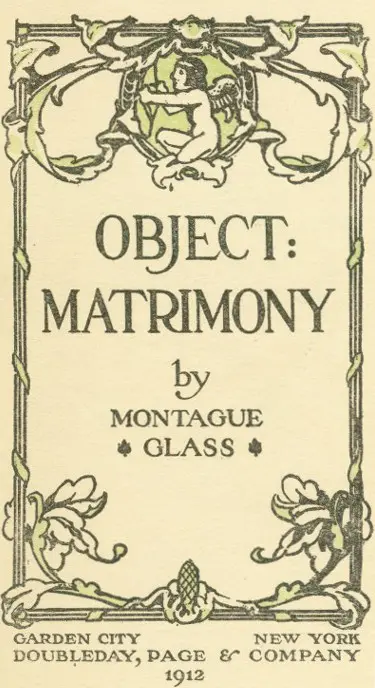
Object: matrimony
Montague Glass

THE CLASSIC COLLECTION · 1911
"Elkan Lubliner, American" by Montague Glass is a novel written in the early 20th century. The story revolves around the character Elkan Lubliner and his experiences as he navigates life as an immigrant in America. The narrative explores themes of family, cultural challenges, and the dynamics of business relationships in a humorous and engaging manner. The opening of the book introduces us to Marcus Polatkin and Philip Scheikowitz, partners in a clothing business, as they discuss family matters related to Philip's brother-in-law, who is trying to emigrate from Russia. Their conversation is filled with humor and cultural references that illustrate their backgrounds and the immigrant experience. The focus soon shifts to the arrival of Philip's nephew, Elkan Lubliner, who is expected to come work at their store. However, complications arise when it is revealed that Elkan's father has gambled away the money sent for his passage, prompting questions about family honor and trust. This sets the tone for the unfolding drama, highlighting family ties, identity challenges, and the comedic misunderstandings of immigrant life in America.
Introduction adapted from the source catalogue; source summaries may be automatically generated.
Free to read · English · 69,088 words · No account needed
MAKE TIME FOR A GOOD BOOK
On by default. Untick to stop anonymous reading totals. Each page counts after 10 seconds in view. How this works.
Anonymous counting is on unless you have switched it off.
Consequently he afforded every opportunity for Marcus to call him back, and he even paused at the factory door and applied a lighted match to his already burning cigarette. The expected summons failed, however, and instead he was nearly precipitated to the foot of the stairs by no less a person than Elkan Lubliner.
"Excuse me, Mr. Flaxberg," Elkan said. "I ain't seen you at all."
Flaxberg turned suddenly, but at the sight of Elkan his anger evaporated as he recalled a piece of gossip retailed by Sam Markulies, the shipping clerk, to the effect that, despite his eighteen years, Elkan had at least two savings-bank accounts and kept in his pocket a bundle of bills as large as a roll of piece goods.
"That's all right," Flaxberg cried with a forced grin. "I ain't surprised you are pretty near blinded when you are coming into the daylight out of the cutting room. It's dark in there like a tomb."
"I bet yer," Elkan said fervently.
"You should get into the air more often," Flaxberg went on. "A feller could get all sorts of things the matter with him staying in a hole like that."
"Gott sei dank I got, anyhow, my health," Elkan commented.
"Sure, I know," Flaxberg said as they reached the street; "but you must got to take care of it too. A feller which he don't get no exercise should ought to eat well, Lubliner. For instance, I bet yer you are taking every day your lunch in a bakery--ain't it?"
Elkan nodded.
"Well, there you are!" Flaxberg cried triumphantly. "A feller works all the time in a dark hole like that cutting room, and comes lunchtime he fresses a bunch of Kuchen and a cup of coffee, verstehst du--and is it any wonder you are looking sick?"
"I feel all right," Elkan said.
"I know you feel all right," Flaxberg continued, "but you look something terrible, Lubliner. Just for to-day, Lubliner, take my advice and try Wasserbauer's regular dinner."
Elkan laughed aloud.
"Wasserbauer's!" he exclaimed. "Why, what do you think I am, Mr. Flaxberg? If I would be a salesman like you, Mr. Flaxberg, I would say, 'Yes; eat once in a while at Wasserbauer's'; aber for an assistant cutter, Mr. Flaxberg, Wasserbauer's is just so high like the Waldorfer."
"That's all right," Flaxberg retorted airily. "No one asks you you should pay for it. Come and have a decent meal with me."
For a brief interval Elkan hesitated, but at length he surrendered, and five minutes later he found himself seated opposite Harry Flaxberg in the rear of Wasserbauer's cafe.
Your reading position is saved on this browser. Take it to another device with a library code. Reading pages adapt to text, rather than matching a printed edition.
Montague Glass
Montague Glass
Montague Glass
Montague Glass
BEHIND THE BOOK
This eBook is for the use of anyone anywhere in the United States and most other parts of the world at no cost and with almost no restrictions whatsoever. You may copy it, give it away or re-use it under the terms of the Project Gutenberg License included with this eBook or online at www.gutenberg.org. If you are not located in the United States, you will have to check the laws of the country where you are located before using this eBook. Read the source licence.
The original source file, including credits and licence, is retained by this library. Request an original-format copy at no charge. Please include the book title and Project Gutenberg identifier #27423.
KEEP YOUR CURIOSITY GOING
Coulson Kernahan

Maurice Baring
Frances Wright
Cécile Tormay

Frederic Jesup Stimson

W. H. P. (William Henry Pope) Jarvis