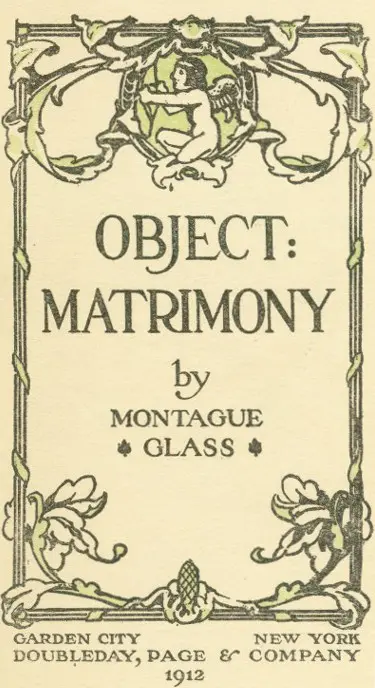
Object: matrimony
Montague Glass

THE CLASSIC COLLECTION · 1911
"Elkan Lubliner, American" by Montague Glass is a novel written in the early 20th century. The story revolves around the character Elkan Lubliner and his experiences as he navigates life as an immigrant in America. The narrative explores themes of family, cultural challenges, and the dynamics of business relationships in a humorous and engaging manner. The opening of the book introduces us to Marcus Polatkin and Philip Scheikowitz, partners in a clothing business, as they discuss family matters related to Philip's brother-in-law, who is trying to emigrate from Russia. Their conversation is filled with humor and cultural references that illustrate their backgrounds and the immigrant experience. The focus soon shifts to the arrival of Philip's nephew, Elkan Lubliner, who is expected to come work at their store. However, complications arise when it is revealed that Elkan's father has gambled away the money sent for his passage, prompting questions about family honor and trust. This sets the tone for the unfolding drama, highlighting family ties, identity challenges, and the comedic misunderstandings of immigrant life in America.
Introduction adapted from the source catalogue; source summaries may be automatically generated.
Free to read · English · 69,088 words · No account needed
MAKE TIME FOR A GOOD BOOK
On by default. Untick to stop anonymous reading totals. Each page counts after 10 seconds in view. How this works.
Anonymous counting is on unless you have switched it off.
He scraped his bowl clean and handed it to Mrs. Lesengeld.
"And that is," he concluded, "that it makes me eat so much of it,
understand me, I'm scared I wouldn't got no room for the brown stewed
fish."
Again he emptied the bowl, and at last the moment arrived when the brown stewed fish smoked upon the table. Mrs. Lesengeld helped Scharley to a heaping plateful, and both she and Yetta watched him intently, as with the deftness of a Japanese juggler he balanced approximately a half pound of the succulent fish on the end of his fork. For nearly a minute he blew on it, and when it reached an edible temperature he opened wide his mouth and thrust the fork load home. Slowly and with great smacking of his moist lips he chewed away, and then his eyes closed and he laid down his knife and fork.
"Gan-eden!" he declared as he reached across the table and shook hands
with Mrs. Lesengeld.
"Mrs. Lesengeld," he said, "my mother olav hasholom was a good cook, understand me, aber you are a good cook, Mrs. Lesengeld, and that's all there is to it."
Forthwith he resumed his knife and fork, and with only two pauses for the necessary replenishments, he polished off three platefuls of the fish, after which he heaved a great sigh of contentment, and as a prelude to conversation he lit one of B. Gans' choicest cigars.
"There's some dessert coming," Mrs. Lesengeld said.
"Dessert after this, Mrs. Lesengeld," he replied, through clouds of contented smoke, "would be a sacrilege, ain't it?"
"That's something I couldn't make at all," Mrs. Lesengeld admitted. "All I got it here is some frimsel kugel."
"Frimsel kugel!" Scharley exclaimed, laying down his cigar. "Why ain't you told me that before?"
A quarter of an hour later he again lighted his cigar, and this time he settled back in his campstool for conversation, while Mrs. Lesengeld busied herself about the oil stove. Instantly, however, he straightened up as another and more delicious odour assailed his nostrils, for Mrs. Lesengeld made coffee by a mysterious process, that conserved in the flavour of the decoction the delicious fragrance of the freshly ground bean.
"And are you staying down here with Mrs. Lesengeld?" Scharley asked Yetta after he had finished his third cup.
"In this little place here?" Mrs. Lesengeld cried indignantly. "Well, I should say not. She's stopping at the Salisbury, ain't you, Yetta?"
Yetta nodded and sighed.
"It ain't so comfortable as here," she said.
"I bet yer," Scharley added fervently. "I am stopping there too, and them Chinese Lantern Dinners which they are putting up!"
He waved his hand eloquently.
Your reading position is saved on this browser. Take it to another device with a library code. Reading pages adapt to text, rather than matching a printed edition.
Montague Glass
Montague Glass
Montague Glass
Montague Glass
BEHIND THE BOOK
This eBook is for the use of anyone anywhere in the United States and most other parts of the world at no cost and with almost no restrictions whatsoever. You may copy it, give it away or re-use it under the terms of the Project Gutenberg License included with this eBook or online at www.gutenberg.org. If you are not located in the United States, you will have to check the laws of the country where you are located before using this eBook. Read the source licence.
The original source file, including credits and licence, is retained by this library. Request an original-format copy at no charge. Please include the book title and Project Gutenberg identifier #27423.
KEEP YOUR CURIOSITY GOING
Coulson Kernahan

Maurice Baring
Frances Wright
Cécile Tormay

Frederic Jesup Stimson

W. H. P. (William Henry Pope) Jarvis