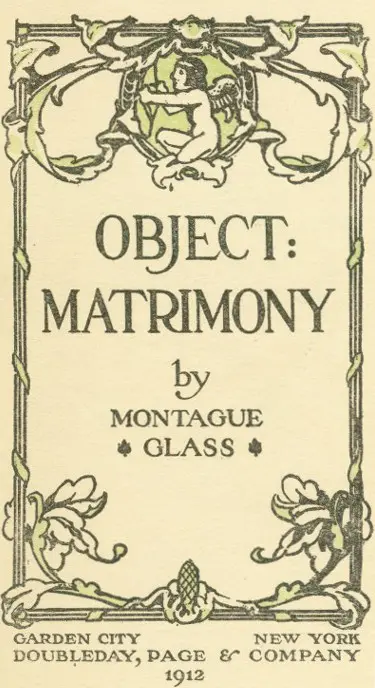
Object: matrimony
Montague Glass

THE CLASSIC COLLECTION · 1911
"Elkan Lubliner, American" by Montague Glass is a novel written in the early 20th century. The story revolves around the character Elkan Lubliner and his experiences as he navigates life as an immigrant in America. The narrative explores themes of family, cultural challenges, and the dynamics of business relationships in a humorous and engaging manner. The opening of the book introduces us to Marcus Polatkin and Philip Scheikowitz, partners in a clothing business, as they discuss family matters related to Philip's brother-in-law, who is trying to emigrate from Russia. Their conversation is filled with humor and cultural references that illustrate their backgrounds and the immigrant experience. The focus soon shifts to the arrival of Philip's nephew, Elkan Lubliner, who is expected to come work at their store. However, complications arise when it is revealed that Elkan's father has gambled away the money sent for his passage, prompting questions about family honor and trust. This sets the tone for the unfolding drama, highlighting family ties, identity challenges, and the comedic misunderstandings of immigrant life in America.
Introduction adapted from the source catalogue; source summaries may be automatically generated.
Free to read · English · 69,088 words · No account needed
MAKE TIME FOR A GOOD BOOK
On by default. Untick to stop anonymous reading totals. Each page counts after 10 seconds in view. How this works.
Anonymous counting is on unless you have switched it off.
"Schmooes, Elkan!" Scheikowitz retorted. "It wouldn't make it not one degrees warmer in Egremont supposing you could get a couple new accounts down there."
"B. Gans don't take it so particular about the weather," Polatkin commented. "I bet yer he would a whole lot sooner take off his coat and shirt and spiel a little auction pinocle mit Sol Klinger and Leon Sammet and all them fellers as be giving dinners already in a tuxedo suit to Sam Feder. I bet yer he gets a fine accommodation from the Kosciusko Bank out of that dinner yet."
"The other people also he ain't schencking no dinners to 'em for nothing neither," Scheikowitz declared. "Every one of 'em means something to B. Gans, I bet yer."
Elkan nodded.
"Particularly Scharley," he said.
"What d'ye mean, particularly Scharley?" Polatkin and Scheikowitz
inquired with one voice.
"Why, ain't you heard about Scharley?" Elkan asked. "It's right there in the Daily Cloak and Suit Journal."
He indicated the front sheet of that newsy trade paper, where under the heading of "Incorporations" appeared the following item:
The Scharley, Oderburg Drygoods Company, San Francisco, Cal., has filed articles of incorporation, giving its capital stock as $500,000, and expects to open its new store in September next.
"And you are talking about staying by Mrs. Kotlin's!" Scheikowitz exclaimed in injured tones. "You should ought to be ashamed of yourself, Elkan."
Elkan received his senior partner's upbraiding with a patient smile.
"What show do we stand against a concern like B. Gans?" he asked.
"B. Gans sells him only highgrade goods, Elkan," Scheikowitz declared. "I bet yer the least the feller buys is for twenty thousand dollars garments here, and a good half would be popular price lines, which if we would get busy, we stand an elegant show there, Elkan."
"You should ought to go down there to-morrow yet," Polatkin cried, "because the first thing you know Leon Sammet would entertain him mit oitermobiles yet, and Sol Klinger gets also busy, understand me, and the consequences is we wouldn't be in it at all."
"Next Saturday is the earliest Yetta could get ready," Elkan replied positively, and Polatkin strode up and down the floor in an access of despair.
"All right, Elkan," he said, "if you want to let such an opportunity slip down your fingers, y'understand, all right. Aber if I would be you, Elkan, I would go down there to-night yet."
Elkan shrugged his shoulders.
Your reading position is saved on this browser. Take it to another device with a library code. Reading pages adapt to text, rather than matching a printed edition.
Montague Glass
Montague Glass
Montague Glass
Montague Glass
BEHIND THE BOOK
This eBook is for the use of anyone anywhere in the United States and most other parts of the world at no cost and with almost no restrictions whatsoever. You may copy it, give it away or re-use it under the terms of the Project Gutenberg License included with this eBook or online at www.gutenberg.org. If you are not located in the United States, you will have to check the laws of the country where you are located before using this eBook. Read the source licence.
The original source file, including credits and licence, is retained by this library. Request an original-format copy at no charge. Please include the book title and Project Gutenberg identifier #27423.
KEEP YOUR CURIOSITY GOING
Coulson Kernahan

Maurice Baring
Frances Wright
Cécile Tormay

Frederic Jesup Stimson

W. H. P. (William Henry Pope) Jarvis