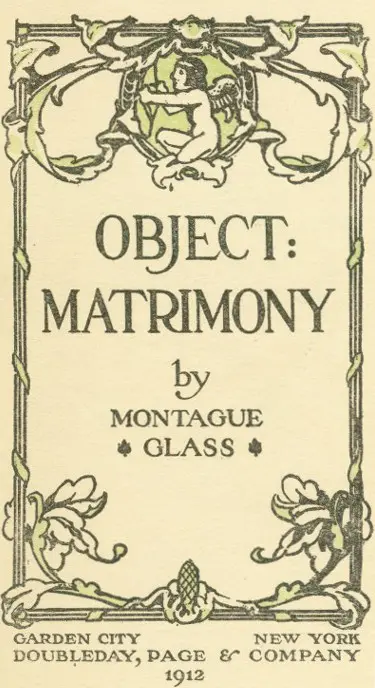
Object: matrimony
Montague Glass
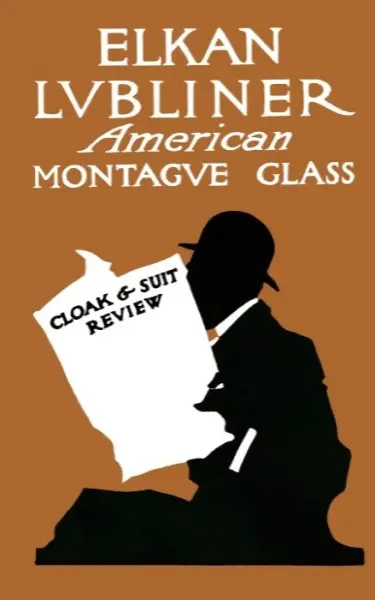
THE CLASSIC COLLECTION · 1911
"Elkan Lubliner, American" by Montague Glass is a novel written in the early 20th century. The story revolves around the character Elkan Lubliner and his experiences as he navigates life as an immigrant in America. The narrative explores themes of family, cultural challenges, and the dynamics of business relationships in a humorous and engaging manner. The opening of the book introduces us to Marcus Polatkin and Philip Scheikowitz, partners in a clothing business, as they discuss family matters related to Philip's brother-in-law, who is trying to emigrate from Russia. Their conversation is filled with humor and cultural references that illustrate their backgrounds and the immigrant experience. The focus soon shifts to the arrival of Philip's nephew, Elkan Lubliner, who is expected to come work at their store. However, complications arise when it is revealed that Elkan's father has gambled away the money sent for his passage, prompting questions about family honor and trust. This sets the tone for the unfolding drama, highlighting family ties, identity challenges, and the comedic misunderstandings of immigrant life in America.
Introduction adapted from the source catalogue; source summaries may be automatically generated.
Free to read · English · 69,088 words · No account needed
MAKE TIME FOR A GOOD BOOK
On by default. Untick to stop anonymous reading totals. Each page counts after 10 seconds in view. How this works.
Anonymous counting is on unless you have switched it off.
It was late in the afternoon when Elkan's office door opened to admit
Sam, the office boy.
"Mr. Lubliner," he said, "another feller is here about this
here--now--Jacobowitz."
Elkan glanced through the half-open door and recognized the figure of Ringentaub, the antiquarian.
"Tell him to come in," he said; and a moment later Ringentaub was wringing Elkan's hand and babbling his gratitude for his brother-in-law's deliverance from bankruptcy.
"God will bless you for it, Mr. Lubliner," he said; "and I am ashamed of myself when I think of it. I am a dawg, Mr. Lubliner--and that's all there is to it."
Here he drew a greasy wallet from his breast-pocket and extracted three
ten-dollar bills.
"Take 'em, Mr. Lubliner," he said, "and forgive me."
He pressed the bills into Elkan's hand.
"What's this?" Elkan demanded.
"That's the change from your fifty dollars," Ringentaub replied; "because, so help me, Mr. Lubliner, there is first-class material in them chairs and the feller that makes 'em for me is a highgrade cabinetmaker. Then you got to reckon it stands me in a couple of dollars also to get 'em fixed up antique, y'understand; so, if you get them chairs for twenty dollars you are buying a bargain, Mr. Lubliner."
"Why, what d'ye mean?" Elkan cried. "Ain't them chairs gen-wine Jacobean
chairs?"
"Not by a whole lot they ain't," Ringentaub declared fervently.
"But Mr. Paul thinks they are!" Elkan exclaimed.
"Sure, I know," Ringentaub answered; "and that shows what a lot a collector knows about such things. Paul is a credit man for the Hamsuckett Mills, Mr. Lubliner; but he collects old furniture on the side."
For a moment Elkan gazed open-mouthed at the antiquarian and a great light began to break in on him.
"So-o-o!" he cried. "That's what you mean by a collector!"
Ringentaub nodded.
"And furthermore, Mr. Lubliner, when collectors knows more about antiques as dealers does, Mr. Lubliner," he said with his hand on the doorknob, "I'll go into the woollen piece-goods business too--which you could take it from me, Mr. Lubliner, it wouldn't be soon, by a hundred years even."
When Elkan emerged from the One-Hundred-and-Sixteenth Street station of the subway that evening a familiar voice hailed him from the rear.
"Nu, Elkan!" cried B. Gans, for it was none other than he. "You made out fine at the meeting this morning--ain't it?"
"Who told you?" Elkan asked as he linked arms with the highgrade
manufacturer.
Your reading position is saved on this browser. Take it to another device with a library code. Reading pages adapt to text, rather than matching a printed edition.
Montague Glass
Montague Glass
Montague Glass
Montague Glass
BEHIND THE BOOK
This eBook is for the use of anyone anywhere in the United States and most other parts of the world at no cost and with almost no restrictions whatsoever. You may copy it, give it away or re-use it under the terms of the Project Gutenberg License included with this eBook or online at www.gutenberg.org. If you are not located in the United States, you will have to check the laws of the country where you are located before using this eBook. Read the source licence.
The original source file, including credits and licence, is retained by this library. Request an original-format copy at no charge. Please include the book title and Project Gutenberg identifier #27423.
KEEP YOUR CURIOSITY GOING
Coulson Kernahan

Maurice Baring
Frances Wright
Cécile Tormay

Frederic Jesup Stimson

W. H. P. (William Henry Pope) Jarvis