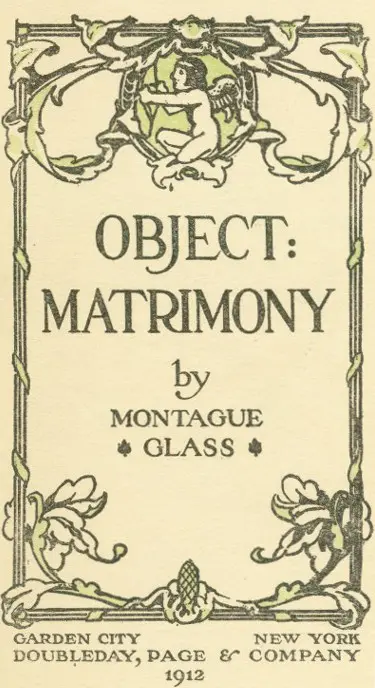
Object: matrimony
Montague Glass

THE CLASSIC COLLECTION · 1911
"Elkan Lubliner, American" by Montague Glass is a novel written in the early 20th century. The story revolves around the character Elkan Lubliner and his experiences as he navigates life as an immigrant in America. The narrative explores themes of family, cultural challenges, and the dynamics of business relationships in a humorous and engaging manner. The opening of the book introduces us to Marcus Polatkin and Philip Scheikowitz, partners in a clothing business, as they discuss family matters related to Philip's brother-in-law, who is trying to emigrate from Russia. Their conversation is filled with humor and cultural references that illustrate their backgrounds and the immigrant experience. The focus soon shifts to the arrival of Philip's nephew, Elkan Lubliner, who is expected to come work at their store. However, complications arise when it is revealed that Elkan's father has gambled away the money sent for his passage, prompting questions about family honor and trust. This sets the tone for the unfolding drama, highlighting family ties, identity challenges, and the comedic misunderstandings of immigrant life in America.
Introduction adapted from the source catalogue; source summaries may be automatically generated.
Free to read · English · 69,088 words · No account needed
MAKE TIME FOR A GOOD BOOK
On by default. Untick to stop anonymous reading totals. Each page counts after 10 seconds in view. How this works.
Anonymous counting is on unless you have switched it off.
As Dishkes finished speaking Elkan drew Max and Yetta into the shadow cast by a tall highboy; and, without noticing their presence, Leon Sammet plunged toward the door and let himself out into the street.
Immediately Elkan tiptoed to the door and threw it wide open, after which he shuffled his feet with sufficient noise to account for the entrance of three people. Thereat Ringentaub emerged from behind the partition.
"Hello, Ringentaub," Max cried. "I am bringing you here some customers."
Ringentaub bowed and coughed a warning to Dishkes and Mrs. Ringentaub, who continued to talk in hoarse whispers behind the partition.
"What's the matter, Ringentaub?" Max Merech asked; "couldn't you afford it here somehow a little light?"
Ringentaub reached into the upper darkness and turned on a gas jet which had been burning a blue point of flame.
"I keep it without light here on purpose," he said, "on account Sundays is a big night for the candlestick fakers up the street and I don't want to be bothered with their trade. What could I show your friends, Mr. Merech?"
Max winked almost imperceptibly at Elkan and prepared to approach the subject of the Jacobean chairs by a judicious detour.
"Do you got maybe a couple Florentine frames, Ringentaub?" he asked; and Ringentaub shook his head.
"Florentine frames is hard to find nowadays, Mr. Merech," he said; "and I guess I told it you Friday that I ain't got none."
Elkan shrugged his shoulders and smiled.
"I thought might you would of picked up a couple since then, maybe," Max rejoined, glancing round him. "You got a pretty nice highboy over there, Ringentaub, for a reproduction."
Ringentaub nodded satirically.
"That only goes to show how much you know about such things, Mr. Merech," he retorted, "when you are calling reproductions something which it is a gen-wine Shippendaler, understand me, in elegant condition."
It was now Elkan's turn to nod, and he did so with just the right degree of skepticism as at last he broached the object of his visit.
"I suppose," he said, "that them chairs over there is also gen-wine
Jacobean chairs?"
"I'll tell you what I'll do with you, Mr. Merech," Ringentaub declared. "You could bring down here any of them good Fourth Avenue or Fifth Avenue dealers, understand me, or any conoozer you want to name, like Jacob Paul, oder anybody, y'understand; and if they would say them chairs ain't gen-wine Jacobean I'll make 'em a present to you free for nothing."
"I ain't schnorring for no presents, Mr. Ringentaub," Max declared. "Bring 'em out in the light and let's give a look at 'em."
Your reading position is saved on this browser. Take it to another device with a library code. Reading pages adapt to text, rather than matching a printed edition.
Montague Glass
Montague Glass
Montague Glass
Montague Glass
BEHIND THE BOOK
This eBook is for the use of anyone anywhere in the United States and most other parts of the world at no cost and with almost no restrictions whatsoever. You may copy it, give it away or re-use it under the terms of the Project Gutenberg License included with this eBook or online at www.gutenberg.org. If you are not located in the United States, you will have to check the laws of the country where you are located before using this eBook. Read the source licence.
The original source file, including credits and licence, is retained by this library. Request an original-format copy at no charge. Please include the book title and Project Gutenberg identifier #27423.
KEEP YOUR CURIOSITY GOING
Coulson Kernahan

Maurice Baring
Frances Wright
Cécile Tormay

Frederic Jesup Stimson

W. H. P. (William Henry Pope) Jarvis