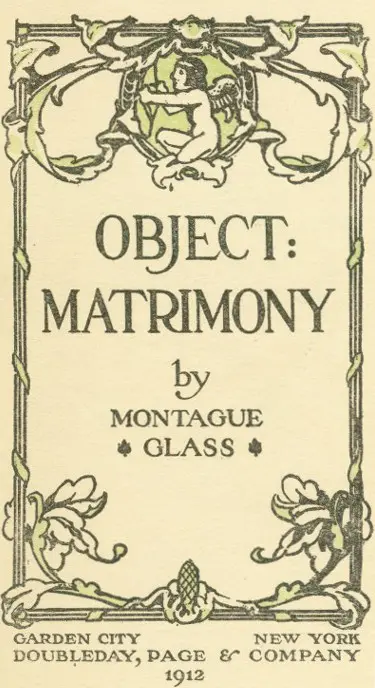
Object: matrimony
Montague Glass

THE CLASSIC COLLECTION · 1911
"Elkan Lubliner, American" by Montague Glass is a novel written in the early 20th century. The story revolves around the character Elkan Lubliner and his experiences as he navigates life as an immigrant in America. The narrative explores themes of family, cultural challenges, and the dynamics of business relationships in a humorous and engaging manner. The opening of the book introduces us to Marcus Polatkin and Philip Scheikowitz, partners in a clothing business, as they discuss family matters related to Philip's brother-in-law, who is trying to emigrate from Russia. Their conversation is filled with humor and cultural references that illustrate their backgrounds and the immigrant experience. The focus soon shifts to the arrival of Philip's nephew, Elkan Lubliner, who is expected to come work at their store. However, complications arise when it is revealed that Elkan's father has gambled away the money sent for his passage, prompting questions about family honor and trust. This sets the tone for the unfolding drama, highlighting family ties, identity challenges, and the comedic misunderstandings of immigrant life in America.
Introduction adapted from the source catalogue; source summaries may be automatically generated.
Free to read · English · 69,088 words · No account needed
MAKE TIME FOR A GOOD BOOK
On by default. Untick to stop anonymous reading totals. Each page counts after 10 seconds in view. How this works.
Anonymous counting is on unless you have switched it off.
Polatkin was busy checking the ravages made upon his linen by the perspiration that literally streamed down his face and neck; but Scheikowitz, who had listened open-mouthed to Elkan's pronunciamento, straightened up in his chair and his face grew set with determination.
"We ain't millionaires, Mr. Ribnik," he said--"far from it; and we ain't never going to be, understand me, if we got to buy eighteen-thousand dollar houses for every bill of goods we sell to Schnorrers and deadbeats!"
"Scheikowitz!" Polatkin pleaded.
"Never mind, Polatkin," Scheikowitz declared. "The boy is right, Polatkin; and if we are making our living in America we got to act like Americans--not peasants. So, go ahead, Stout. Telephone Flugel and tell him from me that if he wants to take it that way he should do so; and you, too, Stout--and that's all there is to it!"
"Then I apprehend, gentlemen, that we had better proceed to close," Feldman said; and Elkan nodded, for as Scheikowitz finished speaking a ball had risen in Elkan's throat which, blink as he might, he could not down for some minutes.
"All right, Goldstein," Feldman continued. "Let's fix up the statement
of closing."
"One moment, gentlemen," Max Kovner said. "Do I understand that, if Elkan Lubliner buys the house to-day, we've got to move out?"
Feldman raised his eyebrows.
"I think Mr. Goldstein will agree with me, Kovner, when I say you haven't a leg to stand on," he declared. "You're completely out of court on your own testimony."
"You mean we ain't got a lease for a year?" Mrs. Kovner asked.
"That's right," Goldstein replied.
"And I am working my fingers to the bone getting rid of them
verfluchte painters and all!" she wailed. "What do you think I am
anyway?"
"Well, if you don't want to move right away," Elkan began, "when would it be convenient for you to get out, Mrs. Kovner?"
"I don't want to get out at all," she whimpered. "Why should I want to get out? The house is an elegant house, which I just planted yesterday string beans and tomatoes; and the parlor looks elegant now we got the old paper off."
"Supposing we say the first of May," Elkan suggested--"not that I am so crazy to move out to Burgess Park, y'understand; but I don't see what is the sense buying a house in the country and then not living in it."
There was a brief silence, broken only by the soft weeping of Mrs. Kovner; and at length Max Kovner shrugged his shoulders.
Your reading position is saved on this browser. Take it to another device with a library code. Reading pages adapt to text, rather than matching a printed edition.
Montague Glass
Montague Glass
Montague Glass
Montague Glass
BEHIND THE BOOK
This eBook is for the use of anyone anywhere in the United States and most other parts of the world at no cost and with almost no restrictions whatsoever. You may copy it, give it away or re-use it under the terms of the Project Gutenberg License included with this eBook or online at www.gutenberg.org. If you are not located in the United States, you will have to check the laws of the country where you are located before using this eBook. Read the source licence.
The original source file, including credits and licence, is retained by this library. Request an original-format copy at no charge. Please include the book title and Project Gutenberg identifier #27423.
KEEP YOUR CURIOSITY GOING
Coulson Kernahan

Maurice Baring
Frances Wright
Cécile Tormay

Frederic Jesup Stimson

W. H. P. (William Henry Pope) Jarvis