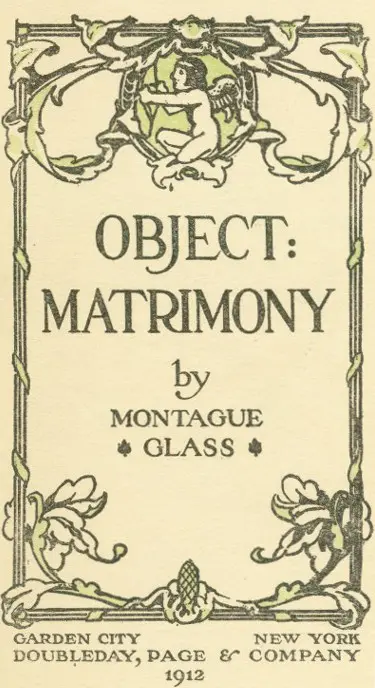
Object: matrimony
Montague Glass

THE CLASSIC COLLECTION · 1911
"Elkan Lubliner, American" by Montague Glass is a novel written in the early 20th century. The story revolves around the character Elkan Lubliner and his experiences as he navigates life as an immigrant in America. The narrative explores themes of family, cultural challenges, and the dynamics of business relationships in a humorous and engaging manner. The opening of the book introduces us to Marcus Polatkin and Philip Scheikowitz, partners in a clothing business, as they discuss family matters related to Philip's brother-in-law, who is trying to emigrate from Russia. Their conversation is filled with humor and cultural references that illustrate their backgrounds and the immigrant experience. The focus soon shifts to the arrival of Philip's nephew, Elkan Lubliner, who is expected to come work at their store. However, complications arise when it is revealed that Elkan's father has gambled away the money sent for his passage, prompting questions about family honor and trust. This sets the tone for the unfolding drama, highlighting family ties, identity challenges, and the comedic misunderstandings of immigrant life in America.
Introduction adapted from the source catalogue; source summaries may be automatically generated.
Free to read · English · 69,088 words · No account needed
MAKE TIME FOR A GOOD BOOK
On by default. Untick to stop anonymous reading totals. Each page counts after 10 seconds in view. How this works.
Anonymous counting is on unless you have switched it off.
"Show in Mr. and Mrs. Kovner," he said to the boy who responded. "We'll let them speak for themselves."
This, it would appear, they were more than willing to do; for as soon as they entered the room and caught sight of Glaubmann, who by this time was fairly cowering in his chair, they immediately began a concerted tirade that was only ended when Goldstein banged vigorously on the library table, using as a gavel one of Feldman's metal-tipped rulers.
"That'll do, Goldstein!" Feldman said hoarsely. "I think I can preserve
order in my own office."
"Why don't you then?" Goldstein retorted, as he leaned back in his chair and regarded with a malicious smile the damage he had wrought.
"Yes, Mr. Glaubmann," Kovner began anew, "you thought you got us helpless there in your house; but----"
"Shut up!" Feldman roared again, forgetting his role of the polished advocate; and Goldstein fairly beamed with satisfaction.
"Don't bully your own witness," he said. "Let me do it for you."
He turned to Kovner with a beetling frown.
"Now, Kovner," he commenced, "you claim you've got a verbal lease for a year of this Linden Boulevard house, don't you?"
"I sure do," Kovner replied, "and I got witnesses to prove it."
"That's all right," Goldstein rejoined; "so long as there's Bibles there'll always be witnesses to swear on 'em. The point is: How do you claim the lease was made?"
"I don't claim nothing," Kovner replied. "I got a year's lease on that property because, in the presence of my wife and his wife, Mr. Goldstein, he says to me I must either take the house for a year from last October to next October or I couldn't take it at all."
Feldman smiled loftily at his opponent.
"The art of cross-examination is a subtle one, Goldstein," he said, "and if you don't understand it you're apt to prove the other fellow's case."
"Nevertheless," Goldstein continued, "I'm going to ask him one more question, and that is this: When was this verbal agreement made--before or after you moved into the house?"
"Before I moved in, certainly," Kovner answered. "I told you that he says to me I couldn't move in unless I would agree to take the place for a year."
"And when did you move in?" Goldstein continued.
"On the first of October," Kovner said.
"No, popper," Mrs. Kovner interrupted; "we didn't move in on the first. We moved in the day before."
"That's right," Kovner said--"we moved in on the thirtieth of
September."
"So," Goldstein declared, "you made a verbal agreement before September thirtieth for a lease of one year from October first?"
Your reading position is saved on this browser. Take it to another device with a library code. Reading pages adapt to text, rather than matching a printed edition.
Montague Glass
Montague Glass
Montague Glass
Montague Glass
BEHIND THE BOOK
This eBook is for the use of anyone anywhere in the United States and most other parts of the world at no cost and with almost no restrictions whatsoever. You may copy it, give it away or re-use it under the terms of the Project Gutenberg License included with this eBook or online at www.gutenberg.org. If you are not located in the United States, you will have to check the laws of the country where you are located before using this eBook. Read the source licence.
The original source file, including credits and licence, is retained by this library. Request an original-format copy at no charge. Please include the book title and Project Gutenberg identifier #27423.
KEEP YOUR CURIOSITY GOING
Coulson Kernahan

Maurice Baring
Frances Wright
Cécile Tormay

Frederic Jesup Stimson

W. H. P. (William Henry Pope) Jarvis