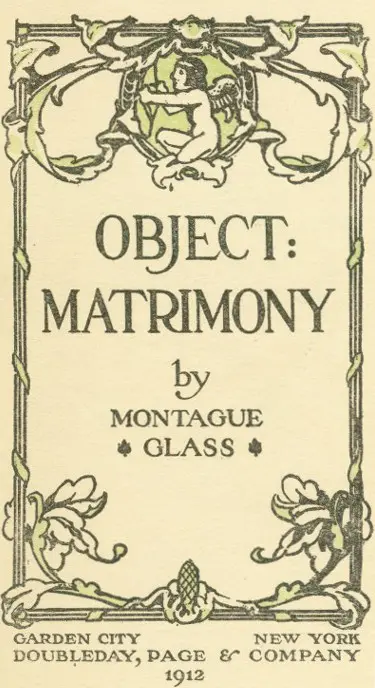
Object: matrimony
Montague Glass

THE CLASSIC COLLECTION · 1911
"Elkan Lubliner, American" by Montague Glass is a novel written in the early 20th century. The story revolves around the character Elkan Lubliner and his experiences as he navigates life as an immigrant in America. The narrative explores themes of family, cultural challenges, and the dynamics of business relationships in a humorous and engaging manner. The opening of the book introduces us to Marcus Polatkin and Philip Scheikowitz, partners in a clothing business, as they discuss family matters related to Philip's brother-in-law, who is trying to emigrate from Russia. Their conversation is filled with humor and cultural references that illustrate their backgrounds and the immigrant experience. The focus soon shifts to the arrival of Philip's nephew, Elkan Lubliner, who is expected to come work at their store. However, complications arise when it is revealed that Elkan's father has gambled away the money sent for his passage, prompting questions about family honor and trust. This sets the tone for the unfolding drama, highlighting family ties, identity challenges, and the comedic misunderstandings of immigrant life in America.
Introduction adapted from the source catalogue; source summaries may be automatically generated.
Free to read · English · 69,088 words · No account needed
MAKE TIME FOR A GOOD BOOK
On by default. Untick to stop anonymous reading totals. Each page counts after 10 seconds in view. How this works.
Anonymous counting is on unless you have switched it off.
With this conciliatory prelude he assumed an easy attitude by crossing his legs and supporting himself with one hand on the freshly painted doorjamb, whereat Mrs. Kovner uttered a horrified shriek, and the rage which three weeks of housepainters' clutter had fomented in her bosom burst forth unchecked.
"Out from here, you dirty loafer you!" she shrieked, and grabbed a calcimining brush from one of the many paintpots that bestrewed the hallway. Glaubmann bounded down the front stoop to the sidewalk just as Mrs. Kovner made a frenzied pass at him with the brush; and consequently, when he entered Kent J. Goldstein's office on Nassau Street an hour later, his black overcoat was speckled like the hide of an axis deer.
"Goldstein," he said hoarsely, "is it assault that some one paints you from head to foot with calcimine?"
"It is if you got witnesses," Goldstein replied; "otherwise it's
misfortune. Who did it?"
"That she-devil--the wife of the tenant in that house I sold Lubliner," Glaubmann replied. "I think we're going to have trouble with them people, Goldstein."
"You will if you try to sue 'em without witnesses, Glaubmann," Goldstein observed; "because suing without witnesses is like trying to play pinocle without cards. It can't be done."
Glaubmann shook his head sadly.
"I ain't going to sue 'em," he said. "I ain't so fond of lawsuits like all that; and, besides, a little calcimine is nothing, Goldstein, to what them people can do to me. They're going to claim they got there a year's verbal lease."
Goldstein shrugged his shoulders.
"That's all right," he commented. "They want to gouge you for fifty dollars or so; and, with the price you're getting for the house, Glaubmann, you can afford to pay 'em."
"Gouge nothing!" Glaubmann declared. "They just got done there a couple hundred dollars' painting and plumbing, y'understand, and they're going to stick it out."
Goldstein pursed his lips in an ominous whistle.
"A verbal lease, hey?" he muttered.
Glaubmann nodded sadly.
"And this time there is witnesses," he said; and he related to his attorney the circumstances under which the original lease was made, together with the incident attending Kovner's visit to Ortelsburg's house.
"It looks like you're up against it, Glaubmann," Goldstein declared.
"But couldn't I claim that I was only bluffing the feller?" Glaubmann
asked.
"Sure you could," Goldstein replied; "but when Kovner went to work and painted the house and fixed the plumbing he called your bluff, Glaubmann; so the only thing to do is to ask for an adjournment to-morrow."
"And suppose they won't give it to us?" Glaubmann asked.
Goldstein shrugged his shoulders.
Your reading position is saved on this browser. Take it to another device with a library code. Reading pages adapt to text, rather than matching a printed edition.
Montague Glass
Montague Glass
Montague Glass
Montague Glass
BEHIND THE BOOK
This eBook is for the use of anyone anywhere in the United States and most other parts of the world at no cost and with almost no restrictions whatsoever. You may copy it, give it away or re-use it under the terms of the Project Gutenberg License included with this eBook or online at www.gutenberg.org. If you are not located in the United States, you will have to check the laws of the country where you are located before using this eBook. Read the source licence.
The original source file, including credits and licence, is retained by this library. Request an original-format copy at no charge. Please include the book title and Project Gutenberg identifier #27423.
KEEP YOUR CURIOSITY GOING
Coulson Kernahan

Maurice Baring
Frances Wright
Cécile Tormay

Frederic Jesup Stimson

W. H. P. (William Henry Pope) Jarvis