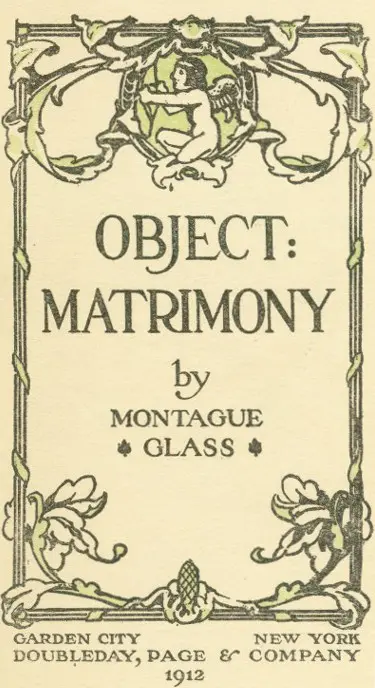
Object: matrimony
Montague Glass

THE CLASSIC COLLECTION · 1911
"Elkan Lubliner, American" by Montague Glass is a novel written in the early 20th century. The story revolves around the character Elkan Lubliner and his experiences as he navigates life as an immigrant in America. The narrative explores themes of family, cultural challenges, and the dynamics of business relationships in a humorous and engaging manner. The opening of the book introduces us to Marcus Polatkin and Philip Scheikowitz, partners in a clothing business, as they discuss family matters related to Philip's brother-in-law, who is trying to emigrate from Russia. Their conversation is filled with humor and cultural references that illustrate their backgrounds and the immigrant experience. The focus soon shifts to the arrival of Philip's nephew, Elkan Lubliner, who is expected to come work at their store. However, complications arise when it is revealed that Elkan's father has gambled away the money sent for his passage, prompting questions about family honor and trust. This sets the tone for the unfolding drama, highlighting family ties, identity challenges, and the comedic misunderstandings of immigrant life in America.
Introduction adapted from the source catalogue; source summaries may be automatically generated.
Free to read · English · 69,088 words · No account needed
MAKE TIME FOR A GOOD BOOK
On by default. Untick to stop anonymous reading totals. Each page counts after 10 seconds in view. How this works.
Anonymous counting is on unless you have switched it off.
"All right, Mr.----Forget your name!" Kent cried. "Cut out 'and the present tenancies of said premises.'"
At this easy victory a shade of disappointment passed over the faces of Harvey Sugarberg and his clients, and the contract proceeded without further objection to its rapid conclusion.
"Now then, my friends," Kent announced briskly, "we're ready for the
signatures."
At this, the crucial point of all real-estate transactions, a brief silence fell upon the assembled company, which included not only the attorneys and the clients, but Ortelsburg, Kamin, Tarnowitz and Ribnik as well. Finally Glaubmann seized a pen, and, jabbing it viciously in an inkpot, he made a John Hancock signature at the foot of the agreement's last page.
"Now, Mr. Lubliner," Kent said--and Elkan hesitated.
"Ain't we going to wait for Louis Stout?" he asked; and immediately there was a roar of protest that sounded like a mob scene in a Drury Lane melodrama.
"If Louis Stout ain't here it's his own fault," Ortelsburg declared; and Ribnik, Tarnowitz, and Kamin glowered in unison.
"I guess he's right, Elkan," Polatkin murmured.
"It is his own fault if he ain't here," Scheikowitz agreed feebly; and, thus persuaded, Elkan appended a small and, by contrast with Glaubmann's, a wholly unimpressive signature to the agreement. Immediately thereafter Elkan passed over a certified check for eight hundred dollars, according to the terms of the contract, which provided that the title be closed in twenty days at the office of Henry D. Feldman.
"Well, Mr. Lubliner," Glaubmann said, employing the formula hallowed by long usage in all real-estate transactions involving improved property, "I wish you luck in your new house."
"Much obliged," Elkan said; and after a general handshaking the entire assemblage crowded into one elevator, so that finally Elkan was left alone with his partners.
Polatkin was the first to break a silence of over five minutes'
duration.
"Ain't it funny," he said, "that we ain't heard from Louis?"
Scheikowitz nodded; and as he did so the elevator door creaked noisily and there alighted a short, stout person, who, having once been described in the I. O. M. A. Monthly as Benjamin J. Flugel, the Merchant Prince, had never since walked abroad save in a freshly ironed silk hat and a Prince Albert coat.
"Why, how do you do, Mr. Flugel?" Polatkin and Scheikowitz cried with one voice, and Mr. Flugel bowed. Albeit a tumult raged within his breast, he remained outwardly the dignified man of business; and, as Elkan viewed for the first time Louis Stout's impressive partner, he could not help congratulating himself on the mercantile sagacity that had made him buy Glaubmann's house.
Your reading position is saved on this browser. Take it to another device with a library code. Reading pages adapt to text, rather than matching a printed edition.
Montague Glass
Montague Glass
Montague Glass
Montague Glass
BEHIND THE BOOK
This eBook is for the use of anyone anywhere in the United States and most other parts of the world at no cost and with almost no restrictions whatsoever. You may copy it, give it away or re-use it under the terms of the Project Gutenberg License included with this eBook or online at www.gutenberg.org. If you are not located in the United States, you will have to check the laws of the country where you are located before using this eBook. Read the source licence.
The original source file, including credits and licence, is retained by this library. Request an original-format copy at no charge. Please include the book title and Project Gutenberg identifier #27423.
KEEP YOUR CURIOSITY GOING
Coulson Kernahan

Maurice Baring
Frances Wright
Cécile Tormay

Frederic Jesup Stimson

W. H. P. (William Henry Pope) Jarvis