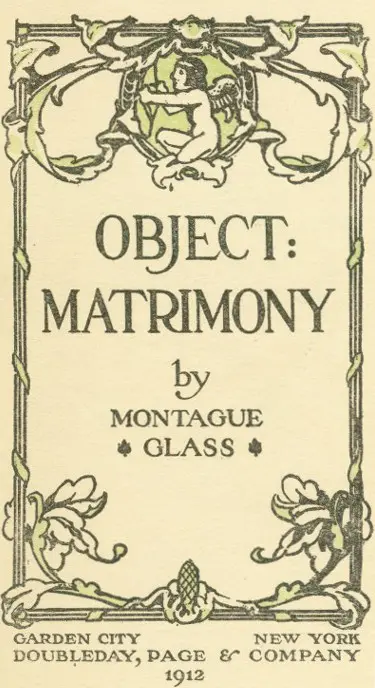
Object: matrimony
Montague Glass

THE CLASSIC COLLECTION · 1911
"Elkan Lubliner, American" by Montague Glass is a novel written in the early 20th century. The story revolves around the character Elkan Lubliner and his experiences as he navigates life as an immigrant in America. The narrative explores themes of family, cultural challenges, and the dynamics of business relationships in a humorous and engaging manner. The opening of the book introduces us to Marcus Polatkin and Philip Scheikowitz, partners in a clothing business, as they discuss family matters related to Philip's brother-in-law, who is trying to emigrate from Russia. Their conversation is filled with humor and cultural references that illustrate their backgrounds and the immigrant experience. The focus soon shifts to the arrival of Philip's nephew, Elkan Lubliner, who is expected to come work at their store. However, complications arise when it is revealed that Elkan's father has gambled away the money sent for his passage, prompting questions about family honor and trust. This sets the tone for the unfolding drama, highlighting family ties, identity challenges, and the comedic misunderstandings of immigrant life in America.
Introduction adapted from the source catalogue; source summaries may be automatically generated.
Free to read · English · 69,088 words · No account needed
MAKE TIME FOR A GOOD BOOK
On by default. Untick to stop anonymous reading totals. Each page counts after 10 seconds in view. How this works.
Anonymous counting is on unless you have switched it off.
"Is that so?" Elkan exclaimed. "We ourselves are going to Burgess
Park--to visit a friend."
"A customer," Yetta corrected.
"A customer could also be a friend," Kamin declared, "especially if he's
a good customer."
"This is a very good customer," Elkan went on, "by the name Louis
Stout."
"Louis Stout, from Flugel & Stout?" Kamin cried. "Why, him and Benno Ortelsburg is like brothers already! Well, then, I'll probably see you down in Burgess Park this afternoon, on account every Sunday afternoon Louis plays pinocle at my brother-in-law's house. Why don't he fetch you round to take a hand?"
"I should be delighted," Elkan said; but Yetta sniffed audibly.
"I guess we would be going home right after dinner, before the crowd
starts back," she said.
"Not on a fine day like this you wouldn't," Kamin protested; "because once you get out to Burgess Park you ain't in such a hurry to come back. I wish we would got such a place near Pittsburgh, Mrs. Lubliner. I bet yer I would quick move out there. The smoke gets worser and worser in Pittsburgh; in fact, it's so nowadays we couldn't sell a garment in pastel shades."
"Well, we got plenty blacks, navy blues, Copenhagen blues and brown in our spring line, Mr. Kamin," Elkan said; and therewith he commenced so graphically to catalogue Polatkin, Scheikowitz & Company's new stock that, by the time the train drew into Burgess Park, Kamin was making figures on the back of an envelope in an effort to convince Elkan that his prices were all wrong.
"But, anyhow," Kamin said, as they parted in front of the Ortelsburgs'
colonial residence, "I will see you in the store to-morrow morning
sure."
"You'll see me before then, because me and Yetta is coming round this afternoon sure--ain't we, Yetta?"
Mrs. Lubliner nodded, for her good humour had been restored by Elkan's splendid exhibition of salesmanship.
"This afternoon is something else again," Kamin said, "because a feller which tries to mix pinocle with business is apt to overplay his hand in both games."
"No, Joe; you're wrong," Benno Ortelsburg said to his brother-in-law, Joseph Kamin, as they sipped their after-dinner coffee in the Ortelsburg library that day. "It wouldn't be taking advantage of the feller at all. You say yourself he tries to sell goods to you on the car already. Why shouldn't we try to sell Glaubmann's house to him while he's down here? And we'll split the commission half and half."
Kamin hesitated before replying.
"In business, Joe--it's Esau's fable of the lion and the mouse every time!" Ortelsburg continued. "The mouse scratches the lion's back and the lion scratches the mouse's back! Ain't it?"
Your reading position is saved on this browser. Take it to another device with a library code. Reading pages adapt to text, rather than matching a printed edition.
Montague Glass
Montague Glass
Montague Glass
Montague Glass
BEHIND THE BOOK
This eBook is for the use of anyone anywhere in the United States and most other parts of the world at no cost and with almost no restrictions whatsoever. You may copy it, give it away or re-use it under the terms of the Project Gutenberg License included with this eBook or online at www.gutenberg.org. If you are not located in the United States, you will have to check the laws of the country where you are located before using this eBook. Read the source licence.
The original source file, including credits and licence, is retained by this library. Request an original-format copy at no charge. Please include the book title and Project Gutenberg identifier #27423.
KEEP YOUR CURIOSITY GOING
Coulson Kernahan

Maurice Baring
Frances Wright
Cécile Tormay

Frederic Jesup Stimson

W. H. P. (William Henry Pope) Jarvis