
Old People and the Things That Pass
Louis Couperus
THE CLASSIC COLLECTION · 1892
"Eline Vere" by Louis Couperus is a novel written in the late 19th century. The book explores themes of beauty, youth, and societal roles through the life of the main character, Eline Vere, a sensitive and dreamy young woman navigating her relationships and ambitions in a social milieu that often feels stifling and unkind. The narrative offers a richly detailed look at the intricacies of her world, where social expectations clash with personal desires. The opening of "Eline Vere" introduces readers to a vibrant setting of a grand social event where various characters prepare for a tableau performance. Frédérique van Erlevoort, one of the performers, is assisted by Paul van Raat as she readies herself. The atmosphere is filled with excitement and a flurry of activity. Through insightful descriptions, we learn about Eline, who is later revealed as a more introspective character, feeling somewhat isolated due to her melancholic nature and her struggles with identity and purpose. Tender moments are interspersed with observations on the superficiality of social interactions, setting the stage for Eline's deeper emotional journey.
Introduction adapted from the source catalogue; source summaries may be automatically generated.
Free to read · English · 128,052 words · No account needed
MAKE TIME FOR A GOOD BOOK
On by default. Untick to stop anonymous reading totals. Each page counts after 10 seconds in view. How this works.
Anonymous counting is on unless you have switched it off.
“What shall we have? Une Nuit à Venise?”
“Right you are, Une Nuit à Venise.”
She opened a music portfolio, bound in red leather, with “Eline Vere” in golden letters on the cover.
“But don’t bring out your high sol so loud here,” said she. “Take it in your medium register, and not from the chest. It will sound much sweeter. And begin very softly, swelling here and there; and keep in good time with me towards the end—the refrain, you know. Now, nicely, Paul.”
She played the prelude to Lucantoni’s duet, whilst Paul gave a little cough to clear his voice, and both commenced together, very softly—
“Ah viens la nuit est belle!
Viens, le ciel est d’azur!”
His light tenor sounded a little shaky, but still it went very well with the resonant ring of her pure soprano. It was a pleasure to her to sing together like that, when Paul was in voice, and would listen to advice. It seemed to her as though she sang with more feeling when another voice accompanied hers, and that she felt more, especially in the repetition of such a phrase as—
“Laisse moi dans tes yeux,
Voir le reflet des cieux!”
words into which she infused something of the glow and languor of an Italian’s love. To her mind the duet assumed a more dramatic form. In her imagination she saw herself, with Paul as tenor, gliding along in the radiant moonbeams in a gondola on a Venetian canal. To her mind’s eye she saw herself in the rich dress of a young patrician, Paul in the garb of a poor fisherman, and they loved each other, and half-dreaming, half-singing, they went gliding along the water—
“Devant Dieu même
Dire; Je t’aime
Dans un dernier soupir.”
There was the refrain! She feared—ah, she feared that Paul would break down. No; Paul kept time with her. That was splendid! and their voices died away in unison—
“Dans un dernier soupir.”
“Lovely, lovely, Eline!” cried Madame van Raat, who had been listening
attentively.
“You are in good voice,” said Betsy.
“Now you must sing by yourself, Eline,” cried Paul, pleased with his
success.
While the duet was being sung, Mina had come in with the papers, the Vaderland and the Dagblad, and Henk was soon absorbed in them, turning over the sheets as noiselessly as possible.
“But, Paul, don’t you want to sing any more?” asked Eline. “Something else; or are you tired?”
“I had rather you sang alone, Eline.”
Your reading position is saved on this browser. Take it to another device with a library code. Reading pages adapt to text, rather than matching a printed edition.
Louis Couperus
Louis Couperus

Louis Couperus
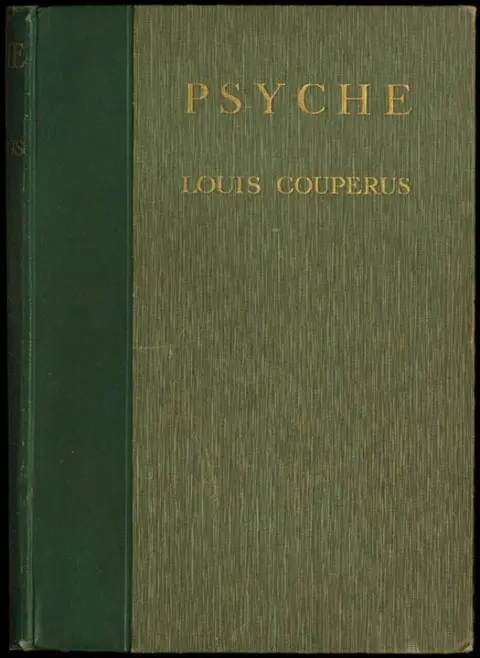
Louis Couperus
BEHIND THE BOOK
This eBook is for the use of anyone anywhere in the United States and most other parts of the world at no cost and with almost no restrictions whatsoever. You may copy it, give it away or re-use it under the terms of the Project Gutenberg License included with this eBook or online at www.gutenberg.org. If you are not located in the United States, you will have to check the laws of the country where you are located before using this eBook. Read the source licence.
The original source file, including credits and licence, is retained by this library. Request an original-format copy at no charge. Please include the book title and Project Gutenberg identifier #66911.
KEEP YOUR CURIOSITY GOING
Coulson Kernahan

Maurice Baring
Frances Wright
Cécile Tormay

Frederic Jesup Stimson

W. H. P. (William Henry Pope) Jarvis