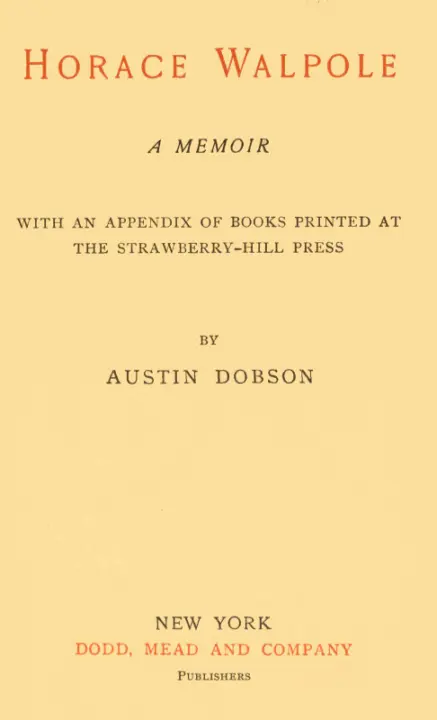
Horace Walpole: A memoir With an appendix of books printed at the Strawberry Hill Press
Austin Dobson
THE CLASSIC COLLECTION · 1892
"Eighteenth Century Vignettes" by Austin Dobson is a collection of historical essays written in the late 19th century. The work presents a series of episodic portraits and reflections on significant figures and events of the 18th century, blending fact with a light degree of narrative elaboration. This compilation aims to capture the essence of the era, focusing on both personal stories and broader cultural moments that shaped the time. The opening portion of the book introduces the reader to a scene from 1708 involving Captain Richard Steele and his wife, Mary Scurlock Steele. The narrative describes a moment of impatience experienced by Mrs. Steele as she awaits her husband in a coach outside Lord Sunderland's office in Whitehall. The text paints a vivid picture of their marriage, highlighting Steele's charming yet tumultuous nature, conflicts over his frequent absences from home, and Mrs. Steele's wrestling emotions. Through letters exchanged between the couple, we gain insights into their relationship dynamics, revealing both affection and underlying tensions that characterize their life together in a bustling 18th century London.
Introduction adapted from the source catalogue; source summaries may be automatically generated.
Free to read · English · 58,985 words · No account needed
MAKE TIME FOR A GOOD BOOK
On by default. Untick to stop anonymous reading totals. Each page counts after 10 seconds in view. How this works.
Anonymous counting is on unless you have switched it off.
````'Nay;'tis so moving that the Knight
````Can't even bear it in his sight;
````Then who would tears so dearly buy,
````As give four hundred pounds to cry?
````I own, he chose the prudent part,
````Rather to break his word than heart;
````And yet, methinks,'tis ticklish dealing
````With one so delicate--in feeling.'=
As a result of Sir Richard Grosvenor's action, the picture remained on the artist's hands,--a source of continual mortification to himself, and a fruitful theme of discussion to both his friends and enemies. The political caricaturists got hold of it, and used it as a stick to beat the pensionary of Lord Bute; the critics employed it to continue their assaults on the precepts of the 'Analysis.' When Wilkes retorted to Hogarth's ill-advised print of the 'Times,' he openly described 'Sigismunda' as a portrait of Mrs. Hogarth 'in an agony of passion;' and the fact that she had served as her husband's model was not neglected by his meaner assailants. Finally, after various attempts had been made to engrave it, the picture was left by the artist to his widow with injunctions not to sell it for less than £500. After her death it was bought at the 'Golden Head' sale for £56 by Alderman Boydell. As already stated, it is now in the National Gallery, to which it was bequeathed by the late Mr. Anderdon in 1879.
In the couplets already quoted, Hogarth had ended by saying:=
````'Let the picture rust.
```Perhaps Time's price-enhancing dust,
```As statues moulder into earth,
```When I'm no more, may mark its worth,
````And future connoisseurs may rise,
````Honest as ours, and full as wise,
````To puff the piece and painter too,
````And make me then what Guido's now.'=
To some extent the reaction he hoped for has arrived. The latter-day student of 'Sigis-munda,' unblinded by political prejudice or private animosity, renders full justice to the soundness of its execution and the undoubted skill of its technique. Indeed, at the present moment, the tendency seems to be rather to overrate than to underrate its praiseworthy qualities. Yet, when all is said, the subject remains an unattractive and even a repulsive one. It must be admitted also that, in one respect, contemporary critics were right. They were wrong in their unreasoning preference for doubtful 'exotics,' but they were right in their contention that, upon this occasion, Hogarth had strayed perilously from his own peculiar walk, and that so-called 'history painting' was not his strongest point. Conscientious and painstaking, 'Sigismunda' is still a mistake, although it is the mistake of a great artist; and Hogarth's recorded partiality for it affords but one more example of that unaccountable blindness which led Addison to put his poems before the 'Spectator,' Prior to rank his 'Solomon' above the 'loose and hasty scribble' of 'Alma,' and Liston, whose nose alone was provocative of laughter, to cherish the extraordinary delusion that his true vocation was that of a tragic actor.
Your reading position is saved on this browser. Take it to another device with a library code. Reading pages adapt to text, rather than matching a printed edition.
Austin Dobson
Austin Dobson
Austin Dobson
Austin Dobson
BEHIND THE BOOK
This eBook is for the use of anyone anywhere in the United States and most other parts of the world at no cost and with almost no restrictions whatsoever. You may copy it, give it away or re-use it under the terms of the Project Gutenberg License included with this eBook or online at www.gutenberg.org. If you are not located in the United States, you will have to check the laws of the country where you are located before using this eBook. Read the source licence.
The original source file, including credits and licence, is retained by this library. Request an original-format copy at no charge. Please include the book title and Project Gutenberg identifier #47996.
KEEP YOUR CURIOSITY GOING

David Patterson (Spirit) Hatch

David Patterson (Spirit) Hatch

David Patterson (Spirit) Hatch
Cécile Tormay

Moritz Busch
John L. Ransom