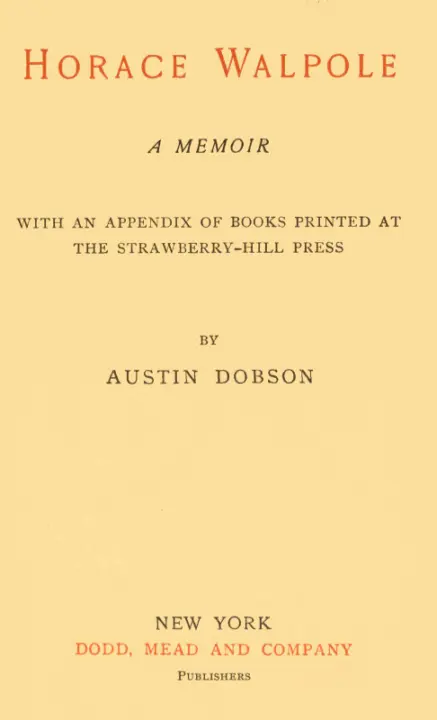
Horace Walpole: A memoir With an appendix of books printed at the Strawberry Hill Press
Austin Dobson
THE CLASSIC COLLECTION · 1892
"Eighteenth Century Vignettes" by Austin Dobson is a collection of historical essays written in the late 19th century. The work presents a series of episodic portraits and reflections on significant figures and events of the 18th century, blending fact with a light degree of narrative elaboration. This compilation aims to capture the essence of the era, focusing on both personal stories and broader cultural moments that shaped the time. The opening portion of the book introduces the reader to a scene from 1708 involving Captain Richard Steele and his wife, Mary Scurlock Steele. The narrative describes a moment of impatience experienced by Mrs. Steele as she awaits her husband in a coach outside Lord Sunderland's office in Whitehall. The text paints a vivid picture of their marriage, highlighting Steele's charming yet tumultuous nature, conflicts over his frequent absences from home, and Mrs. Steele's wrestling emotions. Through letters exchanged between the couple, we gain insights into their relationship dynamics, revealing both affection and underlying tensions that characterize their life together in a bustling 18th century London.
Introduction adapted from the source catalogue; source summaries may be automatically generated.
Free to read · English · 58,985 words · No account needed
MAKE TIME FOR A GOOD BOOK
On by default. Untick to stop anonymous reading totals. Each page counts after 10 seconds in view. How this works.
Anonymous counting is on unless you have switched it off.
* By a piece of auction-room humour, 'The Bathos' appears as
'The Bathers.'
'Sigismunda Mourning over the Heart of Guiscardo' is the full title of the picture in the National Gallery catalogue. As one looks at it now, asylumed safely, post tot discrimina, in Trafalgar Square, it is not so much its qualities as its story that it recalls. How much heartburning, how much bitterness, would have been saved to its sturdy little 'Author,' as he loved to style himself, if it had never been projected! He was an unparalleled pictorial satirist; he was, and still is, an unsurpassed story-teller upon canvas.=
```'In walks of Humour, in that cast of Style,
```Which, probing to the quick, yet makes us smile;
```In Comedy, thy nat'ral road to fame,
```Nor let me call it by a meaner name,
```Where a beginning, middle, and an end
```Are aptly joined; where parts on parts depend,
```Each made for each, as bodies for their soul,
```So as to form one true and perfect whole,
```Where a plain story to the eye is told,
```Which we conceive the moment we behold,
```Hogarth unrivall'd stands, and shall engage
```Unrivall'd praise to the most distant age.'=
Thus even his enemy and assailant, Charles Churchill. But Hogarth had the misfortune to live in an age when Art was given over to the bubblemongers and 'black masters;' when, to the suppression of native talent, sham chefs d'ouvre were praised extravagantly by sham connoisseurs; and the patriotic painter of 'Marriage À-la-Mode' justly resented the invasion of the country by the rubbish of the Roman art-factories. Had he confined himself to the forcible indignation of which, as an impenitent islander, he possessed unlimited command, it would have been better for his peace of mind. But, in an unpropitious hour, he undertook to prove his case by demonstration. Among the pictures from Sir Luke Schaub's collection, offered for sale in 1758, was a 'Sigismunda,' attributed to Correggio, but in reality from the brush of the far inferior artist, Furini. It was recklessly run up by the virtuosi, and was finally bought in for over £400. Hogarth, whose inimitable 'Marriage' had fetched only £126 (frames included), determined to paint the same subject. He had an open commission from Sir Richard Grosvenor, a wealthy art-collector, who had been one of the bidders for the Furini, and he set to work. He took unusual pains--a thing which, in his case, was of evil augury; and he modified the details of his design again and again, in obedience to the suggestions of friends. When at last the picture was completed, Sir Richard, who, perhaps not unreasonably, had looked for something more in the artist's individual manner, took advantage of Hogarth's conventional offer to release him from his bargain, and rather shabbily withdrew from it upon the specious ground 'that the constantly having it [the picture] before one's eyes would be too often occasioning melancholy ideas'--a sentiment which the irritated painter, calling verse to his relief, afterwards neatly paraphrased. Admitting its power to touch the heart to be the 'truest test' of a masterpiece, he says of 'Sigismunda':=
Your reading position is saved on this browser. Take it to another device with a library code. Reading pages adapt to text, rather than matching a printed edition.
Austin Dobson
Austin Dobson
Austin Dobson
Austin Dobson
BEHIND THE BOOK
This eBook is for the use of anyone anywhere in the United States and most other parts of the world at no cost and with almost no restrictions whatsoever. You may copy it, give it away or re-use it under the terms of the Project Gutenberg License included with this eBook or online at www.gutenberg.org. If you are not located in the United States, you will have to check the laws of the country where you are located before using this eBook. Read the source licence.
The original source file, including credits and licence, is retained by this library. Request an original-format copy at no charge. Please include the book title and Project Gutenberg identifier #47996.
KEEP YOUR CURIOSITY GOING

David Patterson (Spirit) Hatch

David Patterson (Spirit) Hatch

David Patterson (Spirit) Hatch
Cécile Tormay

Moritz Busch
John L. Ransom