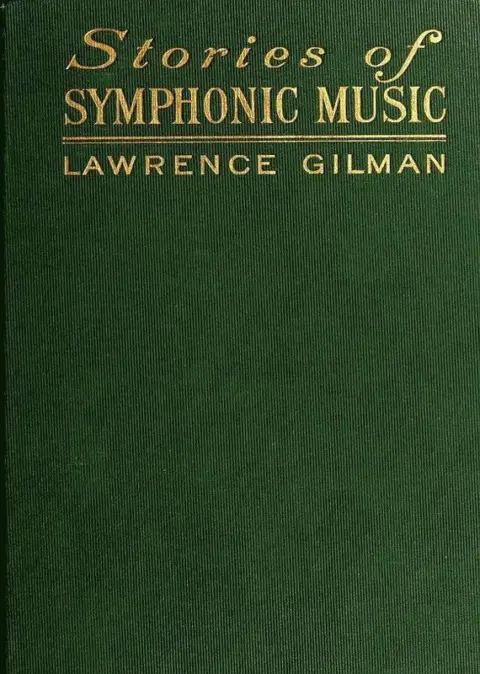
Stories of Symphonic Music A Guide to the Meaning of Important Symphonies, Overtures, and Tone-poems from Beethoven to the Present Day
Lawrence Gilman
THE CLASSIC COLLECTION · 1906
"Edward MacDowell: A Study" by Lawrence Gilman is a biographical analysis written in the early 20th century. This work delves into the life and creative accomplishments of Edward MacDowell, an influential American composer known for his significant contribution to the world of music through a unique fusion of Celtic themes and contemporary classical forms. The text not only charts MacDowell's early life, artistic development, and personal struggles but also provides insights into his music and the methodologies that defined his artistic output. At the start of the study, the author outlines MacDowell's family heritage, highlighting his Irish and Scottish roots, which shaped his artistic sensibilities. It chronicles his early musical education from the age of eight, mentioning notable instructors and his experiences at prestigious conservatories in Europe, like the Paris Conservatory and the Frankfurt Conservatory. The opening sections paint a vivid picture of MacDowell's formative years, his frustrations with convention in musical instruction, and his burgeoning talents in composition alongside his piano studies. These experiences are set against the backdrop of his growing discontent with the teaching methods of the time, leading to a narrative that is both a historical account and a character study of an artist seeking his voice.
Introduction adapted from the source catalogue; source summaries may be automatically generated.
Free to read · English · 39,075 words · No account needed
MAKE TIME FOR A GOOD BOOK
On by default. Untick to stop anonymous reading totals. Each page counts after 10 seconds in view. How this works.
Anonymous counting is on unless you have switched it off.
MacDowell never hesitated, as I have elsewhere said, to adapt--some would say "warp"--the sonata form to the needs of his poetic purposes. Moreover, he declared his convictions as to the considerations which should govern its employment. "If the composer's ideas do not imperatively demand treatment in that [the sonata] form," he has observed--"that is, if his first theme is not actually dependent upon his second and side themes for its poetic fulfilment--he has not composed a sonata movement, but a potpourri, which the form only aggravates." There can be little question of the success which has attended his application of this principle to his own performances in this field, nor of the skill and tact with which he has reshaped the form in accordance with his chosen poetic or dramatic scheme.
His four sonatas belong undeniably, though with a variously strict allegiance, to the domain of programme-music. Neither the "Tragica," the "Eroica," the "Norse," nor the "Keltic," makes its appeal exclusively to the tonal sense. If one looks to these works for the particular kind of gratification which he is accustomed to derive, for example, from a sonata by Brahms (to name the most extreme of contrasts), he will not find it. It is impossible fully to appreciate and enjoy the last page of the "Keltic," for instance, without some knowledge of the dramatic crisis upon which the musician has built--although its beauty and power, as sheer music, are immediately perceptible.
With the exception of the "Tragica," the poetic substratum of the sonatas has been avowed with more or less particularity. In the "Tragica"--his first essay in the form--he has vouchsafed only the general indication of his purpose which is declared in the title of the work, though it is known that in composing the music MacDowell was moved by the memory of his grief over the death of his master Raff (it might stand even more appropriately as a commentary on the tragedy of his own life). The tragic note is sounded, with impressive authority and force, in the brief introduction, largo maestoso. The music, from the first, drives to the very heart of the subject: there is neither pose nor bombast in the presentation of the thought; and this attitude is maintained throughout--in the ingratiating loveliness of the second subject, in the fierce striving of the middle section, in the noble and sombre slow movement,--a largo of profound pathos and dignity,--and in the dramatic and impassioned close (the scherzo is, I think, less good). Of this final allegro an exposition has been vouchsafed. While in the preceding movements, it is said, he aimed at expressing tragic details, in the last he has tried to generalise. He wished "to heighten the darkness of tragedy by making it follow closely on the heels of triumph. Therefore, he attempted to make the last movement a steadily progressive triumph, which, at its close, is utterly broken and shattered, thinking that the most poignant tragedy is that of catastrophe in the hour of triumph.... In doing this he has tried to epitomise the whole work." The meaning of the coda is thus made clear: a climax approached with the utmost pomp and brilliancy, and cut short by a precipitato descent in octaves, fff, ending with a reminiscence of the portentous subject of the introduction. It is a profoundly moving conclusion to a noble work--a work which Mr. James Huneker has not extravagantly called "the most marked contribution to solo sonata literature since Brahms' F-minor piano sonata"; yet it is not so fine a work as any one of the three sonatas which MacDowell afterward wrote. The style evinces, for the first time in his piano music, the striking orchestral character of his thought--yet the writing is not, paradoxical as it may seem, unpianistic. The suggestion of orchestral relationships is contained in the massiveness of the harmonic texture, and in the cumulative effect of the climaxes and crescendi. He conveys an impression of extended tone-spaces, of a largeness, complexity, and solidity of structure, which are peculiar to his own music, and which presuppose a rather disdainful view of the limitations of mere strings and hammers; yet it is all playable: its demands are formidable, but not prohibitive.
Your reading position is saved on this browser. Take it to another device with a library code. Reading pages adapt to text, rather than matching a printed edition.
Lawrence Gilman
Lawrence Gilman
BEHIND THE BOOK
This eBook is for the use of anyone anywhere in the United States and most other parts of the world at no cost and with almost no restrictions whatsoever. You may copy it, give it away or re-use it under the terms of the Project Gutenberg License included with this eBook or online at www.gutenberg.org. If you are not located in the United States, you will have to check the laws of the country where you are located before using this eBook. Read the source licence.
The original source file, including credits and licence, is retained by this library. Request an original-format copy at no charge. Please include the book title and Project Gutenberg identifier #14109.
KEEP YOUR CURIOSITY GOING
John L. Ransom

Herman W. Mudgett
Harriet Monroe
Daniel Dulany Addison
Charles Lanman
Harold Rosher