THE CLASSIC COLLECTION✦Creative Chemistry: Descriptive of Recent Achievements in the Chemical IndustriesCLASSIC FREE BOOKS
Creative Chemistry: Descriptive of Recent Achievements in the Chemical Industries
Edwin E. (Edwin Emery) Slosson
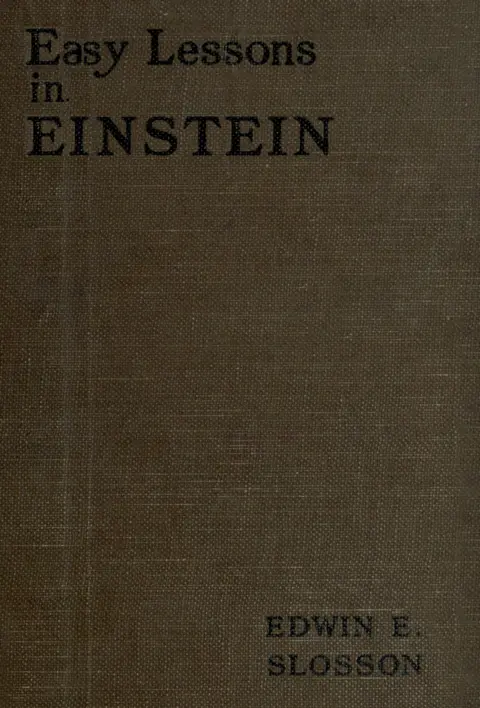
THE CLASSIC COLLECTION · 1920
"Easy Lessons in Einstein: A Discussion of the More Intelligible Features of the Theory of Relativity" by Edwin E. Slosson is a scientific publication written in the early 20th century. The work aims to explain the core concepts of Einstein’s theory of relativity in accessible language for a general audience bewildered by recent scientific discoveries. With references to both historical and contemporary scientific debates, the book introduces readers to the foundational ideas of relativity, its paradoxes, and its philosophical implications, while grounding the discussion in real-world experiments and observations. The opening of the book presents an engaging, conversational dialogue between a curious reader and the author, immediately signaling that the text will demystify the complex topic of relativity for non-specialists. The text quickly contextualizes the importance of Einstein’s ideas by linking them to the high-profile solar eclipse experiments of 1919, which dramatically confirmed predictions unique to Einstein's theories and challenged Newtonian physics. Through analogies involving trains, mirrors, amusement park reflections, and even science fiction, Slosson introduces fundamental concepts such as the relativity of motion, the elusive nature of the ether, the bending of light by gravity, the notion of time as a fourth dimension, and the revolutionary idea that space, time, and measurement are all relative. The narrative blends everyday experience, vivid illustrations, and the latest scientific findings to provide a foundation for readers to grapple with the far-reaching changes Einstein's theories introduce to our understanding of the universe.
Introduction adapted from the source catalogue; source summaries may be automatically generated.
Free to read · English · 29,329 words · No account needed
MAKE TIME FOR A GOOD BOOK
On by default. Untick to stop anonymous reading totals. Each page counts after 10 seconds in view. How this works.
Anonymous counting is on unless you have switched it off.
The principle of generalized relativity and the displacement of the Fraunhofer lines toward the red. Carnegie Institution of Washington. Contributions of the Mount Wilson Solar Observatory, Washington, vol. 7, no. 138.
The equations of the theory of electrons in a gravitation field of Einstein deduced from a variation principle. Koninklijke Akademie van Wetenschappen. Proceedings, Amsterdam, 1917, Band 19, pp. 892-896.
Relativity Theory. Science Progress, 1919, vol. 13.
Eine neue Erweiterung der Relativitätstheorie. Annalen der Physik, 1919, vol. 59, pp. 100-123.
Raum, Zeit, Materie. Springer. 1918.
Zur Gravitätionstheorie. Annalen der Physik, 1917, vol.
54, pp. 117-145.
Generalized coördinates, relativity, and gravitation. Astrophysical Journal, Chicago, 1917, vol. 45, pp. 244-253.
Relativity and gravitation. Physical Society of London. Proceedings, London, 1919, vol. 31, pp. 69-77.
WILSON and LEWIS.
The Time-Space Manifold. Proceedings of the American Academy of Arts and Sciences, Nov., 1912, vol. 48, pp. 389-506.
Most of the mathematical references cited above have been borrowed bodily from the book list prepared by Miss Mary E. Todd of the Science Room of the New York Public Library and published in the Library Journal. As soon as the Einstein craze struck New York these books were placed on a long table and it has been difficult to find a seat at this table, day or evening, ever since. At Cambridge University when Professor Eddington lectured on the Einstein theory the students waiting for the opening of the hall doors formed a cue extending half-way across Trinity Great Court. It is unusual in any university to have “standing room only” at a lecture on mathematical physics.
About half of the present volume appeared in The Independent of November 29, December 7, 13, and 20, 1919, and I am indebted to Hamilton Holt, the editor, and to Karl V. S. Howland, the publisher of that magazine, for the privilege of reprinting them in book form. I am further grateful to several professors of physics, mathematics, astronomy and philosophy who have been kind enough to criticize and correct this material, but since it would not be fair to hold them responsible for my personal views and unconventional language I shall have to express my thanks to them in private.
Bergson, Henri, 47, 51, 52
Carlyle, iv
Curvature of space, 26, 35, 38, 96
Eclipse observations, 2, 65, 72
Einstein, Albert
Postulates of, 13, 83, 111
Theory of time, 109
Theory of gravitation, 39, 58, 76, 80, 86, 93, 96, 109
Life of, 78
Works of, 116, 117
Equivalence, principle of, 14, 83, 86
Ether, 8, 11, 88, 106
Flammarion, Camille, 40
Flatland, 35, 57
Fourth dimension, 24, 34, 49
Gravitation, 68, 74, 77, 80, 86, 90
Laws, natural, 102, 109
Light, deflection of ray, 11, 62, 79, 85
Light, pressure of, 67, 93
Lodge, Sir Oliver, 2, 68, 75, 87, 88
Lorentz, 22, 111, 112, 118
Macdonald, George, 34
Maxwell, Clerk, 67, 111, 112
Mercury, orbit of, 14, 66
Michelson and Morley experiment, 11, 21, 22, 85
Minkowski, iv, 18
Mirror, images, 18
Motion picture illustrations, 31, 44, 46, 50, 53
Newton, 15, 23, 39, 66, 76, 79, 87, 90, 95
Non-Euclidean geometry, 30, 48, 57, 112
Planck, 98, 121
Poincaré, H., 88, 107
Relativity of measurements, 15, 20, 26
Relativity of motion, 4, 8, 15, 23
Relativity of time, 15, 24, 47, 51
Slade, 58, 60
Spectrum, shifting of lines of, 14, 77, 85
Theories, reception of new, 98, 101
Theory of relativity, 2, 15
Your reading position is saved on this browser. Take it to another device with a library code. Reading pages adapt to text, rather than matching a printed edition.
BEHIND THE BOOK
This eBook is for the use of anyone anywhere in the United States and most other parts of the world at no cost and with almost no restrictions whatsoever. You may copy it, give it away or re-use it under the terms of the Project Gutenberg License included with this eBook or online at www.gutenberg.org. If you are not located in the United States, you will have to check the laws of the country where you are located before using this eBook. Read the source licence.
The original source file, including credits and licence, is retained by this library. Request an original-format copy at no charge. Please include the book title and Project Gutenberg identifier #75807.
KEEP YOUR CURIOSITY GOING
John Muir
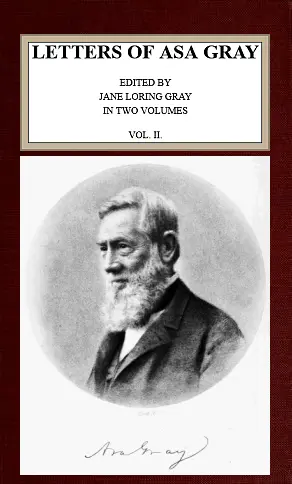
Asa Gray
Asa Gray
Florence Nightingale
Elizabeth Robins Pennell
Denison Olmsted