THE CLASSIC COLLECTION✦Creative Chemistry: Descriptive of Recent Achievements in the Chemical IndustriesCLASSIC FREE BOOKS
Creative Chemistry: Descriptive of Recent Achievements in the Chemical Industries
Edwin E. (Edwin Emery) Slosson
THE CLASSIC COLLECTION · 1920
"Easy Lessons in Einstein: A Discussion of the More Intelligible Features of the Theory of Relativity" by Edwin E. Slosson is a scientific publication written in the early 20th century. The work aims to explain the core concepts of Einstein’s theory of relativity in accessible language for a general audience bewildered by recent scientific discoveries. With references to both historical and contemporary scientific debates, the book introduces readers to the foundational ideas of relativity, its paradoxes, and its philosophical implications, while grounding the discussion in real-world experiments and observations. The opening of the book presents an engaging, conversational dialogue between a curious reader and the author, immediately signaling that the text will demystify the complex topic of relativity for non-specialists. The text quickly contextualizes the importance of Einstein’s ideas by linking them to the high-profile solar eclipse experiments of 1919, which dramatically confirmed predictions unique to Einstein's theories and challenged Newtonian physics. Through analogies involving trains, mirrors, amusement park reflections, and even science fiction, Slosson introduces fundamental concepts such as the relativity of motion, the elusive nature of the ether, the bending of light by gravity, the notion of time as a fourth dimension, and the revolutionary idea that space, time, and measurement are all relative. The narrative blends everyday experience, vivid illustrations, and the latest scientific findings to provide a foundation for readers to grapple with the far-reaching changes Einstein's theories introduce to our understanding of the universe.
Introduction adapted from the source catalogue; source summaries may be automatically generated.
Free to read · English · 29,329 words · No account needed
MAKE TIME FOR A GOOD BOOK
On by default. Untick to stop anonymous reading totals. Each page counts after 10 seconds in view. How this works.
Anonymous counting is on unless you have switched it off.
Tensor Analysis. Annalen der Physik, 1919, vol. 58, pp.
1-54.
Uber die physikalischen Grundlagen der einsteinschen
Gravitätionstheorie. Annalen der Physik, Leipzig, 1918,
Band 56, Folge 4, pp. 408-462.
LARMOR, J.
Essence of Physical Relativity. Nat. Acad. Sci. Proc.,
vol. 4, Nov., 1918.
Das Relativitätsprinzip. Braunschweig, 1911. 208 p.
La Mécanique. Paris: Flammarion, 1909.
Considerations élémentaires sur le principe de relativité.
Revue générale des sciences, Paris, 1914. Tome 25, pp.
179-186.
La gravitation. Scientia. Bologna, 1914, vol. 6, pp. 28-59.
Das Relativitätsprinzip. 1914.
La Gravitation. Scientia, Bologna, 1914, vol. 16, pp. 28-59.
On Einstein’s theory of gravitation. Koninklijke Akademie van Wetenschappen. Proceedings, Amsterdam, 1917-18, vol. 19, pp. 1341-1369; vol. 20, pp. 2-34.
On Hamilton’s principle in Einstein’s theory of gravitation. Koninklijke Akademie van Wetenschappen. Proceedings, Amsterdam, 1917, vol. 19, pp. 751-765.
Some functional equations in the theory of relativity.
American Mathematical Society. Bulletin, Lancaster, Pa.,
1919, vol. 26, pp. 26-34.
MICHELSON, A. A., and MORLEY, E. W.
The Relative Motion of the Earth and the Luminiferous Ether. American Journal of Science, 1887, vol. 34, p. 333.
See also: Astro-Physical Journal, vol. 37, pp. 100-193.
The report of the crucial experiments that upset the idea
of a stationary ether.
Relativitätsprinzip. Jahresbericht der Deutschen Mathematiker-Vereinigung. Leipzig, 1915, Band, 24, pp. 1241-1244.
Einstein’s theory of gravitation and Herglotz’s mechanics of continua. Koninklijke Akademie van Wetenschappen. Proceedings, Amsterdam, 1917, vol. 19.
On the Energy of the Gravitation Field in Einstein’s Theory. Koninklijke Akademie van Wetenschappen. Proceedings, Amsterdam, 1918, vol. 20, pp. 1238-1245.
La Teoria di Relatività nel suo Sviluppo Storieo. Scientia, Nov. and Dec., 1919 (in Italian and French).
Zur Dynamik bewegter Systeme. Königlich Preussischen
Akademie der Wissenschaften. Sitzungberichte, Berlin, 1907,
pp. 542-570.
His theory.
Does the Relativity Theory Exclude the Reality of Space and Time? Deutsche Phys. Gesell., Dec. 30, 1918.
La gravitation. Scientia, Bologna, 1909, vol. 5, pp. 152-165.
Relativity in astronomy. Popular Astronomy, Northfield,
Minn., 1918, vol. 26, pp. 160-165.
The Theory of Relativity. London: Macmillan, 1914,
92 p.
On Einstein’s theory of gravitation, and its astronomical consequences. Royal Astronomical Society. Monthly Notices, London, 1915-18, vol. 76, pp. 699-728; vol. 77, pp. 155-184; vol. 78, pp. 3-28.
On the relativity of rotation in Einstein’s theory. Koninklijke Akademie van Wetenschappen. Proceedings, Amsterdam, 1917, vol. 19, pp. 527-532.
On the relativity of inertia. Remarks concerning Einstein’s
latest hypothesis. Koninklijke Akademie van Wetenschappen.
Proceedings, Amsterdam, 1917, vol. 19, pp.
1217-1255.
Planetary motion and the motion of the moon according to Einstein’s theory. Koninklijke Akademie van Wetenschappen. Proceedings, Amsterdam, 1916, vol. 19, pp. 367-381.
Further Remarks on the Solutions of the Field-equations of Einstein’s Theory of Gravitation. Koninklijke Akademie van Wetenschappen. Proceedings, Amsterdam, 1918, vol. 20, pp. 1309-1312.
Your reading position is saved on this browser. Take it to another device with a library code. Reading pages adapt to text, rather than matching a printed edition.
BEHIND THE BOOK
This eBook is for the use of anyone anywhere in the United States and most other parts of the world at no cost and with almost no restrictions whatsoever. You may copy it, give it away or re-use it under the terms of the Project Gutenberg License included with this eBook or online at www.gutenberg.org. If you are not located in the United States, you will have to check the laws of the country where you are located before using this eBook. Read the source licence.
The original source file, including credits and licence, is retained by this library. Request an original-format copy at no charge. Please include the book title and Project Gutenberg identifier #75807.
KEEP YOUR CURIOSITY GOING
John Muir
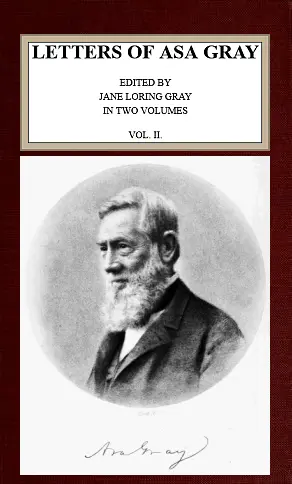
Asa Gray
Asa Gray
Florence Nightingale
Elizabeth Robins Pennell
Denison Olmsted