The orchestra and its instruments
Esther Singleton
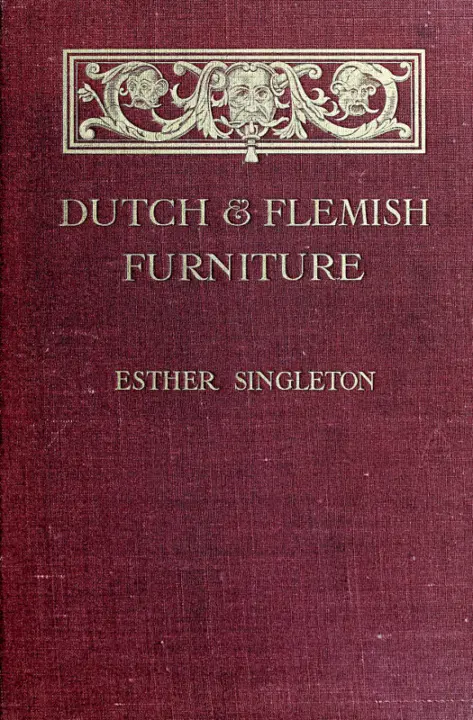
THE CLASSIC COLLECTION · 1907
"Dutch and Flemish Furniture" by Esther Singleton is a historical account written in the early 20th century. This work explores the intricate history and craftsmanship of furniture from the Low Countries, focusing on how various artistic styles evolved from the Middle Ages through the Renaissance to the 19th century. The book likely delves into the impact of socio-political developments on furniture design and manufacturing, as well as the cultural exchanges between different European countries. The opening of the text provides background on the artistic and cultural evolution in the Low Countries, emphasizing the significant influence of the English and Flemish artisans on one another throughout history. Singleton highlights the interconnectedness of trade, craftsmanship, and socio-political relationships between England, France, and the Low Countries. This section sets the stage for a detailed exploration of the various furniture styles and artistic movements, indicating that subsequent chapters will draw upon historical events and artistic trends that shaped the distinctive styles found in Dutch and Flemish designs.
Introduction adapted from the source catalogue; source summaries may be automatically generated.
Free to read · English · 90,730 words · No account needed
MAKE TIME FOR A GOOD BOOK
On by default. Untick to stop anonymous reading totals. Each page counts after 10 seconds in view. How this works.
Anonymous counting is on unless you have switched it off.
The chair on the left of Plate XXX in the Cluny Museum, called “Spanish of the Seventeenth Century,” is a curious transitional piece. The high back and seat are covered with Spanish leather put on with large-headed nails. The pattern of the leather represents peacocks, flowers and human figures. The ornamentation of the top rail consists of a leaf and scrolls ending in sharp spikes at the corners, very much in the early Regency style. On the rail below the seat is carved a heart-shaped ornament. The front legs are cabriole, connected with stretchers and ending in hoof feet. The back legs, also connected by stretchers, are straight.
Other furniture included spinets and harpsichords, Friesland clocks, table watches and pocket watches, which, when not in use, were placed in little cases, as were the mirrors the ladies wore at their waists. Sand- or hour-glasses were to be found especially in the kitchens, and the table-bell, which had now supplanted the whistle as a call for the servants.
The woods used for furniture were oak, walnut, cedar, olive, nutwood, ebony (black, green and yellow); kingwood, from Brazil, a hard wood with black veins on a chocolate ground; beef-wood, from New Holland, of a pale red used for borders; palissandre, or violet wood, from Guiana, for inlays on fine furniture; and, above all, sacredaan, or Java mahogany, a very hard wood, sweet smelling and of a bright yellow or pale orange colour. This was a favourite wood for chests, as the odour served to protect furs and woollen stuffs from the attacks of moths, etc.
The Dutch kitchen towards the end of the century was fully equipped with all kinds of brushes, brooms, pots, pans and every utensil that was necessary to effect the cleanliness and produce the good cheer so necessary to every prosperous burgher. In 1680, a kitchen of a man of moderate means in New Amsterdam contained the following:
£ s. d.
Fourteen pewter dishes, little and great 3 5 0
Three ditto basons, one salt seller, one pye plate 0 9 0
Four chamber potts, one warming pan of brasse 0 15 0
Two pewter flagons, a little one and a greate one 0 5 7½
Two smoothing-irons, three pewter quart potts 0 7 6
Three pewter pint potts, 1½ pint pot and two muck potts 0 6 9
Four old pewter saucers and ½ doz. plates 0 6 0
Six dozen wooden trenchers, three tin cover lids 0 8 0
Two frying pans, five spitts, two dripin pans, iron and tin 1 2 6
One puding pan of tin, one greate brasse kettle, three iron 1 16 0 potts, one brasse skillett
Two copper saucepans, one little iron kettle 0 6 0
Two pair iron pott hookes, a jack with a w^t of 56 lbs. 1 14 0
Two pair andirons, one brasse ladle, one iron beefe forke 1 0 6
Your reading position is saved on this browser. Take it to another device with a library code. Reading pages adapt to text, rather than matching a printed edition.
Esther Singleton
Esther Singleton
Esther Singleton
Esther Singleton
BEHIND THE BOOK
This eBook is for the use of anyone anywhere in the United States and most other parts of the world at no cost and with almost no restrictions whatsoever. You may copy it, give it away or re-use it under the terms of the Project Gutenberg License included with this eBook or online at www.gutenberg.org. If you are not located in the United States, you will have to check the laws of the country where you are located before using this eBook. Read the source licence.
The original source file, including credits and licence, is retained by this library. Request an original-format copy at no charge. Please include the book title and Project Gutenberg identifier #54552.
KEEP YOUR CURIOSITY GOING
Cécile Tormay

Moritz Busch
John L. Ransom
Frances Wright
Cécile Tormay

Mabel Potter Daggett