THE CLASSIC COLLECTION✦Torwood’s trustCLASSIC FREE BOOKS
Torwood’s trust
Evelyn Everett-Green
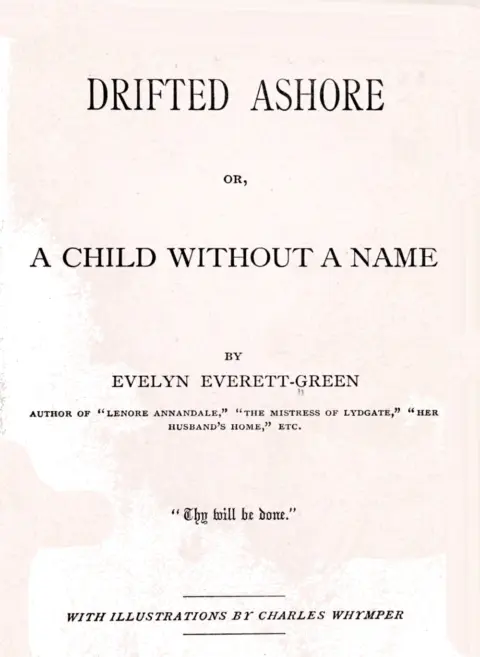
THE CLASSIC COLLECTION · 1890
"Drifted Ashore; or, A Child Without a Name" by Evelyn Everett-Green is a novel written in the late 19th century. This compelling tale revolves around the mysterious fate of a young boy washed ashore after a storm, who is taken in by a kind-hearted fisherwoman while he recovers from his injuries. The book explores themes of identity, belonging, and the search for family, as the boy, later named Bertie, grapples with his lost memories and the kindness extended to him by strangers. The opening of the novel paints a vivid picture of a desolate seaside landscape marked by a tumultuous ocean and a solitary young boy named David, a fisherman's son, reflecting on a name and a life he has yet to uncover. We learn that Bertie, the boy who drifted ashore, lies in a fisherman's cottage, unconscious and without any means of identifying himself. As he slowly regains consciousness, not only does he face the uncertainty of his origins, but he also develops a bond with David and the fisherwoman. The narrative hints at the darker realities of life through the boy’s mysterious past, intertwining the lives of the two boys, and raising questions about class and identity as they navigate their new friendship.
Introduction adapted from the source catalogue; source summaries may be automatically generated.
Free to read · English · 66,074 words · No account needed
MAKE TIME FOR A GOOD BOOK
On by default. Untick to stop anonymous reading totals. Each page counts after 10 seconds in view. How this works.
Anonymous counting is on unless you have switched it off.
But he came at length, the child close at his side, at whom Sir Walter cast one curious glance, and then drew the Squire a little on one side in order to talk at his ease.
The two children were thus left confronting each other. Queenie of
course spoke first.
“What is your name, little boy?” she asked, graciously.
“They call me Bertie here,” he answered, gently, lifting his cap when the little strange lady spoke to him in a way that raised him many steps higher in Queenie’s opinion.
“Well, they call me Queenie,” responded she, laughing, “though it isn’t my name, so we’re something like one another, you see. How old are you?”
He shook his head.
“I don’t know. Mrs. Pritchard and the tailor said I must be about seven
or eight.”
“I thought so!” cried Queenie, quickly; “I always guess people’s ages nearly right. I shall be ten pretty soon. We live in the nearest house to you—next door, we should say in London; but people don’t talk like that here.”
Bertie looked up with a little start.
“Next door,” he said, quickly, and then stopped short.
“What about next door?” asked Queenie.
“I don’t know,” he answered, slowly. “I thought I did; but I didn’t.”
“I want us to be friends,” said Queenie; “would you like to be?”
“If grandpapa likes,” answered Bertie, without the animation Queenie
looked for.
Yet he spoke so gently that she could not be offended, and the wistful look in his eyes touched her, she could not tell why.
“Why do you call him grandpapa?” she asked, with interest. “Do you mean
the Squire?”
“Yes,” answered Bertie. “He lets me call him that. It seems more
natural, somehow.”
Queenie looked at him curiously.
“You must feel very funny, don’t you? I should worry all day to remember
things.”
Bertie’s eyes were troubled and sad.
“That does no good, it only makes my head ache; but I like being in
church.”
Queenie was aware that her father was shaking hands with the Squire. A sudden impulse came over her to speak whilst she had the chance.
“I want us to be friends,” she said again. “Do you know the big oak tree down by the sunk fence at the end of the Squire’s park, near the lodge?”
Bertie thought a little.
“I think I do.”
“If you’ll come out there to-morrow afternoon, I’ll come too. One of us can climb over, and we’ll play together. Don’t forget, and do come.”
Your reading position is saved on this browser. Take it to another device with a library code. Reading pages adapt to text, rather than matching a printed edition.
Evelyn Everett-Green
Evelyn Everett-Green
Evelyn Everett-Green
Evelyn Everett-Green
BEHIND THE BOOK
This eBook is for the use of anyone anywhere in the United States and most other parts of the world at no cost and with almost no restrictions whatsoever. You may copy it, give it away or re-use it under the terms of the Project Gutenberg License included with this eBook or online at www.gutenberg.org. If you are not located in the United States, you will have to check the laws of the country where you are located before using this eBook. Read the source licence.
The original source file, including credits and licence, is retained by this library. Request an original-format copy at no charge. Please include the book title and Project Gutenberg identifier #70089.
KEEP YOUR CURIOSITY GOING
Coulson Kernahan

Maurice Baring
Frances Wright
Cécile Tormay

Frederic Jesup Stimson

W. H. P. (William Henry Pope) Jarvis