THE CLASSIC COLLECTION✦An outlaw’s diary: the CommuneCLASSIC FREE BOOKS
An outlaw’s diary: the Commune
Cécile Tormay
THE CLASSIC COLLECTION · 1912
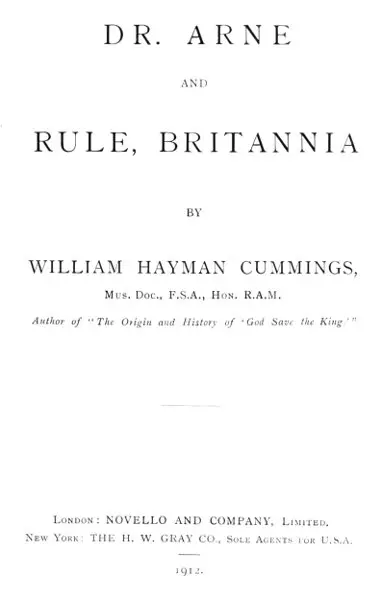
"Dr. Arne and Rule, Britannia" by William Hayman Cummings is a historical account written in the early 20th century. This work chronicles the life and influential career of Thomas Augustine Arne, a prominent composer of the 18th century, most notably known for the national song "Rule, Britannia." Cummings explores not only Arne's compositions but also the personal and sociocultural circumstances that shaped his musical legacy, providing insight into his struggles and triumphs. The opening of the book establishes the context for Arne's life by detailing his lineage, sociopolitical environment, and initial musical education. It describes his family background and the early indicators of his musical talent, including his secretive practice of music while adhering to his father’s wishes for him to pursue a legal career. The author sets the stage for a more comprehensive exploration of Arne’s career development, challenges, and the eventual recognition he gained within the British musical scene. This section hints at a narrative that is both educational for music students and enchanting for readers interested in the history behind one of Britain’s cherished national songs.
Introduction adapted from the source catalogue; source summaries may be automatically generated.
Free to read · English · 37,165 words · No account needed
MAKE TIME FOR A GOOD BOOK
On by default. Untick to stop anonymous reading totals. Each page counts after 10 seconds in view. How this works.
Anonymous counting is on unless you have switched it off.
Let Tommy Arne, with usual pomp of style,
Whose chief, whose only merit's to compile,
Who, meanly pilfering here and there a bit,
Deals music out, as Murphy deals out wit;
Publish proposals, laws for taste prescribe,
And chaunt the praise of an Italian tribe;
Let him reverse Kind Nature's first decrees,
And teach e'en Brent a method not to please:
But never shall a truly British age
Bear a vile race of eunuchs on the stage:
The boasted work's called national in vain,
If one Italian voice pollute the strain.
Where tyrants rule, and slaves with joy obey,
Let slavish minstrels pour th' enervate lay;
To Britons far more noble pleasures spring
In native note, while Beard and Vincent sing.
Arne's Italian proclivities induced him to translate Metastasio's drama "Artaserse," and to transform it into an Opera on the accepted Italian mode, without dialogue. This he did successfully; the recitatives, however, are long and dreary, and the poetry is by no means of a high order. For instance, a very favourite air reads:
Water parted from the sea,
May increase the river's tide;
To the bubbling fount may flee
Or thro' fertile valleys glide:
Yet in search of lost repose,
Doom'd, like me, forlorn to roam,
Still it murmurs as it flows,
Till it reach its native home.
The music of "Artaxerxes" has much charm, and presents excellent harmonization in the accompaniments, which are scored for strings, flutes, oboes, clarinets, bassoons, horns, trumpets, and drums. In two of the pieces the violetta is employed; there are also two violas obbligato, but as was usual with Arne there is no instance of a general ensemble of the instruments employed. In the Air "O too lovely," sung by Tenducci, the violins and basses are marked "Sordini e Pizzicati." The vocal music is quite overladen with ornament, and the compass required for the several voice parts is generally excessive. The opera was produced at Covent Garden Theatre on the 2nd of February, 1762; the principal performers were Miss Brent, Mr. Beard, Mrs. Vernon, Miss Thomas, Mr. Mattocks, and Tenducci and Pesetti, both of whom came under the lash of Churchill's satire. The part of Mandane was composed to show off the compass and flexibility of the voices of the composer's celebrated pupil, Miss Brent, who therefore was the first exponent of the martial song, "The soldier tired of war's alarms," which for many succeeding years was the prescribed test for every new soprano who courted public favour on the stage or in the concert room. This bravura air with its trumpet obbligato still remains a favourite with competent vocalists and discriminating audiences. Arne sold the copyright of his music for sixty guineas, and it was published with the following title: "Artaxerxes An English Opera As it is performed at the Theatre Royal in Covent Garden Set to Music by Dr. Arne. London. Printed for John Johnson at the Harp and Crown opposite Bow Church Cheapside." Another edition of the full score was published from Johnson's plates, "by Authority," by Mr. William Warrell, No. 35 Tavistock Street, Covent Garden. Price 12s. It is again worthy of note that Arne did not publish the music of the recitatives in "Artaxerxes," nor of the concluding chorus, "Live to us, to Empire live." Arne's libretto was published by Tonson in 1763, with a preface written by the composer. A short extract follows: "Metastasio, in his Dialect, seems to affect Simplicity; and from his great Experience in writing for music, has given the following Plan for the Poetry of an Opera, viz., That the Fable, or Recitative, to which fixed Musical Sounds are adapted, should be simple Dialect; hard and dissonant Epithets (though ever so forcible in other Respects) being destructive to Music, and, when sung, for the chief Part, unintelligible. That the similes be confin'd to the Songs; and that the Words, which are to express them, be as smooth and sonorous as possible lest the Composer be cramp'd in his Fancy, and the Singers rendered incapable of shewing their Skill, which chiefly consists in openly displaying the Tones of their Voices or running executive Passages.
Your reading position is saved on this browser. Take it to another device with a library code. Reading pages adapt to text, rather than matching a printed edition.
BEHIND THE BOOK
This eBook is for the use of anyone anywhere in the United States and most other parts of the world at no cost and with almost no restrictions whatsoever. You may copy it, give it away or re-use it under the terms of the Project Gutenberg License included with this eBook or online at www.gutenberg.org. If you are not located in the United States, you will have to check the laws of the country where you are located before using this eBook. Read the source licence.
The original source file, including credits and licence, is retained by this library. Request an original-format copy at no charge. Please include the book title and Project Gutenberg identifier #43214.
KEEP YOUR CURIOSITY GOING
Cécile Tormay

Moritz Busch
John L. Ransom
Frances Wright
Cécile Tormay

Mabel Potter Daggett