THE CLASSIC COLLECTION✦An outlaw’s diary: the CommuneCLASSIC FREE BOOKS
An outlaw’s diary: the Commune
Cécile Tormay
THE CLASSIC COLLECTION · 1912
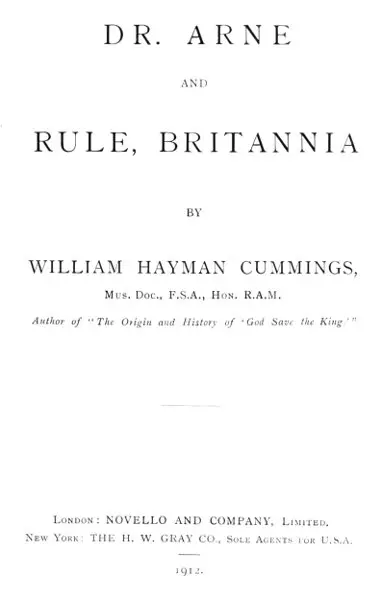
"Dr. Arne and Rule, Britannia" by William Hayman Cummings is a historical account written in the early 20th century. This work chronicles the life and influential career of Thomas Augustine Arne, a prominent composer of the 18th century, most notably known for the national song "Rule, Britannia." Cummings explores not only Arne's compositions but also the personal and sociocultural circumstances that shaped his musical legacy, providing insight into his struggles and triumphs. The opening of the book establishes the context for Arne's life by detailing his lineage, sociopolitical environment, and initial musical education. It describes his family background and the early indicators of his musical talent, including his secretive practice of music while adhering to his father’s wishes for him to pursue a legal career. The author sets the stage for a more comprehensive exploration of Arne’s career development, challenges, and the eventual recognition he gained within the British musical scene. This section hints at a narrative that is both educational for music students and enchanting for readers interested in the history behind one of Britain’s cherished national songs.
Introduction adapted from the source catalogue; source summaries may be automatically generated.
Free to read · English · 37,165 words · No account needed
MAKE TIME FOR A GOOD BOOK
On by default. Untick to stop anonymous reading totals. Each page counts after 10 seconds in view. How this works.
Anonymous counting is on unless you have switched it off.
In 1761, on the 27th of February, at Drury Lane Theatre, Arne brought out his oratorio "Judith," one of his most important compositions. The Public Advertiser of the above date, announced: "At the Theatre Royal in Drury-Lane, This Day, will be performed a new Sacred Oratorio call'd JUDITH. The Music composed by Dr. Arne, with a Concerto on the Organ. Pit and Boxes will be laid together at Half a Guinea. First Gallery 5s. Upper Gallery 3s. 6d. Tickets for the Pit and Boxes may be had of Mr. Varney, at the Stage-Door of the Theatre. To begin at half an hour after Six o'clock." The following day a brief notice appeared in the same journal, which said: "Last Night the new sacred Oratorio call'd Judith, was performed at the Theatre Royal in Drury Lane, to a most polite Audience, who gave it the greatest Approbation and Applause ever known, on the Occasion." Evidence of the success of the oratorio is the repetition of it on the 4th and 6th of March. It was also again performed in Lenten season of 1762 at the theatre. In 1764, on February 29th, it was performed at the Chapel of the Lock Hospital, Grosvenor Place, Pimlico, on behalf of the funds of the charity. A more notable repetition took place at Covent Garden Theatre on the 26th of February 1773, when for the first time ladies formed a part of the chorus; before this time the treble chorus was confined to boys' voices. This happy innovation of Dr. Arne's was well received; the Public Advertiser said: "The Oratorio of Judith, composed by Dr. Arne, which was performed at the Theatre Royal in Covent Garden, yesterday evening, was received with uncommon Applause. The principal singers acquitted themselves to the utmost Satisfaction of the Audience. Mr. Barthelemon was greatly admired in his Solo on the Violin, and too much cannot be said of Signor Spandau's Concerto on the French Horn, as it surpassed any Performance on that Instrument hitherto heard in this Country. The striking Appearance of the Band and Chorus, which were much more numerous than they usually have been, received a most pleasing Addition from the Female Singers, then first introduced." It is somewhat remarkable that the Pianoforte was first used in public as an accompaniment for the voice when a song from "Judith" was sung at Covent Garden Theatre by Miss Brickler on the 16th of May, 1767. The playbill announced that after the first Act of the "Beggar's Opera," "Miss Brickler will sing a favourite song from Judith, accompanied by Mr. Dibdin, on a new instrument called Piano Forte." The published score of the music of "Judith" has for title, "Judith an Oratorio as it is Perform'd at the Theatre-Royal in Drury Lane, Compos'd by Dr. Arne, London. Printed for J. Walsh in Catherine Street in the Strand." This volume unfortunately does not contain a single chorus. The Overture is scored for Strings, Hautboys, Bassoon and Horns. It opens with a spirited Allegro, followed by a short Andante movement for strings only; the other instruments resume in the final Allegro Moderato. A solo, "Wake, my harp," which was sung by Mrs. Cornelys, is accompanied by strings, violins pizzicato, harp and harpsichord in a very effective manner. In an air, "Haste to the gardens of delight," sung by Mr. Tenducci, two flutes are added to the orchestration; and in another air, "With heroes and sages," also sung by Tenducci, we find the bassoons have parts independent of the basses, a somewhat novel departure at the period when Arne wrote. An air, "No more the Heathen shall blaspheme," sung by Mr. Fawcett, has the novel accompaniment of two violoncellos and bass; no other instruments until the last four bars of symphony, when the violins are introduced. Fortunately the composer's autograph score exists in the British Museum, and in that we find much of interest. It exemplifies in some degree the well-known haste and carelessness of the composer; there are sundry memoranda, such as "take care of the Instrumental parts where I have mistaken the lines," "Bassoons in semibriefs," &c. The choruses are in this case his own; there was no borrowing from Handel. The first, "Father of mercies," is short--only thirty-seven bars. The next, "When Israel wept," is also short and good. "Hear, angels, hear" extends to one hundred and twenty-six bars; "Hail, immortal Bacchus," eighty-five bars; "Prepare the genial bower," eighty-seven bars; and the next, a very fine chorus, "Who can Jehovah's wrath abide," one hundred and eight bars; "Breathe the pipe," sixty-two bars; and the last chorus, "Here, sons of Jacob," written in five vocal parts for soprano, alto, tenor and bass, sixty-four bars. Dr. Arne was remarkable for his deficient memory respecting things trifling in themselves, yet sometimes of considerable consequence as connected with other matters. If he made an appointment to meet a friend, whether for the purpose of business or amusement, he would probably mistake the day; if he wrote an order for the theatre, it was equally probable that the play would be misnamed, or that the frank would bear a wrong date. On one occasion, when he had prepared an elaborate Ode, he had it rehearsed, and announced the day for its public performance. The great room at the Crown and Anchor[17] was crowded with company impatiently waiting for their expected gratification. Arne arrived at the tavern-door in a fiacre, leaped out with the score under his arm, and left the parts behind him. When the doctor discovered his neglect, he was in the condition of a madman. Persons were dispatched in all directions in search of the coach, but it could not be found; and the band and company were subjected to the mortification of being dismissed--the first without performing, and the latter without hearing, a note of the prepared Ode. Could this have been the Ode which, it is said, he composed as an exercise for his degree? Arne, by his connection with the theatres, had constant opportunities for cultivating the acquaintance of Italian singers, and of keeping up his knowledge of the Italian language; he was evidently influenced in his later compositions by this familiarity. The simplicity of his melodies became disfigured by excessive ornamentation, and was the subject of adverse criticism. The scurrilous poet, Churchill, in 1761, published the "Rosciad," a satire on actors, in which he violently attacked Arne:
Your reading position is saved on this browser. Take it to another device with a library code. Reading pages adapt to text, rather than matching a printed edition.
BEHIND THE BOOK
This eBook is for the use of anyone anywhere in the United States and most other parts of the world at no cost and with almost no restrictions whatsoever. You may copy it, give it away or re-use it under the terms of the Project Gutenberg License included with this eBook or online at www.gutenberg.org. If you are not located in the United States, you will have to check the laws of the country where you are located before using this eBook. Read the source licence.
The original source file, including credits and licence, is retained by this library. Request an original-format copy at no charge. Please include the book title and Project Gutenberg identifier #43214.
KEEP YOUR CURIOSITY GOING
Cécile Tormay

Moritz Busch
John L. Ransom
Frances Wright
Cécile Tormay

Mabel Potter Daggett