The castaways
James Otis
THE CLASSIC COLLECTION · 1899
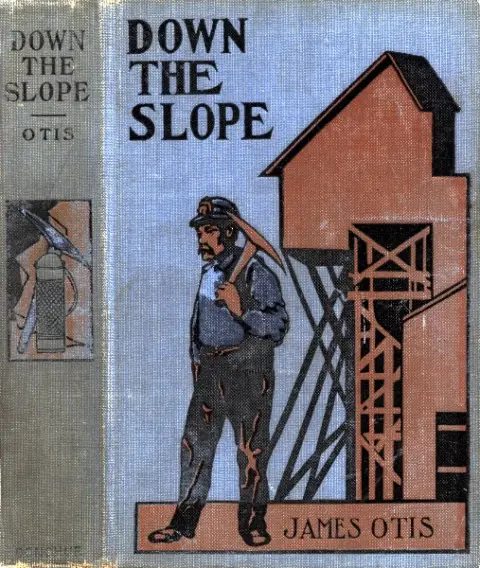
"Down the Slope" by James Otis is a novel written in the late 19th century. The story focuses on Fred Byram, a young breaker boy who begins work in a coal mine, facing adversity and bullying from his peers. As he navigates the harsh realities of working conditions and the dangers posed by a group known as the "regulators," Fred showcases determination and resilience. The opening of the book introduces Fred as he starts his first day at the mine. He quickly encounters Sam Thorpe, another youth who warns him about the rough nature of the boys in this workplace. Fred learns about the exploitative dynamics in the mine, specifically the unwritten rule among the boys that new employees must pay 'footing' or face physical harassment. When Fred refuses to comply, he is bullied, beaten, and eventually thrown into an abandoned mine shaft by Skip Miller and his gang. As the story unfolds, readers are drawn into Fred's struggles against the mob mentality of his peers and the looming threat of danger underground, amplifying the tension and sense of urgency as Fred grapples with survival and courage in the face of fear.
Introduction adapted from the source catalogue; source summaries may be automatically generated.
Free to read · English · 69,895 words · No account needed
MAKE TIME FOR A GOOD BOOK
On by default. Untick to stop anonymous reading totals. Each page counts after 10 seconds in view. How this works.
Anonymous counting is on unless you have switched it off.
"Go on," the second man said fretfully, "an' don't waste time chinnin' here when p'rhaps we oughter be gettin' out to save our lives."
The boys started, feeling a trifle disturbed because of the unexplainable cries, and arrived at the store as the whistle sounded for the night shift to begin work.
The superintendent was surprised by the information brought, and insisted, as had the miners, that the sounds could not have been made by a human being.
"I will go down the slope at once, however," he said, and the boys accompanied him on what proved to be a useless errand.
Every portion of the lower level was searched. A party descended the old shaft, traversing the abandoned passages to the chamber connecting with the new portion of the workings, but nowhere could be seen any signs of life.
Joe and Bill, alarmed because the boys had not returned, came to look for them in time to join the exploring parties, and the latter was decidedly uneasy when Mr. Wright ordered the useless labor to be stopped.
He, in common with several others, believed the mysterious noises to be warnings, and there was every evidence of a panic until Mr. Wright spoke at considerable length on the subject, intimating that the cries were due to natural causes.
Then those who were off duty went home, and among them were Joe, Bill,
and their helpers.
These last discussed the subject without arriving at any definite conclusion when the time to separate arrived.
On the following morning work was resumed in the cutting. The loose earth having been cleared away, a reasonably solid roof was put up, and once more the tunneling operations were pushed forward vigorously.
All hands were on the alert for a repetition of the mysterious cries, but nothing was heard save the noise of the picks and shovels, with now and then a muffled crash as fragments of the vein were detached by blasts.
During the "nooning" lunch was eaten in the cutting, and while they were sitting quiet a singular vibration of the earth could be felt.
"It seems as if some one was digging directly beneath us," Fred said, when the little party ceased eating to gaze at each other in surprise.
"Most likely there's a line of slate just under our feet, an' brings the sound from the other drift," Joe replied promptly.
"That's about the size of it," Bill added; but the boys noticed that both the men listened from time to time as if in great perplexity.
The peculiar tapping continued without interruption, and before the time of rest had more than half expired Joe said, as he arose to his feet:
Your reading position is saved on this browser. Take it to another device with a library code. Reading pages adapt to text, rather than matching a printed edition.
BEHIND THE BOOK
This eBook is for the use of anyone anywhere in the United States and most other parts of the world at no cost and with almost no restrictions whatsoever. You may copy it, give it away or re-use it under the terms of the Project Gutenberg License included with this eBook or online at www.gutenberg.org. If you are not located in the United States, you will have to check the laws of the country where you are located before using this eBook. Read the source licence.
The original source file, including credits and licence, is retained by this library. Request an original-format copy at no charge. Please include the book title and Project Gutenberg identifier #28697.
KEEP YOUR CURIOSITY GOING
Coulson Kernahan

Maurice Baring
Frances Wright
Cécile Tormay

Frederic Jesup Stimson

W. H. P. (William Henry Pope) Jarvis