READ · DISCOVER · ENJOYClassic literature · Always free
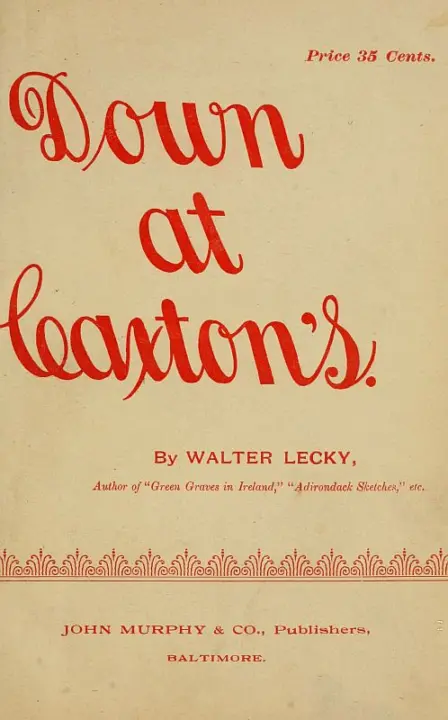
Down at Caxton’s — digital edition cover

THE CLASSIC COLLECTION · 1895

Down at Caxton’s

"Down at Caxton's" by William A. McDermott is a collection of sketches written in the late 19th century. The work captures the essence of various influential figures in American literature and features thoughtful explorations of their contributions and character. Although the author initially focuses on notable literary figures, it seems to set the stage for a wider discussion about the intersections of literature, art, and culture, particularly in relation to the Catholic Church. At the start of the collection, the author dedicates his series of sketches to a dear friend and acknowledges the influence of several prominent writers. The opening section discusses Richard Malcolm Johnston, emphasizing his contributions to dialect fiction and a portrayal of Georgia life before the Civil War. McDermott highlights Johnston's authenticity and ability to represent the local flavor through dialect, arguing for the literary significance that was often overlooked by critics of the time. This introductory exploration serves to establish the cultural and artistic milieu that will be examined throughout the book.

Introduction adapted from the source catalogue; source summaries may be automatically generated.

Start reading ↓

Free to read · English · 30,137 words · No account needed

MAKE TIME FOR A GOOD BOOK

Down at Caxton’s

On by default. Untick to stop anonymous reading totals. Each page counts after 10 seconds in view. How this works.

Anonymous counting is on unless you have switched it off.

Down at Caxton’s

“Sing and dance
And parley vous France,
Drink beer Alanna
And play on the grand piano.”

The songs are of no literary value, sometimes comic, sometimes sentimental, more often with an ambiguity that is more suggestive than downright obscenity. Of the so-called comic, “McGinty” was a great hit, while “After the Ball” was its equal in the sentimental line. It is a strange sight to see pale, flaccid, worn-out Juliet thrum the indifferent piano, while near her in a dramatic posture, learned from some melo-dramatic actor, stands twisted Romeo, singing some sentimental song, balancing his voice to the poor performer, and indifferent piano. To hear such stuff—I speak from auricular demonstration—is no small affliction. After songs come dances, weary night flies quickly away. Work comes with the morrow. Sleepy and tired they buckle on their armor and go out uncomplainingly to tear and wear the sickly body. Thus generation after generation passes to the tread-mill and beyond. It is not to be expected that the literature of such people would be of a high grade. To say that they have no time to read were a fallacy, inasmuch as they do read. Here the question arises, what do they read? I answer that they possess a literature of their own, both in weekly journals and published volumes. They support, strange as it may seem, a school of novelists for their delectation. These journals are a medley of blood-and-thunder stories, far-fetched jokes, sporting news, etiquette as she is above stairs, marriage hints, palmistry, dress making, now and then a page of original topical music hemmed with fake advertising. The point to be noted in these journals, a shrewd business one, they are never beyond the reader’s intelligence. Their novels must be simple and amusing. That is, their author must know how to spin a story. He must amuse. Each weekly instalment must have its comic as well as tragic denouement. The hero must be a villain of the most approved type, neither wanting in courage nor in cunning. The heroine must be on the side of the angelic, mesmerized by the prowess of her hero. A vast quantity of supers are constantly on hand, in case of emergency. Murders, suicides, broken hearts and lesser afflictions are of frequent occurrence. The hero may perish at any moment, provided a more reckless devil takes his place. Half a dozen heroines may come to grief in one serial. An author must be lavish. Provided he is, style is not reckoned, and bad grammar but adds a taking flavor. Woe be to the editor who would inflict on his readers a novel of the school of Henry James or Paul Bourget. The masses hold that the primary condition of fiction is to amuse. They are right. These journals are carried in ladies’ satchels, they stick out of young men’s pockets. On ferry-boats, in street cars, in their stuffy rooms, in the few minutes snatched from the dinner hour they are eagerly read. They may be crumpled and thrust into the pocket at any moment. No handwashing is necessary to handle them. Their cost is light, five cents a week. By a system of interchange a club of five may for that cost peruse five different story papers. This system is in general practice. The greatest amount for the least money strongly appeals to the poor. The novels in book form are of a much lower grade than the serials. Written by profligate men and women, in a vile style, their only object is to undermine morality. Falsity to the marriage vows, deception, theft, the catalogue of a criminal court, is strongly inculcated as the right path. These novels, generally in paper covers, are showy and eye-catching. A voluptuous siren on the cover, with an ambiguous title allures the minor to his ruin. I have known not a few book-sellers who passed as eminently respectable, do a thriving trade in this class of books. The fact that they kept the stock in drawers in the rear of their stores told of their conscious complicity in the destruction and degradation of our youth. These novels are cheap, within the reach of the poor, a point to be noted. The question arises, what can be done to counteract this spread of pernicious literature among our Catholic poor? There is but one answer on the lips of those who should be heard; fight it with good literature—yet literature not beyond their understanding. Put in their hands good novels, whose primary purpose is to amuse. The good-natured gentleman who would put into the hands of the poor as a Christmas gift Fabiola, Callista, Pauline Seward, etc., would make a great mistake. These books would become playthings for greasy babies or curled paper to light the “evening smoke.” The bread winners will not be bored. They have worked hard all day, and at evening want some kind of amusement. The book must be nervy, a tonic. Dictionaries are scarce in the haunts of the poor. Footnotes are an abomination. The author must whisk the reader along. A rapid canter, only broken by hearty laughter or honest pity. Have we any Catholic novels that will do this? It is the plaint of the know-nothing scribes, tossing their empty skulls, to write a capital No. From experience I answer yes. The novels of that true writer of boys’ stories, Father Finn, are just the thing for the poor. They want to read of boys that are not old men, none of your goody-goody little nobodies. A boy is no fool. In real life he would not chum with your sweet little Toms, your praying, psalm-singing Jamies, and your dying angelic Marys. Nor shall he in books, thank heaven. Father Finn has drawn the boy as he is. His books would be joyfully welcomed, if published in a cheap paper form, say at twenty-five cents per copy. List to the wail of the fattening Catholic publisher, who will read that idea. It is, however, a sane one. If Protestants can make cheap books, thereby creating the market, why not Catholics? Until this is done it is useless to cry out, as authors do, nobody will buy my books. Yes, your books will be bought if they are reasonable in price, and properly placed before the public. As it is, your books are snuffed out by the immense amount of trash handled by the ordinary Catholic bookseller, and you help this by writing deep-dyed hypocrisy of the trash-makers. Azarias mildly expresses my idea in one of his posthumous papers: “Catholic reviewers must plead guilty to the impeachment of having been in the past too laudatory of inferior work.” The stories of that sterling man, Malcolm Johnston, called Dukesborough Tales, I once gave to a wretched family. On visiting them a week after, what delight it was to hear the health-giving laughter they had found in them. To another family I gave Billy Downs. Asking how they liked them, I was told that they were as “fine as silk.” A youth of fourteen, his face decidedly humorous, volunteered the criticism that “Billy had no grit.” During the illness of four or five patients of mine I read the assembled family “Chumming With a Savage,” “Joe of Lahaina.” When I came to the final sentence in Joe, where Charlie Stoddard leaves him “sitting and singing in the mouth of his grave—clothed all in death,” two of the youngsters burst into tears, while the father much agitated, said, “Doctor, I don’t see how he had the heart to leave him.” They were so much attached to the book that, although it had been my choice old chum in many a land, I gave it to them. Lately I gave “Life Around Us,” a collection of stories by Maurice F. Egan. It was a great success. Egan has the true touch for the masses when he wishes. Another little story much prized was Nugent Robinson’s “Better Than Gold.” To these might be added in cheap form those of Marian Brunowe, May Crowley, Helen Sweeney, a promising young writer, and Lelia Bugg. How to reach the poor with these books presents few obstacles. Cardinal Vaughan has solved the difficulty in England. Attach to every parish church in city and country a library of well selected interesting Catholic books. Let their circulation be free of charge. The great majority of Catholic poor attend some of the Sunday Masses. If the library is open, they will gladly take a book home. The reading of this book will instil a taste. They will tell their friends of it. It will be the subject of many a chat. If it is cheap, not a few of the neighbors will wish to purchase it. Their criticism, always racy and generally correct, will, as Birrell has pointed out in one of his essays, be its sure pass to success. After a year’s friendly intercourse the library will become a necessity, and they will gladly pay a fee for their week’s delight. The author that has won their hearts will be on their lips, his new books, on account of old ties, will be eagerly purchased and loudly proclaimed.

Your reading position is saved on this browser. Take it to another device with a library code. Reading pages adapt to text, rather than matching a printed edition.

BEHIND THE WORDS

About William A. McDermott

William A. McDermott (1863–1913). Explore Down at Caxton’s in this collection. These books span essays & ideas, history.

Explore this author’s books →

THE READERS’ VERDICT

How did this story stay with you?

Not rated yet
Your rating for Down at Caxton’s

Be the first to share your verdict.

One rating per browser, which you can change or remove. A necessary browser identifier remembers your vote. How ratings work

A GOOD STORY DESERVES COMPANY

Pass this book along.

A great read is even better when it’s shared.

SEND A LITTLE INSPIRATION

Share this book

BEHIND THE BOOK

Edition & source details.

Title
Down at Caxton’s
Author
William A. McDermott
Publication year
1895
Digital edition publisher
Project Gutenberg
Gutenberg release date
2016-04-29
Language
English
Source edition imprint
Not stated in source catalogue
Source identifier
Project Gutenberg #51886
Contributors
No additional named contributors in source metadata

Public-domain source & licence

This eBook is for the use of anyone anywhere in the United States and most other parts of the world at no cost and with almost no restrictions whatsoever. You may copy it, give it away or re-use it under the terms of the Project Gutenberg License included with this eBook or online at www.gutenberg.org. If you are not located in the United States, you will have to check the laws of the country where you are located before using this eBook. Read the source licence.

Full source licence and obtaining an original copy

The original source file, including credits and licence, is retained by this library. Request an original-format copy at no charge. Please include the book title and Project Gutenberg identifier #51886.

the full Project Gutenberg License must appear
prominently whenever any copy of a Project Gutenberg work (any work
on which the phrase “Project Gutenberg” appears, or with which the
phrase “Project Gutenberg” is associated) is accessed, displayed,
performed, viewed, copied or distributed:

This eBook is for the use of anyone anywhere in the United States and most
other parts of the world at no cost and with almost no restrictions
whatsoever. You may copy it, give it away or re-use it under the terms
of the Project Gutenberg™ License included with this eBook or online
at www.gutenberg.org. If you
are not located in the United States, you will have to check the laws
of the country where you are located before using this eBook.

1.E.2. If an individual Project Gutenberg electronic work is
derived from texts not protected by U.S. copyright law (does not
contain a notice indicating that it is posted with permission of the
copyright holder), the work can be copied and distributed to anyone in
the United States without paying any fees or charges. If you are
redistributing or providing access to a work with the phrase “Project
Gutenberg” associated with or appearing on the work, you must comply
either with the requirements of paragraphs 1.E.1 through 1.E.7 or
obtain permission for the use of the work and the Project Gutenberg
trademark as set forth in paragraphs 1.E.8 or 1.E.9.

1.E.3. If an individual Project Gutenberg electronic work is posted
with the permission of the copyright holder, your use and distribution
must comply with both paragraphs 1.E.1 through 1.E.7 and any
additional terms imposed by the copyright holder. Additional terms
will be linked to the Project Gutenberg License for all works
posted with the permission of the copyright holder found at the
beginning of this work.

1.E.4. Do not unlink or detach or remove the full Project Gutenberg
License terms from this work, or any files containing a part of this
work or any other work associated with Project Gutenberg.

1.E.5. Do not copy, display, perform, distribute or redistribute this
electronic work, or any part of this electronic work, without
prominently displaying the sentence set forth in paragraph 1.E.1 with
active links or immediate access to the full terms of the Project
Gutenberg License.

1.E.6. You may convert to and distribute this work in any binary,
compressed, marked up, nonproprietary or proprietary form, including
any word processing or hypertext form. However, if you provide access
to or distribute copies of a Project Gutenberg work in a format
other than “Plain Vanilla ASCII” or other format used in the official
version posted on the official Project Gutenberg website
(www.gutenberg.org), you must, at no additional cost, fee or expense
to the user, provide a copy, a means of exporting a copy, or a means
of obtaining a copy upon request, of the work in its original “Plain
Vanilla ASCII” or other form. Any alternate format must include the
full Project Gutenberg License as specified in paragraph 1.E.1.

1.E.7. Do not charge a fee for access to, viewing, displaying,
performing, copying or distributing any Project Gutenberg works
unless you comply with paragraph 1.E.8 or 1.E.9.

1.E.8. You may charge a reasonable fee for copies of or providing
access to or distributing Project Gutenberg electronic works
provided that:

• You pay a royalty fee of 20% of the gross profits you derive from
the use of Project Gutenberg works calculated using the method
you already use to calculate your applicable taxes. The fee is owed
to the owner of the Project Gutenberg trademark, but he has
agreed to donate royalties under this paragraph to the Project
Gutenberg Literary Archive Foundation. Royalty payments must be paid
within 60 days following each date on which you prepare (or are
legally required to prepare) your periodic tax returns. Royalty
payments should be clearly marked as such and sent to the Project
Gutenberg Literary Archive Foundation at the address specified in
Section 4, “Information about donations to the Project Gutenberg
Literary Archive Foundation.”

• You provide a full refund of any money paid by a user who notifies
you in writing (or by e-mail) within 30 days of receipt that s/he
does not agree to the terms of the full Project Gutenberg™
License. You must require such a user to return or destroy all
copies of the works possessed in a physical medium and discontinue
all use of and all access to other copies of Project Gutenberg™
works.

• You provide, in accordance with paragraph 1.F.3, a full refund of
any money paid for a work or a replacement copy, if a defect in the
electronic work is discovered and reported to you within 90 days of
receipt of the work.

• You comply with all other terms of this agreement for free
distribution of Project Gutenberg™ works.


1.E.9. If you wish to charge a fee or distribute a Project
Gutenberg™ electronic work or group of works on different terms than
are set forth in this agreement, you must obtain permission in writing
from the Project Gutenberg Literary Archive Foundation, the manager of
the Project Gutenberg™ trademark. Contact the Foundation as set
forth in Section 3 below.

1.F.

1.F.1. Project Gutenberg volunteers and employees expend considerable
effort to identify, do copyright research on, transcribe and proofread
works not protected by U.S. copyright law in creating the Project
Gutenberg™ collection. Despite these efforts, Project Gutenberg™
electronic works, and the medium on which they may be stored, may
contain “Defects,” such as, but not limited to, incomplete, inaccurate
or corrupt data, transcription errors, a copyright or other
intellectual property infringement, a defective or damaged disk or
other medium, a computer virus, or computer codes that damage or
cannot be read by your equipment.

1.F.2. LIMITED WARRANTY, DISCLAIMER OF DAMAGES - Except for the “Right
of Replacement or Refund” described in paragraph 1.F.3, the Project
Gutenberg Literary Archive Foundation, the owner of the Project
Gutenberg™ trademark, and any other party distributing a Project
Gutenberg™ electronic work under this agreement, disclaim all
liability to you for damages, costs and expenses, including legal
fees. YOU AGREE THAT YOU HAVE NO REMEDIES FOR NEGLIGENCE, STRICT
LIABILITY, BREACH OF WARRANTY OR BREACH OF CONTRACT EXCEPT THOSE
PROVIDED IN PARAGRAPH 1.F.3. YOU AGREE THAT THE FOUNDATION, THE
TRADEMARK OWNER, AND ANY DISTRIBUTOR UNDER THIS AGREEMENT WILL NOT BE
LIABLE TO YOU FOR ACTUAL, DIRECT, INDIRECT, CONSEQUENTIAL, PUNITIVE OR
INCIDENTAL DAMAGES EVEN IF YOU GIVE NOTICE OF THE POSSIBILITY OF SUCH
DAMAGE.

1.F.3. LIMITED RIGHT OF REPLACEMENT OR REFUND - If you discover a
defect in this electronic work within 90 days of receiving it, you can
receive a refund of the money (if any) you paid for it by sending a
written explanation to the person you received the work from. If you
received the work on a physical medium, you must return the medium
with your written explanation. The person or entity that provided you
with the defective work may elect to provide a replacement copy in
lieu of a refund. If you received the work electronically, the person
or entity providing it to you may choose to give you a second
opportunity to receive the work electronically in lieu of a refund. If
the second copy is also defective, you may demand a refund in writing
without further opportunities to fix the problem.

1.F.4. Except for the limited right of replacement or refund set forth
in paragraph 1.F.3, this work is provided to you ‘AS-IS’, WITH NO
OTHER WARRANTIES OF ANY KIND, EXPRESS OR IMPLIED, INCLUDING BUT NOT
LIMITED TO WARRANTIES OF MERCHANTABILITY OR FITNESS FOR ANY PURPOSE.

1.F.5. Some states do not allow disclaimers of certain implied
warranties or the exclusion or limitation of certain types of
damages. If any disclaimer or limitation set forth in this agreement
violates the law of the state applicable to this agreement, the
agreement shall be interpreted to make the maximum disclaimer or
limitation permitted by the applicable state law. The invalidity or
unenforceability of any provision of this agreement shall not void the
remaining provisions.

1.F.6. INDEMNITY - You agree to indemnify and hold the Foundation, the
trademark owner, any agent or employee of the Foundation, anyone
providing copies of Project Gutenberg™ electronic works in
accordance with this agreement, and any volunteers associated with the
production, promotion and distribution of Project Gutenberg™
electronic works, harmless from all liability, costs and expenses,
including legal fees, that arise directly or indirectly from any of
the following which you do or cause to occur: (a) distribution of this
or any Project Gutenberg work, (b) alteration, modification, or
additions or deletions to any Project Gutenberg work, and (c) any
Defect you cause.

Section 2. Information about the Mission of Project Gutenberg

Project Gutenberg is synonymous with the free distribution of
electronic works in formats readable by the widest variety of
computers including obsolete, old, middle-aged and new computers. It
exists because of the efforts of hundreds of volunteers and donations
from people in all walks of life.

Volunteers and financial support to provide volunteers with the
assistance they need are critical to reaching Project Gutenberg’s
goals and ensuring that the Project Gutenberg collection will
remain freely available for generations to come. In 2001, the Project
Gutenberg Literary Archive Foundation was created to provide a secure
and permanent future for Project Gutenberg and future
generations. To learn more about the Project Gutenberg Literary
Archive Foundation and how your efforts and donations can help, see
Sections 3 and 4 and the Foundation information page at www.gutenberg.org.

Section 3. Information about the Project Gutenberg Literary Archive Foundation

The Project Gutenberg Literary Archive Foundation is a non-profit
501(c)(3) educational corporation organized under the laws of the
state of Mississippi and granted tax exempt status by the Internal
Revenue Service. The Foundation’s EIN or federal tax identification
number is 64-6221541. Contributions to the Project Gutenberg Literary
Archive Foundation are tax deductible to the full extent permitted by
U.S. federal laws and your state’s laws.

The Foundation’s business office is located at 41 Watchung Plaza #516,
Montclair NJ 07042, USA, +1 (862) 621-9288. Email contact links and up
to date contact information can be found at the Foundation’s website
and official page at www.gutenberg.org/contact

Section 4. Information about Donations to the Project Gutenberg
Literary Archive Foundation

Project Gutenberg™ depends upon and cannot survive without widespread
public support and donations to carry out its mission of
increasing the number of public domain and licensed works that can be
freely distributed in machine-readable form accessible by the widest
array of equipment including outdated equipment. Many small donations
($1 to $5,000) are particularly important to maintaining tax exempt
status with the IRS.

The Foundation is committed to complying with the laws regulating
charities and charitable donations in all 50 states of the United
States. Compliance requirements are not uniform and it takes a
considerable effort, much paperwork and many fees to meet and keep up
with these requirements. We do not solicit donations in locations
where we have not received written confirmation of compliance. To SEND
DONATIONS or determine the status of compliance for any particular state
visit www.gutenberg.org/donate.

While we cannot and do not solicit contributions from states where we
have not met the solicitation requirements, we know of no prohibition
against accepting unsolicited donations from donors in such states who
approach us with offers to donate.

International donations are gratefully accepted, but we cannot make
any statements concerning tax treatment of donations received from
outside the United States. U.S. laws alone swamp our small staff.

Please check the Project Gutenberg web pages for current donation
methods and addresses. Donations are accepted in a number of other
ways including checks, online payments and credit card donations. To
donate, please visit: www.gutenberg.org/donate.

Section 5. General Information About Project Gutenberg electronic works

Professor Michael S. Hart was the originator of the Project
Gutenberg concept of a library of electronic works that could be
freely shared with anyone. For forty years, he produced and
distributed Project Gutenberg eBooks with only a loose network of
volunteer support.

Project Gutenberg eBooks are often created from several printed
editions, all of which are confirmed as not protected by copyright in
the U.S. unless a copyright notice is included. Thus, we do not
necessarily keep eBooks in compliance with any particular paper
edition.

Most people start at our website which has the main PG search
facility: www.gutenberg.org.

This website includes information about Project Gutenberg,
including how to make donations to the Project Gutenberg Literary
Archive Foundation, how to help produce our new eBooks, and how to
subscribe to our email newsletter to hear about new eBooks.


KEEP YOUR CURIOSITY GOING

Your next chapter awaits.