
Last letters from the living dead man
David Patterson (Spirit) Hatch
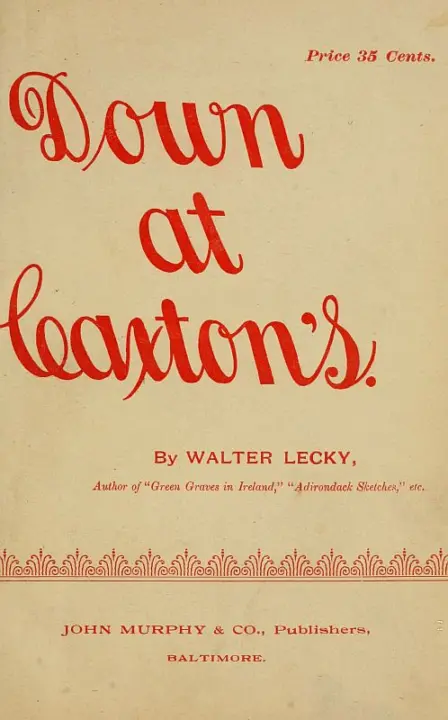
THE CLASSIC COLLECTION · 1895
"Down at Caxton's" by William A. McDermott is a collection of sketches written in the late 19th century. The work captures the essence of various influential figures in American literature and features thoughtful explorations of their contributions and character. Although the author initially focuses on notable literary figures, it seems to set the stage for a wider discussion about the intersections of literature, art, and culture, particularly in relation to the Catholic Church. At the start of the collection, the author dedicates his series of sketches to a dear friend and acknowledges the influence of several prominent writers. The opening section discusses Richard Malcolm Johnston, emphasizing his contributions to dialect fiction and a portrayal of Georgia life before the Civil War. McDermott highlights Johnston's authenticity and ability to represent the local flavor through dialect, arguing for the literary significance that was often overlooked by critics of the time. This introductory exploration serves to establish the cultural and artistic milieu that will be examined throughout the book.
Introduction adapted from the source catalogue; source summaries may be automatically generated.
Free to read · English · 30,137 words · No account needed
MAKE TIME FOR A GOOD BOOK
On by default. Untick to stop anonymous reading totals. Each page counts after 10 seconds in view. How this works.
Anonymous counting is on unless you have switched it off.
“I never ain’t had no show;
But I’ve got a middlin’ tight grip, sir
On the handful o’ things I know.”
We are told, with some show of truth, that this age shall be noted in history as one given to the study of social problems. The contemporary literature of a country is a good index to what people are thinking about. Magazines are, as a rule, for their time, and deal with the forces upward in men’s minds. The most cursory glance at their contents will show the predominance of the Social Problem treated from some phase or other. The best minds are engaged as partisans. Social science may be said to be the order of the day. It has crushed poetry to the skirts of advertising, romance is its happy basking ground. The drama has made it its own. There are some, fogies of course, so says your sapient scientist, who believe that the social science so spasmodically treated in current literature is but a passing fad, and that poetry shall be restored to her old quarters, romance amuse as of old, and the drama be winnowed of rant, scenic sensation, and bestial morality. These dreams may be vain, but then even fogies have their hopes. A branch of this science—the tree is overshadowing—treats of the literature and the masses. Anything about the masses interests me.
When I read the other day, “Literature and the Masses; a Social Study,” among the contents of a fin de siècle magazine, I would have pawned my wearing apparel rather than go home without it. Its reading was painful, as all reading must be where the author knows less about his subject than the ordinary reader. Later, another article fell in my way, dealing with the same subject. Its author had more material, but his use of it was clumsy. It was while reading this article, that I noted the utter stupidity with which things Catholic are treated by the ordinary literary purveyor. These ephemeral pen-wielders seem to hold the most fantastic notions of the Church. What Azarias says of Emerson is true of them: “They seek truth in every religious and philosophical system outside of the teachings of the Catholic Church.” They will not drink from Rome. To correct all this author’s errors is not my plan. In this paper I restrict myself to a part of the same subject, Literature and Our Catholic Poor. I prefer an independent study to patchwork. It is the usual thing in such studies to present credentials. I present mine. Five years’ life in the tenement districts of New York and other great cities of the Union, in full contact, from the peculiarity of my position, with the poor. During these years I was led to make a study of their reading. This study, to be intelligible, must be prefaced by a few hints on their life and environment. It is useless to deny the often-repeated assertion that their lot in the great cities is hard and crushing. It is a continual struggle for nominal existence. The children commence work at a premature age. Their education is meagre and broken. Marriage is entered in early life, without the slightest provision. To these marriages there is little selection. The girls have been brought up in factories, household restraint frets their soul. Of household economy, so necessary to the city toiler, they know nothing. If ends meet it is well. If not, there is trust and sorrow. The day of their marriage means a few stuffy rooms, badly ventilated, filled with the most bizarre and useless furniture put in by shylock, who will, in the coming years, exact ten times their value. Thus started, children are born, puny and sickly, prey of physician and druggist. If these children survive, at an early age they follow the father and mother by entering foundries and factories to toil life’s weary round away. When they die the family is pauperized for years. It is a common plaint of the tenements that “I would have been worth something if my boy had not died.” Every death is not only a drain on the immediate family, but on their friends, who are supposed to turn out and give “the corpse a decent burial.” The decent burial means coaches, flowers and whiskey. The most casual observer must notice the giant part liquor plays, in the lives of the poor. Liquor and its concomitant, tobacco, in the deadly form of cigarettes, are known to the boy. He has been brought up in that atmosphere. His father has his cheap, ill-smelling cigar and frothy pint for supper. His mother and a few gossiping friends have chased the heavy day with a few pints “because they were dry.” He delights in being the Mercury of the “growler.” Hanging by the balustrade he sips the beer, “just to taste it.” That taste, alas, lingers through life. As he grows older it becomes more refined. His teachers are the sumptuous, dazzling bar-rooms guarding each city corner, while betraying the nation. The owners of these vice palaces are wise in their generation. For his stuffy home, broken furniture and cheerless aspects, they show him wide, airy rooms, polished furniture, bevelled glass mirrors, dazzling light, music, gaiety, companionship, and the illusive charm of revelry. The reading matter in such places is on a par with the other attractions. It is sensational. Its authors are skilled in the base development of the passions. It smacks obscenity, and early dulls the intellect to finer things. To be enmeshed in its threads is the greatest sorrow of a young life. When the bar-room does not allure, there is another siren to be taken into account. It is the promiscuous gathering at the neighbor’s house who has been so unfortunate as to find a music dealer to trust him with a piano at three times its price. Here gather the Romeos and Juliets to
Your reading position is saved on this browser. Take it to another device with a library code. Reading pages adapt to text, rather than matching a printed edition.
BEHIND THE BOOK
This eBook is for the use of anyone anywhere in the United States and most other parts of the world at no cost and with almost no restrictions whatsoever. You may copy it, give it away or re-use it under the terms of the Project Gutenberg License included with this eBook or online at www.gutenberg.org. If you are not located in the United States, you will have to check the laws of the country where you are located before using this eBook. Read the source licence.
The original source file, including credits and licence, is retained by this library. Request an original-format copy at no charge. Please include the book title and Project Gutenberg identifier #51886.
KEEP YOUR CURIOSITY GOING
David Patterson (Spirit) Hatch

David Patterson (Spirit) Hatch

David Patterson (Spirit) Hatch
Cécile Tormay

Moritz Busch
John L. Ransom