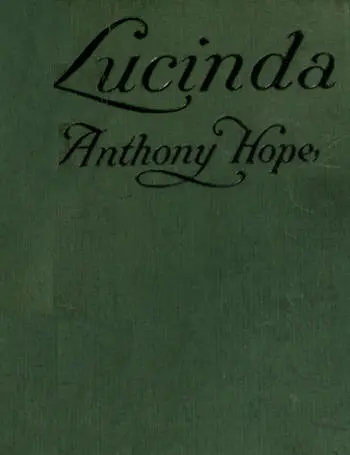
Lucinda
Anthony Hope

THE CLASSIC COLLECTION · 1904
"Double Harness" by Anthony Hope is a novel written in the early 20th century. The story revolves around Grantley Imason and his fiancée Sibylla Chiddingfold, exploring themes of love, marriage, and societal expectations. The interactions between characters set the stage for a narrative that probes the complexities of relationships, particularly as they navigate the ups and downs of impending commitment against the backdrop of differing personalities and life experiences. The opening of the book introduces Tom Courtland, who is feeling burdened by his marriage and longs for freedom as he spends time with his friend Grantley Imason. Through their dialogue, the reader gets a glimpse of the societal pressures surrounding love and marriage, specifically focusing on Courtland's reluctance to return to his wife. The scene shifts to various characters, including Sibylla’s brother, Jeremy, who expresses skeptical views about marriage. This rich tapestry of characters and their conversations foreshadows a deeper exploration of romance and its challenges, particularly as Grantley's affection for Sibylla develops amidst societal scrutiny and personal dilemmas. The introduction sets a tone of reflective observation on the institution of marriage, laying the groundwork for the ensuing narrative.
Introduction adapted from the source catalogue; source summaries may be automatically generated.
Free to read · English · 119,780 words · No account needed
MAKE TIME FOR A GOOD BOOK
On by default. Untick to stop anonymous reading totals. Each page counts after 10 seconds in view. How this works.
Anonymous counting is on unless you have switched it off.
It was the eve of Dora Hutting's wedding--a thing in itself quite enough to put Milldean into an unwonted stir. Everybody was very excited about the event and very sympathetic. Kate Raymore had come to the front; not even preoccupation with Charley could prevent a marriage from interesting her. She had given much counsel, and had exerted herself to effect a reconciliation between the bride and Jeremy Chiddingfold. Into this diplomatic effort Sibylla also had been drawn, and peace had been signed at a tea-party. With the help of Christine's accomplished manner and Grantley's tactful composure, it had been found possible to treat the whole episode as a boy-and-girl affair which could be laughed at and thus dismissed into oblivion. The two principals could not take quite this view; but they consented to be friends, to wish each other well, and to say nothing about the underlying contempt which each could not but entertain for the other's fickleness. For Jeremy would have been faithful if Dora had been, and Dora could not perceive how the fact of her having made a mistake as to her own feelings explained the extraordinary rapidity with which Jeremy had been able to transfer an affection professedly so lasting and so deep. Christine warned her that all men were like that--except Mr. Mallam; and Grantley told Jeremy that Dora was flighty, as all girls were--except Eva Raymore. So peace, though not very cordial peace, was obtained, the satirical remarks which the parties felt entitled to make privately not appearing on the face of the formal proceedings.
Important though these matters might be, they were not in Sibylla's mind as she stood at the end of the garden and looked down on Old Mill House. Twenty-four hours before, Mrs. Mumple had started on her journey. Sibylla, Eva, and Jeremy had escorted her to Fairhaven. The fat old woman was very apprehensive and tremulous; anxious about her looks and the fit of her new silk gown; full of questionings about the meeting to which she went. It was impossible not to smile covertly at some of these manifestations, but over them all shone the beauty of the love which had sustained her through the years. Sibylla prayed that now it might have its reward, half wondering that it had lived to claim it--had lived so long in solitude and uncomforted. It had never despaired, however long the waiting, however much it was starved of all satisfaction, bereft of all pleasure, condemned to seeming uselessness, even unwelcomed, as one well might fear. These things had brought pain and fear, but not despair nor death. Yet Mrs. Mumple was not by nature a patient woman; naturally she craved a full return for what she gave, and an ardent answer to the warmth of her affection. None the less she had not despaired; and as Sibylla thought of this, she accused herself because, unlike the old woman, she had allowed herself to despair--nay, had been ready, almost eager, to do it, had twisted everything into a justification for it, had made no protest against it and no effort to avoid it. That mood had led to ruin; at last she saw that it would have been ruin. Was there now hope? It was difficult to go back, to retrace the steps so confidently taken, to realise that she too had been wrong. Yet what else was the lesson? It came to her in one form or another from every side--from the Courtlands, where death alone had been strong enough to thwart the evil fate; from the Raymores, where trust, bruised but not broken, had redeemed a boy's life from evil to good; even from Christine, who waited in secret hope; above all, from the quarter whence she had least looked for it--from Grantley himself, for whom no effort was too great, who never lost confidence, who had indeed lacked understanding but had never lacked courage; who now, with eyes opened and at her bidding, was endeavouring the hardest thing a man can do--was trying to change himself, to look at himself with another's eyes, to remodel himself by a new standard, to count as faults what he had cherished as virtues, to put in the foremost place not the qualities which had been his pets, his favourites, his ideals, but those which another asked from him, and which he must do himself a violence to display. Had she no corresponding effort to make? She could not deny the accusation. It lay with her too to try. But it was hard. John Fanshaw found it sorely difficult, grossly against his prejudices, and even in conflict with principles which he held sacred, to belittle his grievance or to let it go. Sibylla was very fond of her grievances too. She was asked to look at them with new eyes, to think of them no more as outrages, as stones of stumbling and rocks of offence. She was asked to consider her grievances as opportunities. That was the plain truth about it, and it involved so much recantation, such a turning upside down of old notions, such a fall for pride. It was very hard to swallow. Yet unless it were swallowed, where was hope? And if it were swallowed, what did it mean? An experiment--only another difficult experiment. For people are not changed readily, and cannot be changed altogether. Difficulties would remain--would remain always; the vain ideal which had once governed all her acts and thoughts would never be realised. She must not be under any delusion as to that. And now, in her heart, she was afraid of delusion coming again; and again disillusion must follow.
Your reading position is saved on this browser. Take it to another device with a library code. Reading pages adapt to text, rather than matching a printed edition.
Anthony Hope

Anthony Hope

Anthony Hope

Anthony Hope
BEHIND THE BOOK
This eBook is for the use of anyone anywhere in the United States and most other parts of the world at no cost and with almost no restrictions whatsoever. You may copy it, give it away or re-use it under the terms of the Project Gutenberg License included with this eBook or online at www.gutenberg.org. If you are not located in the United States, you will have to check the laws of the country where you are located before using this eBook. Read the source licence.
The original source file, including credits and licence, is retained by this library. Request an original-format copy at no charge. Please include the book title and Project Gutenberg identifier #42222.
KEEP YOUR CURIOSITY GOING
Coulson Kernahan

Maurice Baring
Frances Wright
Cécile Tormay

Frederic Jesup Stimson

W. H. P. (William Henry Pope) Jarvis