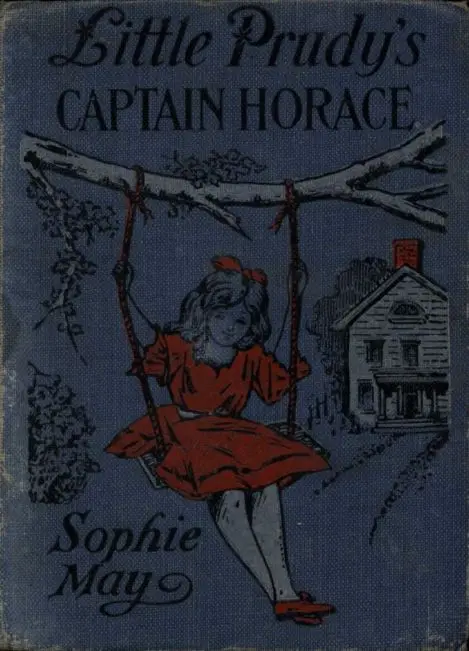
Little Prudy’s Captain Horace
Sophie May
THE CLASSIC COLLECTION · 1869
"Dotty Dimple Out West" by Sophie May is a children's novel written in the late 19th century. The story follows a young girl named Dotty Dimple as she embarks on an adventurous journey to the western United States with her father. Through her innocent observations and imaginative interpretations, Dotty encounters various new experiences and characters, which captures the essence of childhood wonder and exploration. At the start of the narrative, Dotty is filled with excitement as she prepares for her journey West. She shares her whimsical thoughts about the world, including amusing misunderstandings about astronomy and her features, such as her dimples. Dotty's personality shines through her innocent arrogance as she hopes for a delightful trip with her father, all while processing her emotions and relationships with her family and newfound friends. As she boards the train, Dotty's excitement and curiosity lead her to interact with fellow travelers, including the charming Captain Lally and his son Adolphus. This sets the stage for the adventures and lessons that Dotty will navigate throughout her travels, showcasing the joys and trials of growing up.
Introduction adapted from the source catalogue; source summaries may be automatically generated.
Free to read · English · 23,972 words · No account needed
MAKE TIME FOR A GOOD BOOK
On by default. Untick to stop anonymous reading totals. Each page counts after 10 seconds in view. How this works.
Anonymous counting is on unless you have switched it off.
As they drove along "the plank road," farther and farther away from the city, Dotty saw more clearly than ever the wide difference between Indiana and Maine.
"Why, papa," said she, "did you ever breathe such a dust? It seems like
snuff."
"It makes us almost as invisible as the 'tarn cap' we read of in German fairy tales," said Mrs. Clifford, tucking her brown veil under her chin.
She and Mr. Parlin both encouraged Dotty to talk; for they liked to hear her exclamations of wonder at things which to them seemed common-place enough.
"What did you call this road, Aunt 'Ria? Didn't you say it was made of boards? I don't see any boards."
"The planks were put down so long ago, Dotty, that they are overlaid
with earth."
"But what did they put them down for?"
"You musser ask so many kestions, Dotty," said Flyaway, severely; "you say 'what' too many times."
"The planks were laid down, Dotty, on account of the depth of the mud."
"Mud, Aunt 'Ria?"
"Yes, dear, dusty as it is now, at some seasons of the year the roads are so muddy that you might lose off your overshoes if it were not for the large beams which bridge over the crossings."
"That reminds me," said Mr. Parlin, "of the man who was seen sinking in the mud, and, when some one offered to help him out, he replied, cheerfully, 'O, I shall get through; I have a horse under me.'"
"Why, was the horse 'way down out of sight, papa?"
"Where was the hossy, Uncle Eddard?"
"It was only a story, children. If the man said there was a horse under him, it was a figure of speech, which we call hyperbole; he only meant to state in a funny way that the mud was excessively deep."
"Is it right to tell hyperblees, papa? Because Jennie Vance tells them a great deal. I didn't know the name of them before."
"No, Alice, it is not right to tell untrue things expecting to be
believed--of course not."
"Well, she isn't believed. Nobody s'poses her mamma made a bushel of currant wine last summer, unless it's a baby, that doesn't know any better."
"I knows better. I'se a goorl, and can walk," said little Katie,
bridling.
"I didn't say you were a baby, you precious Flyaway! Who's cunning?"
"I'm is," replied the child, settling back upon the seat with a sigh of relief. She was very sensitive on the point of age, and, like Dotty, could not abide the idea of being thought young.
"How far are we going?" asked Mr. Parlin.
Your reading position is saved on this browser. Take it to another device with a library code. Reading pages adapt to text, rather than matching a printed edition.
BEHIND THE BOOK
This eBook is for the use of anyone anywhere in the United States and most other parts of the world at no cost and with almost no restrictions whatsoever. You may copy it, give it away or re-use it under the terms of the Project Gutenberg License included with this eBook or online at www.gutenberg.org. If you are not located in the United States, you will have to check the laws of the country where you are located before using this eBook. Read the source licence.
The original source file, including credits and licence, is retained by this library. Request an original-format copy at no charge. Please include the book title and Project Gutenberg identifier #16383.
KEEP YOUR CURIOSITY GOING
Wilfrid Scawen Blunt
Wilfrid Scawen Blunt

E. W. (Edgar Watson) Howe
Coulson Kernahan

Maurice Baring
Frances Wright