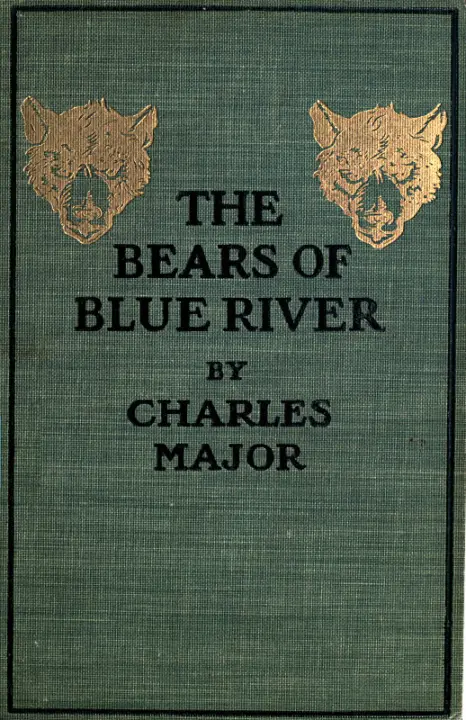
The Bears of Blue River
Charles Major
THE CLASSIC COLLECTION · 1902
"Dorothy Vernon of Haddon Hall" by Charles Major is a historical novel written during the early 20th century. The narrative follows the life of its titular character, Dorothy Vernon, and explores themes of love, lineage, and feudal loyalty in a richly described Elizabethan England. The story is told in part by Sir Malcolm Vernon, a cousin to Dorothy, who finds himself caught between his past, his affection for the deposed Queen Mary, and his duty to his family and heritage. At the start of the novel, readers are introduced to Malcolm, who reflects on his tumultuous past and his quest for safety at Haddon Hall after fleeing danger in Scotland. As he arrives at the hall, he discovers that his childhood cousin, Dorothy, has grown into an unexpectedly beautiful young woman. The dynamics of family obligations, romantic entanglements, and the weight of historical feuds become apparent as Malcolm grapples with the prospect of marrying Dorothy to preserve his family name. The opening sets the stage for a complex interplay of emotions and conflicts, hinting at the tension between personal desires and familial expectations amidst the backdrop of political intrigue involving their kin and the reigning monarch, Queen Elizabeth.
Introduction adapted from the source catalogue; source summaries may be automatically generated.
Free to read · English · 116,699 words · No account needed
MAKE TIME FOR A GOOD BOOK
On by default. Untick to stop anonymous reading totals. Each page counts after 10 seconds in view. How this works.
Anonymous counting is on unless you have switched it off.
"Well," said the girl, beginning her laggard narrative, "after we saw--saw him at Overhaddon, you know, I went to the village on each of three days--"
"Yes, I know that also," I said.
"How did you--but never mind. I did not see him, and when I returned home I felt angry and hurt and--and--but never mind that either. One day I found him, and I at once rode to the well where he was standing by his horse. He drew water for Dolcy, but the perverse mare would not drink."
"A characteristic of her sex," I muttered.
"What did you say?" asked the girl.
"Nothing."
She continued: "He seemed constrained and distant in his manner, but I knew, that is, I thought--I mean I felt--oh, you know--he looked as if he were glad to see me and I--I, oh, God! I was so glad and happy to see him that I could hardly restrain myself to act at all maidenly. He must have heard my heart beat. I thought he was in trouble. He seemed to have something he wished to say to me."
"He doubtless had a great deal he wished to say to you," said I, again
tempted to futile irony.
"I was sure he had something to say," the girl returned seriously. "He was in trouble. I knew that he was, and I longed to help him."
"What trouble?" I inquired.
"Oh, I don't know. I forgot to ask, but he looked troubled."
"Doubtless he was troubled," I responded. "He had sufficient cause for trouble," I finished the sentence to myself with the words, "in you."
"What was the cause of his trouble?" she hastily asked, turning her face
toward me.
"I do not know certainly," I answered in a tone of irony which should have pierced an oak board, while the girl listened and looked at me eagerly; "but I might guess."
"What was it? What was it? Let me hear you guess," she asked.
"You," I responded laconically.
"I!" she exclaimed in surprise.
"Yes, you," I responded with emphasis. "You would bring trouble to any man, but to Sir John Manners--well, if he intends to keep up these meetings with you it would be better for his peace and happiness that he should get him a house in hell, for he would live there more happily than on this earth."
"That is a foolish, senseless remark, Malcolm," the girl replied, tossing her head with a show of anger in her eyes. "This is no time to jest." I suppose I could not have convinced her that I was not jesting.
Your reading position is saved on this browser. Take it to another device with a library code. Reading pages adapt to text, rather than matching a printed edition.
Charles Major
Charles Major
Charles Major
Charles Major
BEHIND THE BOOK
This eBook is for the use of anyone anywhere in the United States and most other parts of the world at no cost and with almost no restrictions whatsoever. You may copy it, give it away or re-use it under the terms of the Project Gutenberg License included with this eBook or online at www.gutenberg.org. If you are not located in the United States, you will have to check the laws of the country where you are located before using this eBook. Read the source licence.
The original source file, including credits and licence, is retained by this library. Request an original-format copy at no charge. Please include the book title and Project Gutenberg identifier #14671.
KEEP YOUR CURIOSITY GOING
Cécile Tormay

Moritz Busch
Coulson Kernahan
John L. Ransom

Maurice Baring
Frances Wright