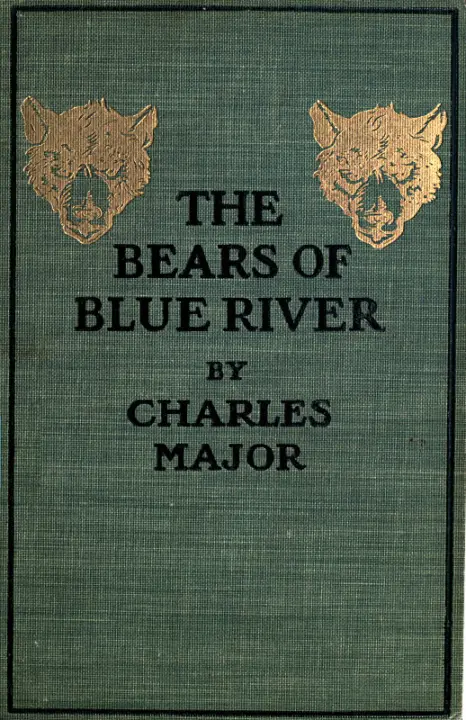
The Bears of Blue River
Charles Major
THE CLASSIC COLLECTION · 1902
"Dorothy Vernon of Haddon Hall" by Charles Major is a historical novel written during the early 20th century. The narrative follows the life of its titular character, Dorothy Vernon, and explores themes of love, lineage, and feudal loyalty in a richly described Elizabethan England. The story is told in part by Sir Malcolm Vernon, a cousin to Dorothy, who finds himself caught between his past, his affection for the deposed Queen Mary, and his duty to his family and heritage. At the start of the novel, readers are introduced to Malcolm, who reflects on his tumultuous past and his quest for safety at Haddon Hall after fleeing danger in Scotland. As he arrives at the hall, he discovers that his childhood cousin, Dorothy, has grown into an unexpectedly beautiful young woman. The dynamics of family obligations, romantic entanglements, and the weight of historical feuds become apparent as Malcolm grapples with the prospect of marrying Dorothy to preserve his family name. The opening sets the stage for a complex interplay of emotions and conflicts, hinting at the tension between personal desires and familial expectations amidst the backdrop of political intrigue involving their kin and the reigning monarch, Queen Elizabeth.
Introduction adapted from the source catalogue; source summaries may be automatically generated.
Free to read · English · 116,699 words · No account needed
MAKE TIME FOR A GOOD BOOK
On by default. Untick to stop anonymous reading totals. Each page counts after 10 seconds in view. How this works.
Anonymous counting is on unless you have switched it off.
"Tell me? No. I knew it when you returned after five hours' absence, looking radiant as the sun."
"Oh!" the girl exclaimed, with a startled movement.
"I also knew," I continued, "that at other times when you rode out upon Dolcy you had not seen him."
"How did you know?" she asked, with quick-coming breath.
"By your ill-humor," I answered.
"I knew it was so. I felt that everybody knew all that I had been doing. I could almost see father and Madge and you--even the servants--reading the wickedness written upon my heart. I knew that I could hide it from nobody." Tears were very near the girl's eyes.
"We cannot help thinking that our guilty consciences, through which we see so plainly our own evil, are transparent to all the world. In that fact lies an evil-doer's greatest danger," said I, preacher fashion; "but you need have no fear. What you have done I believe is suspected by no one save me."
A deep sigh of relief rose from the girl's heaving breast.
"Well," she began, "I will tell you all about it, and I am only too glad to do so. It is heavy, Malcolm, heavy on my conscience. But I would not be rid of it for all the kingdoms of the earth."
"A moment since you told me that your conduct was good and pure and sacred, and now you tell me that it is heavy on your conscience. Does one grieve, Dorothy, for the sake of that which is good and pure and sacred?"
"I cannot answer your question," she replied. "I am no priest. But this I know: I have done no evil, and my conscience nevertheless is sore. Solve me the riddle, Malcolm, if you can."
"I cannot solve your riddle, Dorothy," I replied; "but I feel sure it will be far safer for each of us if you will tell me all that happens hereafter."
"I am sure you are right," she responded; "but some secrets are so delicious that we love to suck their sweets alone. I believe, however, your advice is good, and I will tell you all that has happened, though I cannot look you in the face while doing it." She hesitated a moment, and her face was red with tell-tale blushes. She continued, "I have acted most unmaidenly."
"Unmaidenly perhaps, but not unwomanly," said I.
"I thank you," she said, interrupting my sentence. It probably was well that she did so, for I was about to add, "To act womanly often means to get yourself into mischief and your friends into as much trouble as possible." Had I finished my remark, she would not have thanked me.
Your reading position is saved on this browser. Take it to another device with a library code. Reading pages adapt to text, rather than matching a printed edition.
Charles Major
Charles Major
Charles Major
Charles Major
BEHIND THE BOOK
This eBook is for the use of anyone anywhere in the United States and most other parts of the world at no cost and with almost no restrictions whatsoever. You may copy it, give it away or re-use it under the terms of the Project Gutenberg License included with this eBook or online at www.gutenberg.org. If you are not located in the United States, you will have to check the laws of the country where you are located before using this eBook. Read the source licence.
The original source file, including credits and licence, is retained by this library. Request an original-format copy at no charge. Please include the book title and Project Gutenberg identifier #14671.
KEEP YOUR CURIOSITY GOING
Cécile Tormay

Moritz Busch
Coulson Kernahan
John L. Ransom

Maurice Baring
Frances Wright