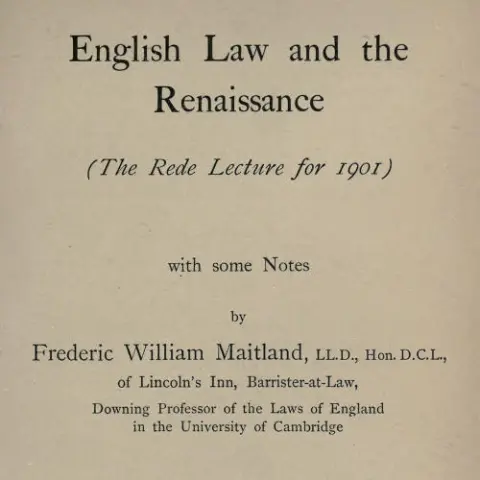
English Law and the Renaissance The Rede Lecture for 1901
Frederic William Maitland
THE CLASSIC COLLECTION · 1897
"Domesday Book and Beyond: Three Essays in the Early History of England" by Frederic William Maitland is a historical account written in the late 19th century. The work explores key themes and documents related to early English law and society, particularly focusing on the significance and implications of the Domesday Book—a comprehensive survey commissioned by William the Conqueror in 1085. The opening of the book presents a detailed introduction to the Domesday Book, describing its creation and its purpose as a tax record rather than a comprehensive legal document. Maitland discusses the methods used by royal commissioners to gather data regarding landholdings and the various classes of people that inhabited England during this period. He highlights the complexities of understanding the legal relationships and historical context of the land and its occupants, setting the stage for a deeper examination of feudalism and its societal ramifications in England.
Introduction adapted from the source catalogue; source summaries may be automatically generated.
Free to read · English · 233,138 words · No account needed
MAKE TIME FOR A GOOD BOOK
On by default. Untick to stop anonymous reading totals. Each page counts after 10 seconds in view. How this works.
Anonymous counting is on unless you have switched it off.
[1712] Hist. Eccl. iv. 13 (p. 232): 'Quo tempore Rex Ædilualch donavit reverentissimo antistiti Vilfrido terram lxxxvii familiarum, ubi suos homines, qui exules vagabantur, recipere posset, vocabulo Selæsu, quod dicitur Latine Insula Vituli Marini.' Bede goes on to describe the Selsey peninsula and Wilfrid's foundation of a monastery. Wilfrid proceeded to convert the men who were given him. They included two hundred and fifty male and female slaves whom he set at liberty.
[1713] K. 992 (v. 32); B. i. 98.
[1714] K. 464 (ii. 341). The 55 hides are reduced to 42, no mention is made of Medemenige, Egesauude or Bessanheie, and the 32 hides are somewhat differently distributed.
[1715] D. B. i. 17. The Bp of Chichester has 24 hides at Amberley.
[1716] I infer this from the thorough discrepancy that there is between these charters and D. B. A forger at work after or soon before the Conquest would have arranged the church's estates in a manner similar to that which we see in King William's record.
[1717] As a matter of fact, however, it is not very easy to reconcile the earlier charter with Bede's story. The charter makes the land proceed from the West-Saxon Ceadwealla and says nothing of Æthelwealh, who, according to Bede, was the donor. Mr Plummer, Bedae Opera, ii. 226, says that the forger betrays his hand by calling Wilfrid archbishop. Really he seems to cut Wilfrid into two, making of him (1) an archbishop, and (2) a bishop of the South Saxons. See the attestations.
[1718] In D. B. i. 17 the bishop's manor at Selsey has but 10 hides and but 7 teamlands.
[1719] See above, p. 378.
[1720] Meitzen, op. cit. ii. 563.
[1721] Meitzen, op. cit., ii. 553-69; iii. 557-61; Lamprecht, Deutsches Wirtschaftsleben, i. 348.
[1722] Meitzen, op. cit. ii. 566. The Kalenberger Hufe was a measure prevalent in the district of Braunschweig-Lüneberg. It contained 180 Morgen or 47.147 hectares. A hide made of 120 statute acres would contain about 48.56 hectares. Apparently Dr Meitzen (ii. 113) has found no difficulty in accepting a hide of 120 acres as the normal share of the English settler. See also Lamprecht, Deutsches Wirtschaftsleben, i. 348.
[1723] Polyptyque de l'abbaye de S. Germain des Prés, ed. Longnon,
i. 102.
[1724] Pertz, Leges, i. 536; Ann. Bertin. (ed. Waitz) 81, 135; Richter, Annalen, ii. 400, 443; Dümmler, Gesch. d. Ostfränk. Reichs, i. 585.
[1725] Meitzen, op. cit. ii. 592-3.
[1726] See above, p. 438.
[1727] Tacitus, Germania, c. 15, 23. The very lenient treatment by Abp Theodore of the monk who gets drunk upon a festival tells a curious tale: Haddan and Stubbs, Councils, iii. 177; Robertson, Hist. Essays, 68.
[1728] Thus, e.g., D. B. i. 127, Fuleham: 'ibi 5 villani, quisque 1
hidam.'
[1729] See above, p. 360.
Abbots, Secular, 242
Abingdon, Church of, 254, 295, 494
Abington, Vill of, 11
Acre, 369, 373-386, 518
Acre, Fiscal, 475-490
Acreage, Medieval statements of, 392
Acreage of counties, 407
Adultery, 281
Advocatus of church, 303
Agrarian morphology, 15, 16, 222, 362
Aids of boroughs, 174-176
Aids of counties, 473
Alfred's army, 189
Your reading position is saved on this browser. Take it to another device with a library code. Reading pages adapt to text, rather than matching a printed edition.
Frederic William Maitland
BEHIND THE BOOK
This eBook is for the use of anyone anywhere in the United States and most other parts of the world at no cost and with almost no restrictions whatsoever. You may copy it, give it away or re-use it under the terms of the Project Gutenberg License included with this eBook or online at www.gutenberg.org. If you are not located in the United States, you will have to check the laws of the country where you are located before using this eBook. Read the source licence.
The original source file, including credits and licence, is retained by this library. Request an original-format copy at no charge. Please include the book title and Project Gutenberg identifier #43255.
KEEP YOUR CURIOSITY GOING
Cécile Tormay

Moritz Busch
John L. Ransom
Frances Wright
Cécile Tormay

Mabel Potter Daggett