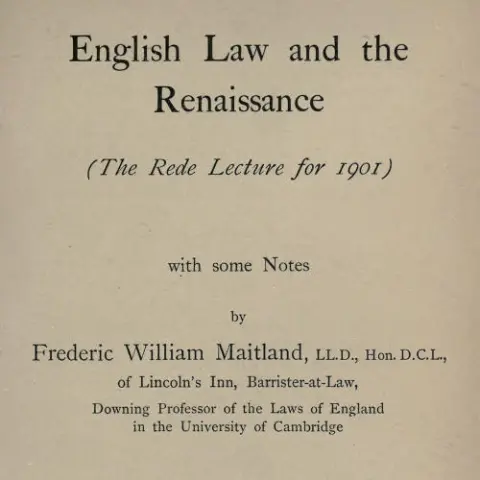
English Law and the Renaissance The Rede Lecture for 1901
Frederic William Maitland
THE CLASSIC COLLECTION · 1897
"Domesday Book and Beyond: Three Essays in the Early History of England" by Frederic William Maitland is a historical account written in the late 19th century. The work explores key themes and documents related to early English law and society, particularly focusing on the significance and implications of the Domesday Book—a comprehensive survey commissioned by William the Conqueror in 1085. The opening of the book presents a detailed introduction to the Domesday Book, describing its creation and its purpose as a tax record rather than a comprehensive legal document. Maitland discusses the methods used by royal commissioners to gather data regarding landholdings and the various classes of people that inhabited England during this period. He highlights the complexities of understanding the legal relationships and historical context of the land and its occupants, setting the stage for a deeper examination of feudalism and its societal ramifications in England.
Introduction adapted from the source catalogue; source summaries may be automatically generated.
Free to read · English · 233,138 words · No account needed
MAKE TIME FOR A GOOD BOOK
On by default. Untick to stop anonymous reading totals. Each page counts after 10 seconds in view. How this works.
Anonymous counting is on unless you have switched it off.
[1700] If the 'Wiht gara 600' of The Tribal Hidage refers to Wight, we have here a discord, for Bede gives the Island 1200. The North and South Mercians have together but 1200 according to Bede; the Mercians have 30,000 according to The Tribal Hidage: but the territory of 'the Mercians' is a variable.
[1701] B. i. 4 b, 12; Elton, Tenures of Kent, 135.
[1702] See above, p. 359.
[1703] Round, Feudal England, 289.
[1704] Stubbs, Const. Hist. ii. 422--3; Rot. Parl. ii. 302.
[1705] Bright, Hist. Engl. ii. 386; Hall's Chronicle, ed. 1809, p.
656.
[1706] Some of them seem to start from The Tribal Hidage and take the number of hides to be 303,201 (Liebermann, Leges Anglorum, 10). Divide this by 5 to find the knight's fees. You have 60,640. In MS. Camb. Univ. Ii. vi. 25, f. 108 we find 60,215 knight's fees, 45,011 parish churches, 52,080 vills. Another note, printed by Hearne, Rob. of Avesbury, 264, gives 53,215 knight's fees, 46,822 parish churches, 52,285 vills.
[1707] Bede, Hist. Eccl. iii. 24 (p. 178): 'donatis insuper xii. possessiunculis terrarum, in quibus ablato studio militiae terrestris, ad exercendam militiam caelestem, supplicandumque pro pace gentis eius aeterna, devotioni sedulae monachorum locus facultasque suppeteret ... Singulae vero possessiones x. erant familiarum, id est simul omnes cxx.' In these villages there have been men who owed military service; they are not being ousted from their homes; they are being turned over as tenants to the church; henceforth they will no longer be bound to fight, and in consideration of this precious immunity, they will have to supply the monks with provender. That is how I read this passage. Others can and will read it to mean something very different. But if Bede were speaking of decuriae of slaves, how could there be talk of military service? The slaves would not fight, and if the slaves belonged to eorls who fought, then how comes it that Oswy can expropriate his nobles?
[1708] Hist. Eccl. iii. 4 (p. 133).
[1709] Keith Johnston, Gazetteer.
[1709] I do not suggest, nor does Bede suggest, that Hii was laid out in hides. He is speaking only of size.
[1711] Bede gives to Anglesey the size of 960 families, to Man that of 300 'or more.' Anglesey has 175,836 acres; Man 145,011. Anglesey in 1895 had 'under all kinds of crops, bare fallow and grass (mountain and heath land excluded)' 152,004 acres. Man 96,098. Anglesey had 24,798 acres growing corn crops and 9,305 growing green crops, while the corresponding figures for Man were 22,666 and 11,580. Rationalistic explanation of Bede's statements would be useless. He is reporting vague guesses.
Your reading position is saved on this browser. Take it to another device with a library code. Reading pages adapt to text, rather than matching a printed edition.
Frederic William Maitland
BEHIND THE BOOK
This eBook is for the use of anyone anywhere in the United States and most other parts of the world at no cost and with almost no restrictions whatsoever. You may copy it, give it away or re-use it under the terms of the Project Gutenberg License included with this eBook or online at www.gutenberg.org. If you are not located in the United States, you will have to check the laws of the country where you are located before using this eBook. Read the source licence.
The original source file, including credits and licence, is retained by this library. Request an original-format copy at no charge. Please include the book title and Project Gutenberg identifier #43255.
KEEP YOUR CURIOSITY GOING
Cécile Tormay

Moritz Busch
John L. Ransom
Frances Wright
Cécile Tormay

Mabel Potter Daggett