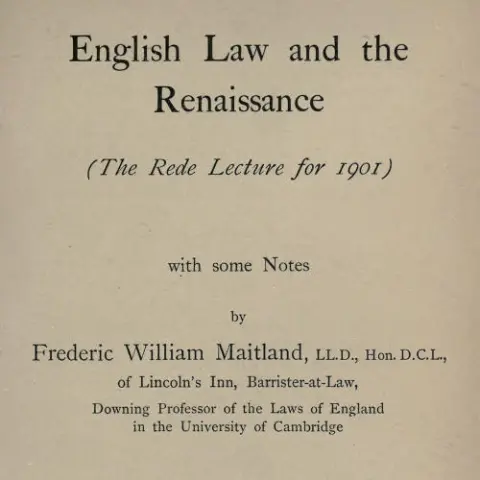
English Law and the Renaissance The Rede Lecture for 1901
Frederic William Maitland
THE CLASSIC COLLECTION · 1897
"Domesday Book and Beyond: Three Essays in the Early History of England" by Frederic William Maitland is a historical account written in the late 19th century. The work explores key themes and documents related to early English law and society, particularly focusing on the significance and implications of the Domesday Book—a comprehensive survey commissioned by William the Conqueror in 1085. The opening of the book presents a detailed introduction to the Domesday Book, describing its creation and its purpose as a tax record rather than a comprehensive legal document. Maitland discusses the methods used by royal commissioners to gather data regarding landholdings and the various classes of people that inhabited England during this period. He highlights the complexities of understanding the legal relationships and historical context of the land and its occupants, setting the stage for a deeper examination of feudalism and its societal ramifications in England.
Introduction adapted from the source catalogue; source summaries may be automatically generated.
Free to read · English · 233,138 words · No account needed
MAKE TIME FOR A GOOD BOOK
On by default. Untick to stop anonymous reading totals. Each page counts after 10 seconds in view. How this works.
Anonymous counting is on unless you have switched it off.
[753] Schmid, App. V. This might mean a seat (of justice) in the gate of his own burh. But this document will hardly be older than, if so old as, cent. x., by which time we should suppose that burh more often pointed to a borough than to a strong house. We may guess that in the latter sense it was supplanted by the hall of which we read a great deal in Domesday. See above, p. 109. However, it does not seem certain that O. E. geat can mean street.
[754] A.-S. Chron. ann. 994.
[755] Thorpe, Diplomatarium, 610. When the Confessor sends a writ to London he addresses it to the bishop, portreeve and burh-thegns. See K. iv. pp. 856, 857, 861, 872.
[756] Gross, Gild Merchant, i. 183, 189.
[757] Gross, op. cit. ii. 37.
[758] Hist. Eng. Law, i. 257.
[759] A.-S. Chron. ann. 1097: 'Eac manege sciran þe mid weorce to Lundenne belumpon ...' Thorpe thought good to substitute scipan for sciran.
[760] D. B. i. 298. Outside York were some lands which gelded with the city; 'et in tribus operibus Regis cum civibus erant.' This refers to the trinoda necessitas.
[761] Sohm, Die Entstehung des deutschen Städtewesens: Leipzig,
1890.
[762] Ellis, Introduction, i. 248-253.
[763] D. B. i. 56 b.
[764] D. B. i. 1. Black Book of the Admiralty, ii. 158: 'the herring season, that is from St. Michael's Day to St. Clement's (Nov. 23).' St. Andrew's Day is Dec. 1.
[765] Edward, I. 1; Æthelstan, II. 12, 13; IV. 2; VI. 10; Edmund, III. 5; Edgar, IV. 7-11; Leg. Will. I. 45; Leg. Will. III. 10. See Schmid, Glossar. s.v. Marktrecht.
[766] Edgar, IV. 3-6. We should expect rather 36 than 33, and xxxvi might easily become xxxiii.
[767] K. 280 (ii. 63), 316 (ii. 118).
[768] Kemble, Cod. Dip. 1075 (v. 142); Kemble, Saxons, ii. 328; Thorpe, 136: 'ge landfeoh, ge fihtwite, ge stale, ge wohceapung, ge burhwealles sceatinge.' In D. B. i. 173 it is said that the Bishop of Worcester had received the third penny of the borough. Apparently in the Confessor's day he received £6, the third of a sum of £18. As to the early history of markets, see the paper contributed by Mr C. I. Elton to the Report of the Royal Commission on Market Rights, 1889.
[769] Æthelstan, II. 14.
[770] The general equivalence of port and burh we may perhaps infer from Æthelstan, II. 14: No one is to coin money outside a port, and there is to be a moneyer in every burh.
[771] Stockport, Langport, Amport, Newport-Pagnell, Milborne Port, Littleport are instances. But a very small river might be sufficient to make a place a haven.
Your reading position is saved on this browser. Take it to another device with a library code. Reading pages adapt to text, rather than matching a printed edition.
Frederic William Maitland
BEHIND THE BOOK
This eBook is for the use of anyone anywhere in the United States and most other parts of the world at no cost and with almost no restrictions whatsoever. You may copy it, give it away or re-use it under the terms of the Project Gutenberg License included with this eBook or online at www.gutenberg.org. If you are not located in the United States, you will have to check the laws of the country where you are located before using this eBook. Read the source licence.
The original source file, including credits and licence, is retained by this library. Request an original-format copy at no charge. Please include the book title and Project Gutenberg identifier #43255.
KEEP YOUR CURIOSITY GOING
Cécile Tormay

Moritz Busch
John L. Ransom
Frances Wright
Cécile Tormay

Mabel Potter Daggett