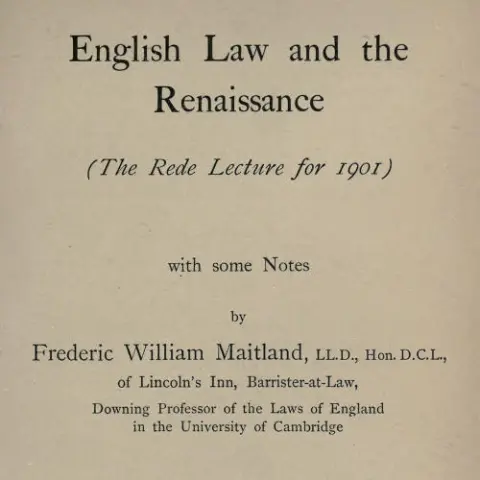
English Law and the Renaissance The Rede Lecture for 1901
Frederic William Maitland
THE CLASSIC COLLECTION · 1897
"Domesday Book and Beyond: Three Essays in the Early History of England" by Frederic William Maitland is a historical account written in the late 19th century. The work explores key themes and documents related to early English law and society, particularly focusing on the significance and implications of the Domesday Book—a comprehensive survey commissioned by William the Conqueror in 1085. The opening of the book presents a detailed introduction to the Domesday Book, describing its creation and its purpose as a tax record rather than a comprehensive legal document. Maitland discusses the methods used by royal commissioners to gather data regarding landholdings and the various classes of people that inhabited England during this period. He highlights the complexities of understanding the legal relationships and historical context of the land and its occupants, setting the stage for a deeper examination of feudalism and its societal ramifications in England.
Introduction adapted from the source catalogue; source summaries may be automatically generated.
Free to read · English · 233,138 words · No account needed
MAKE TIME FOR A GOOD BOOK
On by default. Untick to stop anonymous reading totals. Each page counts after 10 seconds in view. How this works.
Anonymous counting is on unless you have switched it off.
[735] See also Schmid, App. IV. (Be griðe and be munde), § 15: 'If any man fights or steals in the king's burh or the neighbourhood (the 'verge'), he forfeits his life, if the king will not concede that he be redeemed by a wergild.'
[736] Æthelstan, II. 20.
[737] K. 1334 (vi. p. 195): a contract made at Exeter before Earl Godwin and all the shire.
[738] Edgar, III. 5; Cnut, II. 18.
[739] Mention is made of the walls of Rochester and Canterbury in various charters from the middle of cent. viii onwards: K. vol. i. pp. 138, 183, 274; vol. ii. pp. 1, 26, 36, 57, 86; vol. v. p. 68.
[740] Green, Conquest of England, 189-207.
[741] For instance, K. iii. pp. 5, 50.
[742] K. 1154 (v. 302): 'adiacent etiam agri quamplurimi circa castellum quod Welingaford vocitatur.'--K. 152 (i. 183): 'castelli quod nominatur Hrofescester.'--K. 276 (ii. 57): 'castelli Hrobi.'
[743] A beautiful example is given by Staffordshire and Warwickshire. Each has its borough in its centre, while Tamworth on the border is partly in the one shire, partly in the other. See Pipe Roll, 31 Hen. I. 75, 76, 107, 108. As to these Mercian shires, see Stubbs, Const. Hist., i. 123; Green, Conquest of England, 237: 'Hertfordshire, Buckinghamshire and Bedfordshire are other instances of purely military creation, districts assigned to the fortresses which Eadward raised at these points.'
[744] See our index under Burghal Hidage. Mr W. H. Stevenson's valuable aid in the identification of these burgs is gratefully acknowledged.
[745] D. B. i. 154.
[746] D. B. i. 262 b.
[747] It will be understood that we are not contending for an exact correspondence between civil and military geography. Oxford and Wallingford are border towns. Berkshire men help to maintain Oxford, and Oxfordshire men help to maintain Wallingford.
[748] Widukind, I. 35. For comments see Waitz, Heinrich V. 95; Richter, Annalen, iii. 8; Giesebrecht, Kaiserzeit (ed. 5), i. 222, 811; Keutgen, Ursprung der deutschen Stadtverfassung, p. 44. Giesebrecht holds that Edward's measures may well have been Henry's model.
[749] A.-S. Chron. ann. 894.
[750] A charter of 899 (K. v. p. 141) professes to tell how King Alfred, Abp Plegmund and Æthelred ealdorman of the Mercians held a moot 'de instauratione urbis Londoniae.' One result of this moot was that two plots of land inside the walls, with hythes outside the walls, were given by the king, the one to the church of Canterbury, the other to the church of Worcester. How will the instauratio of London be secured by such grants?
[751] K. 1144 (v. 280). Other cases: K. 663 (Chichester), 673 (Winchester), 705 (Warwick), 724 (Warwick), 746 (Oxford), 1235 (Winchester).
Your reading position is saved on this browser. Take it to another device with a library code. Reading pages adapt to text, rather than matching a printed edition.
Frederic William Maitland
BEHIND THE BOOK
This eBook is for the use of anyone anywhere in the United States and most other parts of the world at no cost and with almost no restrictions whatsoever. You may copy it, give it away or re-use it under the terms of the Project Gutenberg License included with this eBook or online at www.gutenberg.org. If you are not located in the United States, you will have to check the laws of the country where you are located before using this eBook. Read the source licence.
The original source file, including credits and licence, is retained by this library. Request an original-format copy at no charge. Please include the book title and Project Gutenberg identifier #43255.
KEEP YOUR CURIOSITY GOING
Cécile Tormay

Moritz Busch
John L. Ransom
Frances Wright
Cécile Tormay

Mabel Potter Daggett