
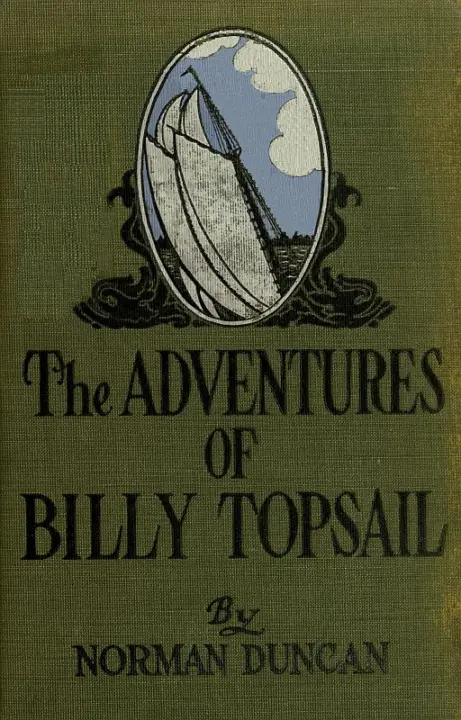
Billy Topsail, M.D.: A Tale of Adventure With Doctor Luke of the Labrador
Norman Duncan
THE CLASSIC COLLECTION · 1904
"Doctor Luke of the Labrador" by Norman Duncan is a novel written in the early 20th century. The story is set against the backdrop of the rugged and barren landscape of Labrador, focusing on the themes of love, resilience, and the bond between a mother and child. The opening chapters introduce the main character, Davy, a young boy, and his close relationship with his mother and father, highlighting the unique challenges of life in this remote and harsh environment. At the start of the novel, the narrative paints a vivid picture of Davy's home and the surrounding harbour, setting the stage for a life defined by the merciless sea and the beauty of familial love. Davy spends time exploring the landscape, enjoying adventures with his mother, and listening to the tales of local fishermen. As the story unfolds, a sense of unease emerges regarding his mother’s health, leading to a tense decision to call for a doctor amidst growing worries about her wellbeing. The dynamics between Davy, his loving but troubled mother, and the colorful characters of the community, including the eccentric Skipper Tommy, establish a poignant tone that draws readers into the challenges of love and the natural world in this isolated part of the world.
Introduction adapted from the source catalogue; source summaries may be automatically generated.
Free to read · English · 67,487 words · No account needed
MAKE TIME FOR A GOOD BOOK
On by default. Untick to stop anonymous reading totals. Each page counts after 10 seconds in view. How this works.
Anonymous counting is on unless you have switched it off.
"A pretty child," the doctor repeated, very distinctly.
"They don't say that t' Bowsprit Head, zur."
"Well--I say it!"
"I'll tell un so!" she exclaimed, joyfully. "I'll tell un you said so, zur, when I gets back t' Bowsprit Head. For nobody--nobody, zur--ever said that afore--about my baby!"
The child stirred and complained. She lifted him from her lap--rocked him--hushed him--drew him close, rocking him all the time.
"Have you another?"
"No, zur; 'tis me first."
"And does he talk?" the doctor asked.
She looked up--in a glow of pride. And she flushed gloriously while she turned her eyes once more upon the gasping, ill-featured babe upon her breast.
"He said 'mama'--once!" she answered.
In the fog--far, far away, in the distances beyond Skull Island, which were hidden--the doctor found at that moment some strange interest.
"Once?" he asked, his face still turned away.
"Ay, zur," she solemnly declared. "I calls my God t' witness! I'm not makin' believe, zur," she went on, with rising excitement. "They says t' Bowsprit Head that I dreamed it, zur, but I knows I didn't. 'Twas at the dawn. He lay here, zur--here, zur--on me breast. I was wide awake, zur--waitin' for the day. Oh, he said it, zur," she cried, crushing the child to her bosom. "I heared un say it! 'Mama!' says he."
"When I have cured him," said the doctor, gently, "he will say more than
that."
"What say?" she gasped.
"When I have taken--something--out of his throat--with my knife--he will be able to say much more than that. When he has grown a little older, he will say, 'Mama, I loves you!'"
The woman began to cry.
There is virtue for the city-bred, I fancy, in the clean salt air and simple living of our coast--and, surely, for every one, everywhere, a tonic in the performance of good deeds. Hard practice in fair and foul weather worked a vast change in the doctor. Toil and fresh air are eminent physicians. The wonder of salty wind and the hand-to-hand conflict with a northern sea! They gave him health, a clear-eyed, brown, deep-breathed sort of health, and restored a strength, broad-shouldered and lithe and playful, that was his natural heritage. With this new power came joyous courage, indomitability of purpose, a restless activity of body and mind. He no longer carried the suggestion of a wrecked ship; however afflicted his soul may still have been, he was now, in manly qualities, the man the good God designed--strong and bonnie and tender-hearted: betraying no weakness in the duties of the day. His plans shot far beyond our narrow prospect, shaming our blindness and timidity, when he disclosed them; and his interests--searching, insatiable, reflective--comprehended all that touched our work and way of life: so that, as Tom Tot was moved to exclaim, by way of an explosion of amazement, 'twas not long before he had mastered the fish business, gill, fin and liver. And he went about with hearty words on the tip of his tongue and a laugh in his gray eyes--merry the day long, whatever the fortune of it. The children ran out of the cottages to greet him as he passed by, and a multitude of surly, ill-conditioned dogs, which yielded the road to no one else, accepted him as a distinguished intimate. But still, and often--late in the night--my sister and I lay awake listening to the disquieting fall of his feet as he paced his bedroom floor. And sometimes I crept to his door--and hearkened--and came away, sad that I had gone.
Your reading position is saved on this browser. Take it to another device with a library code. Reading pages adapt to text, rather than matching a printed edition.
Norman Duncan
Norman Duncan
Norman Duncan
Norman Duncan
BEHIND THE BOOK
This eBook is for the use of anyone anywhere in the United States and most other parts of the world at no cost and with almost no restrictions whatsoever. You may copy it, give it away or re-use it under the terms of the Project Gutenberg License included with this eBook or online at www.gutenberg.org. If you are not located in the United States, you will have to check the laws of the country where you are located before using this eBook. Read the source licence.
The original source file, including credits and licence, is retained by this library. Request an original-format copy at no charge. Please include the book title and Project Gutenberg identifier #19981.
KEEP YOUR CURIOSITY GOING
Coulson Kernahan

Maurice Baring
Frances Wright
Cécile Tormay

Frederic Jesup Stimson

W. H. P. (William Henry Pope) Jarvis