
Billy Topsail, M.D.: A Tale of Adventure With Doctor Luke of the Labrador
Norman Duncan
THE CLASSIC COLLECTION · 1904
"Doctor Luke of the Labrador" by Norman Duncan is a novel written in the early 20th century. The story is set against the backdrop of the rugged and barren landscape of Labrador, focusing on the themes of love, resilience, and the bond between a mother and child. The opening chapters introduce the main character, Davy, a young boy, and his close relationship with his mother and father, highlighting the unique challenges of life in this remote and harsh environment. At the start of the novel, the narrative paints a vivid picture of Davy's home and the surrounding harbour, setting the stage for a life defined by the merciless sea and the beauty of familial love. Davy spends time exploring the landscape, enjoying adventures with his mother, and listening to the tales of local fishermen. As the story unfolds, a sense of unease emerges regarding his mother’s health, leading to a tense decision to call for a doctor amidst growing worries about her wellbeing. The dynamics between Davy, his loving but troubled mother, and the colorful characters of the community, including the eccentric Skipper Tommy, establish a poignant tone that draws readers into the challenges of love and the natural world in this isolated part of the world.
Introduction adapted from the source catalogue; source summaries may be automatically generated.
Free to read · English · 67,487 words · No account needed
MAKE TIME FOR A GOOD BOOK
On by default. Untick to stop anonymous reading totals. Each page counts after 10 seconds in view. How this works.
Anonymous counting is on unless you have switched it off.
"Bessie Roth," said I, severely, "what's come upon you?"
"I'm not knowin', Davy," she answered, softly, looking away.
"'Tis somewhat awful, then," said I, in alarm, "for you're not lookin'
me in the eye."
She looked then in her lap--and did not raise her eyes, though I waited:
which was very strange.
"You isn't sick, is you?"
"No-o," she answered, doubtfully.
"Oh, you mustn't get sick," I protested. "'Twould never do. I'd fair die--if you got sick!"
"'Tisn't sickness; 'tis--I'm not knowin' what."
"Ah, come," I pleaded; "what is it, dear?"
"Davy, lad," she faltered, "I'm just--dreadful--happy."
"Happy?" cried I, scornfully. "'Tis not happiness! Why, sure, your lip
is curlin' with grief!"
"But I was happy."
"You isn't happy now, my girl."
"No," she sobbed, "I'm wonderful miserable--now."
I kicked off the covers. "You've the fever, that's what!" I exclaimed,
jumping out of bed.
"'Tis not that, Davy."
"Then--oh, for pity's sake, Bessie, tell your brother what's gone wrong
along o' you!"
"I'm thinkin', Davy," she whispered, despairingly, "that I'm nothin' but
a sinful woman."
"A--what! Why, Bessie----"
"Nothin'," she repeated, positively, "but a sinful, wicked person."
"Who told you that?" said I, dancing about in a rage.
"My own heart."
"Your heart!" cried I, blind angry. "'Tis a liar an it says so."
"What words!" she exclaimed, changed in a twinkling. "An' to your sister! Do you get back in bed this instant, David Roth, an' tell her that you're sorry."
I was loath to do it, but did, to pacify her; and when she had carried away the candle I chuckled, for I had cured her of her indisposition for that night, at any rate: as I knew, for when she kissed me 'twas plain that she was more concerned for her wayward brother than for herself.
Past midnight I was awakened by the clang of the bell on my father's wharf. 'Twas an unpleasant sound. Half a gale--no less--could do it. I then knew that the wind had freshened and veered to the southeast; and I listened to determine how wild the night. Wild enough! The bell clanged frequently, sharply, jangling in the gusts--like an anxious warning. My window was black; there was no light in the sky--no star shining. Rain pattered on the roof. I heard the rush of wind. 'Twas inevitable that I should contrast the quiet of the room, the security of my place, the comfort of my couch and blankets, with a rain-swept, heaving deck and a tumultuous sea. A gusty night, I thought--thick, wet, with the wind rising. The sea would be in a turmoil on the grounds by dawn: there would be no fishing; and I was regretting this--between sleep and waking--when the bell again clanged dolefully. Roused, in a measure, I got ear of men stumbling up the path. I was into my breeches before they had trampled half the length of the platform--well on my way down the dark stair when they knocked on the door--standing scared in the light of their lantern, the door open, before they found time to hail.
Your reading position is saved on this browser. Take it to another device with a library code. Reading pages adapt to text, rather than matching a printed edition.
Norman Duncan
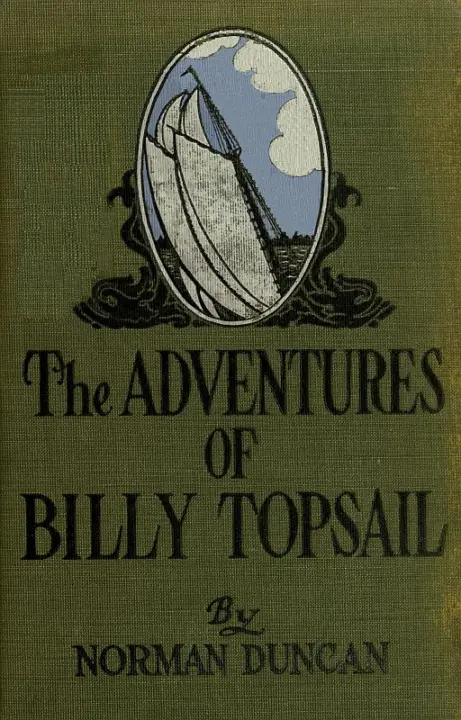
Norman Duncan
Norman Duncan
Norman Duncan
BEHIND THE BOOK
This eBook is for the use of anyone anywhere in the United States and most other parts of the world at no cost and with almost no restrictions whatsoever. You may copy it, give it away or re-use it under the terms of the Project Gutenberg License included with this eBook or online at www.gutenberg.org. If you are not located in the United States, you will have to check the laws of the country where you are located before using this eBook. Read the source licence.
The original source file, including credits and licence, is retained by this library. Request an original-format copy at no charge. Please include the book title and Project Gutenberg identifier #19981.
KEEP YOUR CURIOSITY GOING
Coulson Kernahan

Maurice Baring
Frances Wright
Cécile Tormay

Frederic Jesup Stimson

W. H. P. (William Henry Pope) Jarvis