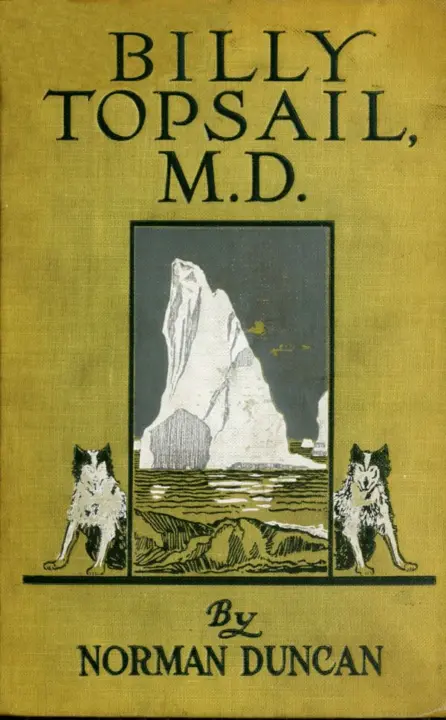
Billy Topsail, M.D.: A Tale of Adventure With Doctor Luke of the Labrador
Norman Duncan
THE CLASSIC COLLECTION · 1904
"Doctor Luke of the Labrador" by Norman Duncan is a novel written in the early 20th century. The story is set against the backdrop of the rugged and barren landscape of Labrador, focusing on the themes of love, resilience, and the bond between a mother and child. The opening chapters introduce the main character, Davy, a young boy, and his close relationship with his mother and father, highlighting the unique challenges of life in this remote and harsh environment. At the start of the novel, the narrative paints a vivid picture of Davy's home and the surrounding harbour, setting the stage for a life defined by the merciless sea and the beauty of familial love. Davy spends time exploring the landscape, enjoying adventures with his mother, and listening to the tales of local fishermen. As the story unfolds, a sense of unease emerges regarding his mother’s health, leading to a tense decision to call for a doctor amidst growing worries about her wellbeing. The dynamics between Davy, his loving but troubled mother, and the colorful characters of the community, including the eccentric Skipper Tommy, establish a poignant tone that draws readers into the challenges of love and the natural world in this isolated part of the world.
Introduction adapted from the source catalogue; source summaries may be automatically generated.
Free to read · English · 67,487 words · No account needed
MAKE TIME FOR A GOOD BOOK
On by default. Untick to stop anonymous reading totals. Each page counts after 10 seconds in view. How this works.
Anonymous counting is on unless you have switched it off.
The doctor whom I had found with my father in my mother's room was not among the folk who babbled on the roads and came prying into the stages with tiresome exclamations of "Really!" and "How in-tres-ting!" He kept aloof from them and from us all. All day long he wandered on the heads and hills of our harbour--a melancholy figure, conspicuous against the blue sky of those days: far off, solitary, bowed. Sometimes he sat for hours on the Watchman, staring out to sea, so still that it would have been small blame to the gulls had they mistaken him for a new boulder, mysteriously come to the hill; sometimes he lay sprawling on the high point of Skull Island, staring at the sky, lost to knowledge of the world around; sometimes he clambered down the cliffs of Good Promise to the water's edge, and stood staring, forever staring, at the breakers (which no man should do). Often I was not content with watching him from afar, but softly followed close, and peered at him from the shelter of a boulder or peeped over the shoulder of a hill; and so sad did he seem--so full of sighs and melancholy attitudes--that invariably I went home pitying: for at that time my heart was tender, and the sight of sorrow hurt it.
Once I crept closer and closer, and, at last, taking courage (though his clean-shaven face and soft gray hat abashed me), ran to him and slipped my hand in his.
He started; then, perceiving who it was, he withdrew his hand with a wrench, and turned away: which hurt me.
"You are the son," said he, "of the woman who died, are you not?"
I was more abashed than ever--and wished I had not been so bold.
"I'm Davy Roth, zur," I whispered, for I was much afraid. "My mother's
dead an' buried, zur."
"I saw you," said he, "in the room--that night."
There was a long pause. Then, "What's your name, zur?" I asked him.
"Mine?"
"Ay."
"Mine," said he, "is Luke--"
He stopped--and thoughtfully frowned. I waited; but he said no more.
"Doctor Luke?" I ventured.
"Well," he drawled, "that will serve."
Then I thought I must tell him what was in my heart to say. Why not? The wish was good, and his soft, melancholy voice irresistibly appealed to my raw and childish sympathies.
"I wisht, zur," I whispered, looking down at my boots, through sheer embarrassment, "that you----"
My tongue failed me. I was left in a sad lurch. He was not like our folk--not like our folk, at all--and I could not freely speak my mind.
"Yes?" he said, to encourage me.
Your reading position is saved on this browser. Take it to another device with a library code. Reading pages adapt to text, rather than matching a printed edition.
Norman Duncan
Norman Duncan
Norman Duncan
Norman Duncan
BEHIND THE BOOK
This eBook is for the use of anyone anywhere in the United States and most other parts of the world at no cost and with almost no restrictions whatsoever. You may copy it, give it away or re-use it under the terms of the Project Gutenberg License included with this eBook or online at www.gutenberg.org. If you are not located in the United States, you will have to check the laws of the country where you are located before using this eBook. Read the source licence.
The original source file, including credits and licence, is retained by this library. Request an original-format copy at no charge. Please include the book title and Project Gutenberg identifier #19981.
KEEP YOUR CURIOSITY GOING
Coulson Kernahan

Maurice Baring
Frances Wright
Cécile Tormay

Frederic Jesup Stimson

W. H. P. (William Henry Pope) Jarvis