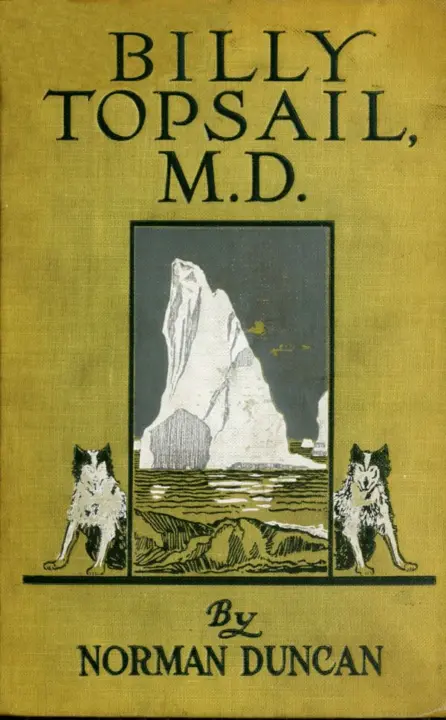
Billy Topsail, M.D.: A Tale of Adventure With Doctor Luke of the Labrador
Norman Duncan
THE CLASSIC COLLECTION · 1904
"Doctor Luke of the Labrador" by Norman Duncan is a novel written in the early 20th century. The story is set against the backdrop of the rugged and barren landscape of Labrador, focusing on the themes of love, resilience, and the bond between a mother and child. The opening chapters introduce the main character, Davy, a young boy, and his close relationship with his mother and father, highlighting the unique challenges of life in this remote and harsh environment. At the start of the novel, the narrative paints a vivid picture of Davy's home and the surrounding harbour, setting the stage for a life defined by the merciless sea and the beauty of familial love. Davy spends time exploring the landscape, enjoying adventures with his mother, and listening to the tales of local fishermen. As the story unfolds, a sense of unease emerges regarding his mother’s health, leading to a tense decision to call for a doctor amidst growing worries about her wellbeing. The dynamics between Davy, his loving but troubled mother, and the colorful characters of the community, including the eccentric Skipper Tommy, establish a poignant tone that draws readers into the challenges of love and the natural world in this isolated part of the world.
Introduction adapted from the source catalogue; source summaries may be automatically generated.
Free to read · English · 67,487 words · No account needed
MAKE TIME FOR A GOOD BOOK
On by default. Untick to stop anonymous reading totals. Each page counts after 10 seconds in view. How this works.
Anonymous counting is on unless you have switched it off.
"'Twas rum," she resumed, "that sent the crew o' the Right an' Tight t' hell. An' 'twas a merry time they had at the gate. Ay, a merry time, with Jagger fillin' the cups an' chalkin' it down agin the fish! But they went t' hell. They went t' hell! She was lost with all hands in the gale o' that week--lost on the Devil's Fingers--an' all hands drunk! An' Jack Ruddy o' Helpful Harbour," she muttered, "went down along o' she. He was a bonnie lad," she added, tenderly, "an' he kissed me by stealth in the kitchen." Very sorrowfully she dreamed of that boisterous kiss. "But," she concluded, "'twas love that put Eliza Hare in th' etarnal fires."
"Not love!" I complained.
"Davy," she said, not deigning to answer me, "Davy," she repeated, her voice again rising splendidly triumphant, "I isn't goin' t' hell! For I've looked in an' got away. The Lard'll never send me, now. Never!"
"I'm glad, Mary."
"I'm not a goat," she boasted. "'Twas all a mistake. I'm a sheep. That's
what I is!"
"I'm wonderful glad."
"But you, Davy," she warned, putting an arm about my waist, in sincere affection, "you better look out."
"I isn't afeared."
"You better look out!"
"Oh, Mary," I faltered, "I--I--isn't much afeared."
"You better look out!"
"Leave us go home!" I begged.
"The Lard'll ship you there an you don't look out. He've no mercy on
little lads."
"Oh, leave us go home!"
"He'll be cotchin' you!"
I could bear it no longer: nor wished to know any more about hell. I took her hand, and dragged her from the black shadow of the rock: crying out that we must now go home. Then we went back to Tom Tot's cheerful kitchen; and there I no longer feared hell, but could not forget, try as I would, what Mary Tot had told me about love.
Skipper Tommy Lovejoy was preaching what the doctor called in his genial way "The Gospel According to Tommy."
"Sure, now, Tom Tot," said he, "the Lard is a Skipper o' wonderful civil disposition. 'Skipper Tommy,' says He t' me, 'an you only does the best----'"
"You're too free with the name o' the Lard."
Skipper Tommy looked up in unfeigned surprise. "Oh, no, Tom," said he, mildly, "I isn't. The Lard an' me is----"
"You're too free," Tom Tot persisted. "Leave Un be or you'll rue it."
"Oh, no, Tom," said the skipper. "The Lard an' me gets along wonderful well together. We're wonderful good friends. I isn't scared o' He!"
Your reading position is saved on this browser. Take it to another device with a library code. Reading pages adapt to text, rather than matching a printed edition.
Norman Duncan
Norman Duncan
Norman Duncan
Norman Duncan
BEHIND THE BOOK
This eBook is for the use of anyone anywhere in the United States and most other parts of the world at no cost and with almost no restrictions whatsoever. You may copy it, give it away or re-use it under the terms of the Project Gutenberg License included with this eBook or online at www.gutenberg.org. If you are not located in the United States, you will have to check the laws of the country where you are located before using this eBook. Read the source licence.
The original source file, including credits and licence, is retained by this library. Request an original-format copy at no charge. Please include the book title and Project Gutenberg identifier #19981.
KEEP YOUR CURIOSITY GOING
Coulson Kernahan

Maurice Baring
Frances Wright
Cécile Tormay

Frederic Jesup Stimson

W. H. P. (William Henry Pope) Jarvis