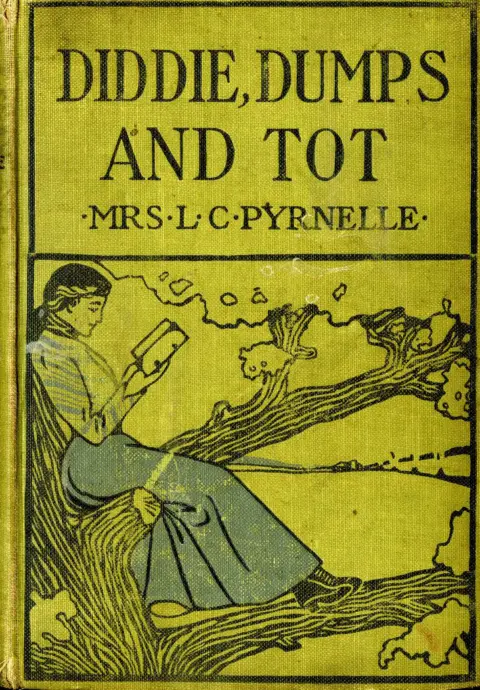
Diddie, Dumps, and Tot; Or, Plantation Child-Life
Louise Clarke Pyrnelle
THE CLASSIC COLLECTION · 1882
"Diddie, Dumps & Tot; or, Plantation Child-Life" by Louise Clarke Pyrnelle is a fictional narrative that captures the childhood experiences of three little girls on a Southern plantation in the mid-19th century. The story unfolds through the adventures of Diddie, Dumps, and Tot, who interact affectionately with the enslaved individuals on their plantation, showcasing the complexities of their relationships in a historical context. The narrative aims to preserve the folk stories, games, and traditions of Southern slaves, reflecting a formative period that the author sought to immortalize. The opening of the book introduces Diddie, Dumps, and Tot, the daughters of Major Waldron, who live in a big house surrounded by both beautiful gardens and their enslaved caregivers, including the nurturing 'Mammy' and various other figures who help raise them. The description paints a vivid picture of plantation life and the closeness between the children and their caregivers. As the story progresses, we learn about their playful interactions, festive celebrations, and the lessons they receive from the adults around them. The text establishes a nostalgic tone as it explores the contrasts and connections between the lives of the white children and the enslaved individuals, illustrating a world soon to change.
Introduction adapted from the source catalogue; source summaries may be automatically generated.
Free to read · English · 43,376 words · No account needed
MAKE TIME FOR A GOOD BOOK
On by default. Untick to stop anonymous reading totals. Each page counts after 10 seconds in view. How this works.
Anonymous counting is on unless you have switched it off.
Now it so happened that Douglas, the head dining-room servant, was also in the kitchen eating his dinner, and, being exceedingly fond of Tot, he told her to wait a moment, and he would get her something from the house. So, getting the keys from Aunt Delia, the housekeeper, on pretence of putting away something, he buttered two or three slices of light bread, and spread them with jam, and, putting with them some thin chips of cold ham and several slices of cake, he carried them back to the kitchen as an addition to Diddie's dinner.
Tot was delighted, and walked very carefully with the plate until she joined the little group waiting under the window, when she called out, joyfully,
"Hyear 'tis, Diddie! 'tis des de bes'es kine er dinner!"
And now the trouble was how to get it up to Diddie.
"I tell yer," said Chris; "me 'n Dilsey'll fotch de step-ladder wat Uncle Douglas washes de winders wid."
No sooner said than done, and in a few moments the step-ladder was placed against the house, and Dilsey prepared to mount it with the plate in her hand.
But just at this juncture Diddie decided that she would make good her escape, and, to the great delight of the children, she climbed out of the window, and descended the ladder, and soon stood safe among them on the ground.
Then, taking the dinner with them, they ran as fast as they could to the grove, where they came to a halt on the ditch bank, and Diddie seated herself on a root of a tree to eat her dinner, while Dumps and Tot watched the little negroes wade up and down the ditch. The water was very clear, and not quite knee-deep, and the temptation was too great to withstand; so the little girls took off their shoes and stockings, and were soon wading too.
When Diddie had finished her dinner, she joined them; and such a merry time as they had, burying their little naked feet in the sand, and splashing the water against each other!
"I tell yer, Diddie," said Dumps, "I don't b'lieve nuthin' 'bout bad little girls gittin' hurt, an' not havin' no fun when they runs away, an' don't min' nobody. I b'lieve Mammy jes makes that up ter skyeer us."
"I don't know," replied Diddie; "you 'member the time 'bout Ole Billy?"
"Oh, I ain't er countin' him," said Dumps; "I ain't er countin' no sheeps; I'm jes er talkin' 'bout ditches an' things."
And just then the little girls heard some one singing,
"De jay bird died wid de hookin'-coff,
Oh, ladies, ain't yer sorry?"
Your reading position is saved on this browser. Take it to another device with a library code. Reading pages adapt to text, rather than matching a printed edition.
Louise Clarke Pyrnelle
BEHIND THE BOOK
This eBook is for the use of anyone anywhere in the United States and most other parts of the world at no cost and with almost no restrictions whatsoever. You may copy it, give it away or re-use it under the terms of the Project Gutenberg License included with this eBook or online at www.gutenberg.org. If you are not located in the United States, you will have to check the laws of the country where you are located before using this eBook. Read the source licence.
The original source file, including credits and licence, is retained by this library. Request an original-format copy at no charge. Please include the book title and Project Gutenberg identifier #17146.
KEEP YOUR CURIOSITY GOING
Cécile Tormay

Moritz Busch
Coulson Kernahan
John L. Ransom

Maurice Baring
Frances Wright