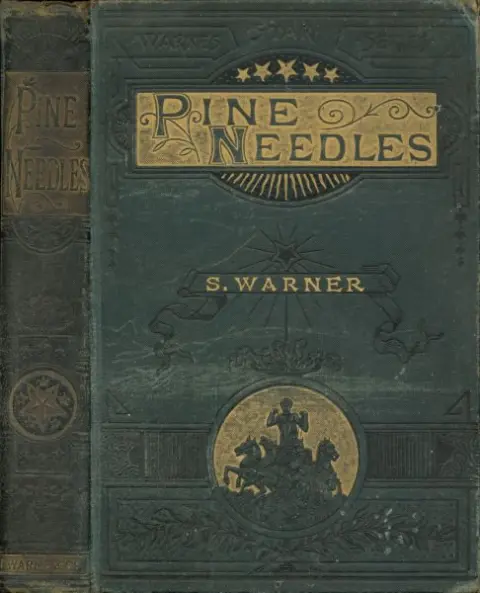
Pine Needles
Susan Warner & Louis Harms
THE CLASSIC COLLECTION · 1877
"Diana" by Susan Warner is a novel written in the late 19th century. The story unfolds in rural New England, centering around a young woman named Diana, who navigates the complexities of her life amid the idyllic yet demanding backdrop of farm life. As the narrative progresses, it hints at her aspirations and relationships within a community that comprises a tapestry of strong characters, including her mother and the newcomers in town. The opening of "Diana" introduces readers to a serene June afternoon, focusing first on Diana as she sits on her doorstep, embodying a blend of youth and duty. We learn about her daily life, characterized by her interactions with her mother who insists on traditional ways of managing their farming household. The tone is light and conversational, showing Diana's boredom with domestic chores, but also her dreams of something beyond her current existence—such as her musings about noble parks. We also see the dynamics of her relationship with her mother, underscored by humor and a hint of teenage rebellion. The chapter paints a vivid picture of life in Pleasant Valley while subtly establishing Diana's character as both contemplative and curious about the world beyond her farm.
Introduction adapted from the source catalogue; source summaries may be automatically generated.
Free to read · English · 132,537 words · No account needed
MAKE TIME FOR A GOOD BOOK
On by default. Untick to stop anonymous reading totals. Each page counts after 10 seconds in view. How this works.
Anonymous counting is on unless you have switched it off.
It was well dusk when Prince stopped under the elm tree. The sun had gone down behind the low distant hills, leaving a white glory in all that region of the heavens; and shadows were settling upon the valleys. All household wants and proprieties were disarranged; the thing to do was to bring up arrears as speedily as possible. To this Mrs. Starling and her daughter addressed themselves. The blackberries were put carefully away; the table set, supper cooked, for the men must have a warm supper; and after supper and clearing up there came a lull.
"If it warn't so late," said Mrs. Starling,--"but it is too
late,--I'd go at those berries."
"Mother! Not to-night."
"Well, no; it's 'most too late, as I said; and I am tired. I want to know if this is what folks call work or play? 'cause if it's play, I'd rather work, for my part. I believe I'd sooner stand at the wash-tub."
"Than pick blackberries, mother?"
"Well, yes," said Mrs. Starling; "'cause then I'd know when my work was done. If the sun hadn't gone down, we'd all be pickin' yet."
"I am sure, you could stop when you were tired, mother; couldn't you?"
"I never am tired, child, while I see my work before me; don't you know that? And it's a sin to let the ripe fruit go unpicked. I wonder what it grows in such a place for! Who were you with all day?"
"Different people."
"Did Will Flandin find you?"
"Yes."
"He was in a takin' to know where you were. So I just gave him a bit of
a notion."
"I don't see how you could know, mother; I had been going so roundabout among the bushes. I don't know where I was, myself."
"When ever you don't know that, Diana, stop and find out."
Mrs. Starling was sitting before the stove in a resting attitude, with her feet stretched out towards it. Diana was busy with some odds and ends, but her mother's tone--or was it her own consciousness?--made her suddenly stop and look towards her. Mrs. Starling did not see this, Diana being behind her.
"Did it ever strike you that Will was sweet on you?" she went on.
"Will Flandin, mother?"
An inarticulate note of assent.
Diana did not answer, and instead went on with what she had been doing.
"Hey?" said Mrs. Starling.
"I hope he'll get cured of it, mother, if he is."
"Why?"
"I don't know why," said Diana, half laughing, "except that he had better be sweet on some one else."
"He's a nice fellow."
"Yes, I think he is; as they go."
Your reading position is saved on this browser. Take it to another device with a library code. Reading pages adapt to text, rather than matching a printed edition.
Susan Warner & Louis Harms
Susan Warner
Susan Warner
Susan Warner
BEHIND THE BOOK
This eBook is for the use of anyone anywhere in the United States and most other parts of the world at no cost and with almost no restrictions whatsoever. You may copy it, give it away or re-use it under the terms of the Project Gutenberg License included with this eBook or online at www.gutenberg.org. If you are not located in the United States, you will have to check the laws of the country where you are located before using this eBook. Read the source licence.
The original source file, including credits and licence, is retained by this library. Request an original-format copy at no charge. Please include the book title and Project Gutenberg identifier #29824.
KEEP YOUR CURIOSITY GOING
Coulson Kernahan

Maurice Baring
Frances Wright
Cécile Tormay

Frederic Jesup Stimson

W. H. P. (William Henry Pope) Jarvis