
Last letters from the living dead man
David Patterson (Spirit) Hatch
THE CLASSIC COLLECTION · 1903
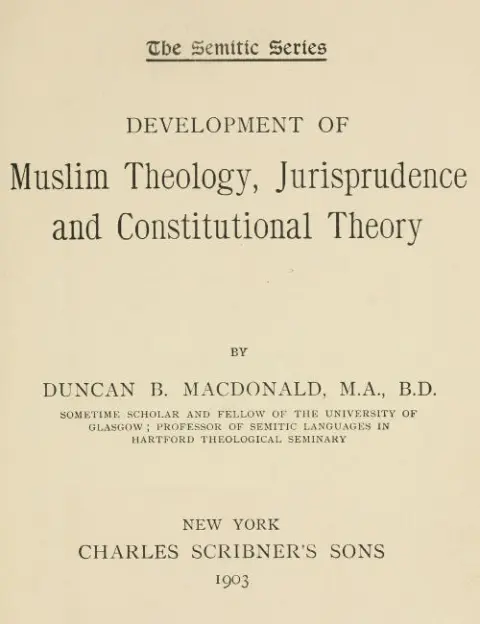
"Development of Muslim Theology, Jurisprudence, and Constitutional Theory" by Duncan B. Macdonald is a scholarly work written in the early 20th century. This comprehensive analysis aims to bridge the gap in understanding the evolution of Muslim institutions, particularly focusing on theology, legal systems, and governance throughout Islamic history. The book is intended for both academic audiences and lay readers interested in Semitic studies. The opening of the text sets a foundational context for the book, explaining the urgent need for a coherent resource on Muslim legal and theological development. Macdonald reflects on the complexities of Islamic institutions and the interconnectedness of theology, jurisprudence, and political theory over time. He introduces the concept that the evolution of these areas cannot be considered in isolation, as they are intricately linked within the framework of Muslim civilization. The preface also acknowledges various scholars whose work has influenced the author's own understanding and approach, emphasizing the reliance on primary Arabic sources to ensure accuracy and authenticity in his discourse.
Introduction adapted from the source catalogue; source summaries may be automatically generated.
Free to read · English · 111,511 words · No account needed
MAKE TIME FOR A GOOD BOOK
On by default. Untick to stop anonymous reading totals. Each page counts after 10 seconds in view. How this works.
Anonymous counting is on unless you have switched it off.
But most important of all was a liberty suggested by that system to the Muslim jurisconsults. This was through the part played in the older school by the Responsa Prudentium, answers by prominent lawyers to questions put to them by their clients, in which the older law of the Twelve Tables was expounded, expanded, and often practically set aside by their comments. Sir Henry Maine thus states the situation: “The authors of the new jurisprudence, during the whole progress of its formation, professed the most sedulous respect for the letter of the code. They were merely explaining it, deciphering it, bringing out its full meaning; but then, in the result, by placing texts together, by adjusting the law to states of fact which actually presented themselves, and by speculating on its possible application to others which might occur, by introducing principles of interpretation derived from the exegesis of other written documents which fell under their observation, they educed a vast variety of canons which had never been dreamt of by the compilers of the Twelve Tables, and which were in truth rarely or never to be found there.” All this precisely applies to the development of law in Islam.
[Sidenote: EQUITY; LEGAL FICTION]
The part of the Twelve Tables was taken by the statute law of the Qur’an and the case law derived from the Usage of Muhammad; that of the Roman Iurisprudentes by those speculative jurists who worked mostly outside of al-Madina in the camp cities of Mesopotamia and Syria—the very name for lawyer in Arabic, faqih, plural fuqaha, is a translation of prudens, prudentes; and that of the Responsa, the answers, by the “Opinion” which they claimed as a legitimate legal method and source. Further, the validity of a general agreement of jurisconsults “reminds us of the rescript of Hadrian, which ordains that, if the opinions of the licensed prudentes all agreed, such common opinion had the force of statute; but if they disagreed, the judge might follow which he chose.” The Arabic term, ra’y, here rendered Opinion, has passed through marked vicissitudes of usage. In old Arabic, before it, in the view of some, began to keep bad company, it meant an opinion that was thoughtful, weighed and reasonable, as opposed to a hasty dictate of ill-regulated passion. In that sense it is used in a tradition—probably forged—handed down from Muhammad. He was sending a judge to take charge of legal affairs in al-Yaman, and asked him on what he would base his legal decisions. “On the Qur’an,” he replied. “But if that contains nothing to the purpose?” “Then upon your usage.” “But if that also fails you?” “Then I will follow my own opinion.” And the Prophet approved his purpose. A similar tradition goes back to Umar, the first Khalifa, and it, too, is probably a later forgery, written to defend this source of law. But, with the revolt against the use of Opinion, to which we shall soon come, the term itself fell into grave disrepute and came to signify an unfounded conclusion. In its extremest development it went beyond the Responsa, which professed always to be in exact accord with the letter of the older law, and attained to be Equity in the strict sense; that is, the rejection of the letter of the law for a view supposed to be more in accordance with the spirit of justice itself. Thus, Equity, in the English sense, is the law administered by the Court of Chancery and claims, in the words again of Sir Henry Maine, to “override the older jurisprudence of the country on the strength of an intrinsic ethical superiority.” In Roman law, as introduced by the edict of the Prætor, it was the law of Nature, “the part of law ‘which natural reason appoints for all mankind.’” This is represented in Islam under two forms, covered by two technical terms. The one is that the legist, in spite of the fact that the analogy of the fixed code clearly points to one course, “considers it better” (istihsan) to follow a different one; and the other is that, under the same conditions, he chooses a free course “for the sake of general benefit to the community” (istislah). Further scope of Equity Muslim law never reached, and the legitimacy of these two developments was, as we shall see, bitterly contested. The freedom of opinion, with its possibility of a system of Equity, had eventually to be given up, and all that was left in its place was a permissibility of analogical deduction (qiyas), the nearest thing to which in Western law is Legal Fiction. In a word, the possibility of development by Equity was lost, and Legal Fiction entered in its place. But this anticipates, and we must return to the strictly historical movement.
Your reading position is saved on this browser. Take it to another device with a library code. Reading pages adapt to text, rather than matching a printed edition.
BEHIND THE BOOK
This eBook is for the use of anyone anywhere in the United States and most other parts of the world at no cost and with almost no restrictions whatsoever. You may copy it, give it away or re-use it under the terms of the Project Gutenberg License included with this eBook or online at www.gutenberg.org. If you are not located in the United States, you will have to check the laws of the country where you are located before using this eBook. Read the source licence.
The original source file, including credits and licence, is retained by this library. Request an original-format copy at no charge. Please include the book title and Project Gutenberg identifier #59135.
KEEP YOUR CURIOSITY GOING
David Patterson (Spirit) Hatch

David Patterson (Spirit) Hatch

David Patterson (Spirit) Hatch
Cécile Tormay

Moritz Busch
John L. Ransom