
Last letters from the living dead man
David Patterson (Spirit) Hatch
THE CLASSIC COLLECTION · 1903
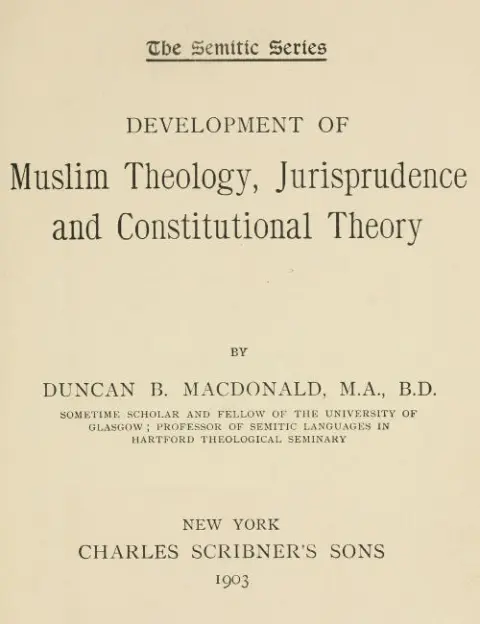
"Development of Muslim Theology, Jurisprudence, and Constitutional Theory" by Duncan B. Macdonald is a scholarly work written in the early 20th century. This comprehensive analysis aims to bridge the gap in understanding the evolution of Muslim institutions, particularly focusing on theology, legal systems, and governance throughout Islamic history. The book is intended for both academic audiences and lay readers interested in Semitic studies. The opening of the text sets a foundational context for the book, explaining the urgent need for a coherent resource on Muslim legal and theological development. Macdonald reflects on the complexities of Islamic institutions and the interconnectedness of theology, jurisprudence, and political theory over time. He introduces the concept that the evolution of these areas cannot be considered in isolation, as they are intricately linked within the framework of Muslim civilization. The preface also acknowledges various scholars whose work has influenced the author's own understanding and approach, emphasizing the reliance on primary Arabic sources to ensure accuracy and authenticity in his discourse.
Introduction adapted from the source catalogue; source summaries may be automatically generated.
Free to read · English · 111,511 words · No account needed
MAKE TIME FOR A GOOD BOOK
On by default. Untick to stop anonymous reading totals. Each page counts after 10 seconds in view. How this works.
Anonymous counting is on unless you have switched it off.
The problem of the Abbasids; the House of Barmak; the crumbling of the empire; the Prætorians of Baghdad; the Buwayhids; the situation of the Khalifa under them; the Saljuqs; the possibilities of development under them; the Mongols and the Abbasid end; the Egyptian Abbasids; the Ottoman Sultans, their heirs; theory of the Khalifate; the modern situation; the signs of sovereignty for Muslims; five grounds of the claim of the Ottoman Sultan; the consequences for the Sultan; other Muslim constitutions; the Shi‘ites; the Ibadites; the Wahhabites; the Brotherhood of as-Sanusi.
[Sidenote: CRUMBLING OF THE EMPIRE]
We must now return to the Abbasids, whose empire we left crumbling away. It was a shrewd stroke of policy on the part of its founder to put the new capital, Baghdad, on the Tigris, right between Persia, Syria and Arabia. For the only hope of permanence to the empire lay in welding these into a unity. For a short time, in the hands of the first vigorous rulers, and, especially, during fifty years of guidance by the House of Barmak—Persians who flung in their lot with the Abbasids and were their stay till the madness of Harun ar-Rashid cast them down—this seemed to be succeeding; but, just as the empire of Charlemagne melted under his sons, so did the empire of al-Mansur and al-Ma’mun. The Bedawi tribes fell back into the desert and to the free chaos of the old pre-Islamic life. As the great philosophical historian, Ibn Khaldun, has remarked, the Arabs by their nature are incapable of founding an empire except when united by religious enthusiasm, and are of all peoples least capable of governing an empire when founded. After the first Abbasids, it is a fatal error to view the Muslim dynasties as Arab or to speak of the Muslim civilization as Arabian. The conquered peoples overcame their conquerors. Persian nationalism reasserted itself and in native independent dynasties flung off the Arab yoke. These dynasties were mostly Shi‘ite; Shi‘ism, in great part, is the revolt of the Aryan against Semitic monotheism. The process in all this was gradual but certain. Governors of provinces revolted and became semi-independent. Sometimes they acknowledged a shadowy sovereignty of the Khalifa, by having his name on their coins and in the Friday prayers; sometimes they did not. At other times they were, or claimed to be, Alids, and when Alids revolted, they revolted absolutely. With them, it was a question of conscience. At last, not even in his own City of Peace or in his own palace was the Khalifa master. As in Rome, so in Baghdad, a body-guard of mercenaries assumed control and their leader was de facto ruler. Later, from A.H. 320 to 447 (A.D. 932-1055), the Sunnite Khalifa found himself the ward and puppet of the Shi‘ite Buwayhids. Baghdad itself they held from 334. But still, a curious spiritual value—we cannot call it authority—was left to the shadowy successors of Muhammad. Muslim princes even in far-off India did not feel quite safe upon their thrones unless they had been solemnly invested by the Khalifa and given their fitting title. Those very rulers in whose power the Khalifa’s life lay sought sanction from him for their rule. At one time there seemed to be some hope that the fatal unity of theocratical Islam would be broken and that a dualism with promise of development through conflict—such as the rivalry between Pope and Emperor which kept Europe alive and prevented both State and Church from falling into decrepit decay—might grow up; that the Khalifa might become a purely spiritual ruler with functions of his own, ruling with mutual subordination and co-ordinate jurisdiction beside a temporal Sultan. The Buwayhids were Shi‘ites and merely tolerated, for state reasons, the impieties of the Sunnite Khalifas. But in 447 (A.D. 1055), Tughril Beg, the Saljuq, entered Baghdad, was proclaimed Sultan of the Muslims and freed the Khalifa from the Shi‘ite yoke. By 470, all western Asia, from the borders of Afghanistan to those of Egypt and the Greek Empire, were Saljuq. With the Saljuq Sultan as Emperor and the Khalifa as Pope, there was a chance that the Muslim State might enter on a stage of healthy growth through conflict. But that was not to be. Neither State nor Church rose to the great opportunity and the experiment was finally and forever cut off by the Mongol flood. When the next great Sultanate—that of the Ottoman Turks—arose, it gathered into its hands the reins of the Khalifate as well. This is what might have been in Islam, built on actual history in Europe. The situation that did arise in Islam may become more clear to us if we can imagine that in Europe the vast plans of Gregory VII. had been carried out and the Pope had become the temporal as well as the spiritual head of the Christian world. Such a situation would have been similar to that in the world of Islam at its earliest time during some few years under the dynasty of the Umayyads, when the one temporal and spiritual sovereign ruled from Samarqand to Spain. Then we can imagine how the vast fabric of such an imperial system broke down by its own weight. Under conflicting claims of legitimacy, an anti-Pope arose and the great schism began. Thereafter the process of disintegration was still more rapid. Provinces rose in insurrection and dropped away from each rival Pope. Kingdoms grew up and the sovereigns over them professed themselves to be the lieutenants of the supreme Pontiff and sought investiture from him. Last, the States of the Church itself—all that was left to it—came under the rule of some one of these princes and the Pope was, to all intents, a prisoner in his own palace. Yet the sovereignty of the Khalifa was not simply a legal fiction, any more than that of the Pope would have been in the parallel just sketched. The Muslim princes thought it well to seek spiritual recognition from him, just as Napoleon I. found it prudent to have himself crowned by Pius VII.
Your reading position is saved on this browser. Take it to another device with a library code. Reading pages adapt to text, rather than matching a printed edition.
BEHIND THE BOOK
This eBook is for the use of anyone anywhere in the United States and most other parts of the world at no cost and with almost no restrictions whatsoever. You may copy it, give it away or re-use it under the terms of the Project Gutenberg License included with this eBook or online at www.gutenberg.org. If you are not located in the United States, you will have to check the laws of the country where you are located before using this eBook. Read the source licence.
The original source file, including credits and licence, is retained by this library. Request an original-format copy at no charge. Please include the book title and Project Gutenberg identifier #59135.
KEEP YOUR CURIOSITY GOING
David Patterson (Spirit) Hatch

David Patterson (Spirit) Hatch

David Patterson (Spirit) Hatch
Cécile Tormay

Moritz Busch
John L. Ransom