
Last letters from the living dead man
David Patterson (Spirit) Hatch
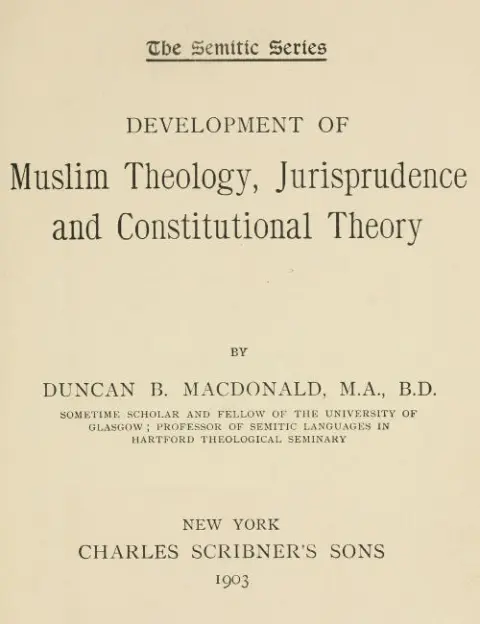
THE CLASSIC COLLECTION · 1903
"Development of Muslim Theology, Jurisprudence, and Constitutional Theory" by Duncan B. Macdonald is a scholarly work written in the early 20th century. This comprehensive analysis aims to bridge the gap in understanding the evolution of Muslim institutions, particularly focusing on theology, legal systems, and governance throughout Islamic history. The book is intended for both academic audiences and lay readers interested in Semitic studies. The opening of the text sets a foundational context for the book, explaining the urgent need for a coherent resource on Muslim legal and theological development. Macdonald reflects on the complexities of Islamic institutions and the interconnectedness of theology, jurisprudence, and political theory over time. He introduces the concept that the evolution of these areas cannot be considered in isolation, as they are intricately linked within the framework of Muslim civilization. The preface also acknowledges various scholars whose work has influenced the author's own understanding and approach, emphasizing the reliance on primary Arabic sources to ensure accuracy and authenticity in his discourse.
Introduction adapted from the source catalogue; source summaries may be automatically generated.
Free to read · English · 111,511 words · No account needed
MAKE TIME FOR A GOOD BOOK
On by default. Untick to stop anonymous reading totals. Each page counts after 10 seconds in view. How this works.
Anonymous counting is on unless you have switched it off.
In consequence of this, there early arose in Islam a class of students who made it their business to investigate and hand down the minutest details as to the habits of Muhammad. This was a separate thing from the study of law, although fated to be eventually connected with it. Even in the time of the Jahiliya—the period before Islam, variously explained as the ignorance or as the rudeness, uncivilizedness—it had been a fixed trait of the Arab mind to hold closely to old paths. An inherent conservatism canonized the sunna—custom, usage—of the ancients; any stepping aside from it was a bid‘a—innovation—and had to win its way by its merits, in the teeth of strong prejudice. With the coming of Muhammad and the preaching of Islam, this ancestral sunna had in great part to yield. But the temper of the Arab mind remained firm, and the sunna of Muhammad took its place. Pious Muslims did not say, “Such was the usage of our fathers, and it is mine;” but, “I follow the usage of the Prophet of God.” Then, just as the old sunna of the heathen times had expressed itself through the stories of great warriors, of their battles and loves; through anecdotes of wise men, and their keen and eloquent words; so it was with the sunna of the one man, Muhammad. What he said, and what he did; what he refrained from doing; what he gave quasi-approval to by silence; all was passed on in rapidly increasing, pregnant little narratives. First, his immediate Companions would note, either by committing to memory or to a written record, his utterances and table-talk generally. We have evidence of several such Boswells, who fixed his words as they fell. Later, probably, would come notes of his doings and his customs, and of all the little and great happenings of the town. Above all, a record was being gathered of all the cases judged by him, and of his decisions; of all the answers which he gave to formal questions on religious life and faith. All this was jotted down by the Companions on sahifas—odd sheets—just as they had done in the Ignorance with the proverbs of the wise and their dark sayings. The records of sayings were called hadiths; the rest, as a whole, sunna—custom, for its details was used the plural, sunan—customs. At first, each man had his own collection in memory or in writing. Then, after the death of the Prophet and when his first Companions were dropping off, these collections were passed on to others of the second generation. And so the chain ran on and in time a tradition came to consist formally of two things—the text or matter (matn) so handed on, and the succession (isnad) over whose lips it had passed. A said, “There narrated to me B, saying, ‘There narrated to me C, saying,’” so far the isnad, until the last link came, and the matn, the Prophet of God said, “Some of my injunctions abrogate others,” or “The Jann were created of a smokeless flame,” or whatever it might be. What has just been said suggests that it was at first indifferent whether traditions were preserved orally or in writing. That is true of the first generation; but it must be remembered at the same time, that the actual passing on was oral; the writing merely aided the memory to hold that which was already learned. But with time, and certainly by the middle of the second century of the Hijra, two opposing tendencies in this respect had developed. Many continued to put their trust in the written word, and even came to pass traditions on without any oral communication. But for others there lay grave dangers in this. One was evidently real. The unhappy character of the Arabic script, especially when written without diacritical points, often made it hard, if not practically impossible, to understand such short, contextless texts as the traditions. A guide was necessary to show how the word should be read, and how understood. At the present time a European scholar will sometimes be helpless before even a fully vocalized text, and must take refuge in native commentaries or in that oral tradition, if it still exists and he has access to it, which supplies at least a third of the meaning of an Arabic book. Strengthening this came theological reasons. The words of the Prophet would be profaned if they were in a book. Or, again, they would be too much honored and the Qur’an itself might be neglected. This last fear has been justified to a certain extent by the event. On these grounds, and many more, the writing and transmitting in writing of traditions came to be fiercely opposed; and the opposition continued, as a theological exercise, long after many books of traditions were in existence, and after the oral transmission had become the merest farce and had even frankly dropped out.
Your reading position is saved on this browser. Take it to another device with a library code. Reading pages adapt to text, rather than matching a printed edition.
BEHIND THE BOOK
This eBook is for the use of anyone anywhere in the United States and most other parts of the world at no cost and with almost no restrictions whatsoever. You may copy it, give it away or re-use it under the terms of the Project Gutenberg License included with this eBook or online at www.gutenberg.org. If you are not located in the United States, you will have to check the laws of the country where you are located before using this eBook. Read the source licence.
The original source file, including credits and licence, is retained by this library. Request an original-format copy at no charge. Please include the book title and Project Gutenberg identifier #59135.
KEEP YOUR CURIOSITY GOING
David Patterson (Spirit) Hatch

David Patterson (Spirit) Hatch

David Patterson (Spirit) Hatch
Cécile Tormay

Moritz Busch
John L. Ransom