
Last letters from the living dead man
David Patterson (Spirit) Hatch
THE CLASSIC COLLECTION · 1903
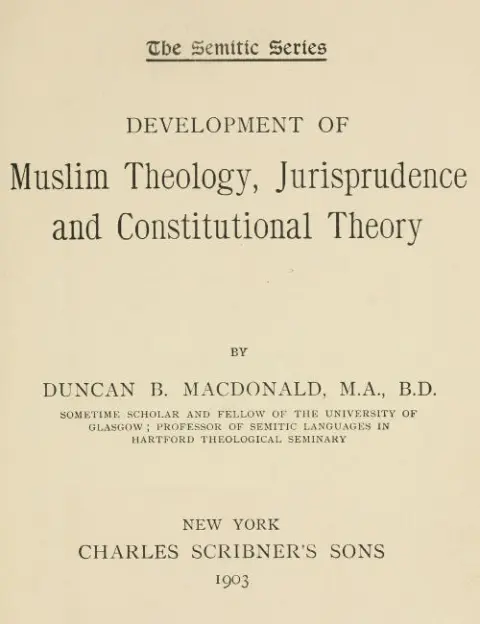
"Development of Muslim Theology, Jurisprudence, and Constitutional Theory" by Duncan B. Macdonald is a scholarly work written in the early 20th century. This comprehensive analysis aims to bridge the gap in understanding the evolution of Muslim institutions, particularly focusing on theology, legal systems, and governance throughout Islamic history. The book is intended for both academic audiences and lay readers interested in Semitic studies. The opening of the text sets a foundational context for the book, explaining the urgent need for a coherent resource on Muslim legal and theological development. Macdonald reflects on the complexities of Islamic institutions and the interconnectedness of theology, jurisprudence, and political theory over time. He introduces the concept that the evolution of these areas cannot be considered in isolation, as they are intricately linked within the framework of Muslim civilization. The preface also acknowledges various scholars whose work has influenced the author's own understanding and approach, emphasizing the reliance on primary Arabic sources to ensure accuracy and authenticity in his discourse.
Introduction adapted from the source catalogue; source summaries may be automatically generated.
Free to read · English · 111,511 words · No account needed
MAKE TIME FOR A GOOD BOOK
On by default. Untick to stop anonymous reading totals. Each page counts after 10 seconds in view. How this works.
Anonymous counting is on unless you have switched it off.
[Sidenote: SCOPE OF MUSLIM LAW]
It will, therefore, be well for the student to work through the sketch of a code of Muslim law which is inserted in Appendix I. One has been chosen which belongs to the school of ash-Shafi‘i because of its general accessibility. It should be remembered that what is given is the merest table of contents. The standard Arabic commentary on the book extends to eight hundred and eleven closely printed quarto pages. Even a mere reading of this table of contents, however, will show in how different a sphere of thought from ours Muslim law moves and lives. But we must return to the beginning of things, to the egg from which this tremendous system was hatched.
The mother-city of Islam was the little town of Yathrib, called Madinat an-Nabi, the City of the Prophet, or, shortly, al-Madina, ever since the Hijra or Migration of Muhammad to it in the year 622 of the Christian era. Here the first Muslim state was founded, and the germinal principles of Muslim jurisprudence fixed. Both state and jurisprudence were the result of the inter-working of the same highly complicated causes. The ferments in the case may be classified and described as follows: First, in the town itself before the appearance of Muhammad on its little stage—little, but so momentous for the future—there were two parties, often at war, oftener at peace. There was a genuine Arab element and there was a large settlement of Jews. To the Arabs any conception of law was utterly foreign. An Arab tribe has no constitution; its system is one of individualism; the single man is a sovereign and no writ can lie against him; the tribe can cast him forth from its midst; it cannot otherwise coerce him. So stands the case now in the desert, and so it was then. Some slight hold there might be on the tribe through the fear of the tribal God, but on the individual Arab, always a somewhat cynical sceptic, that hold was of the slightest. Further, the avenging of a broken oath was left to the God that had witnessed the oath; if he did not care to right his client, no one else would interfere. There was customary law, undoubtedly, but it was protected by no sanction and enforced by no authority. If both parties chose to invoke it, well; if not, neither had anything to fear but the anger of his opponent. That law of custom we shall find again appearing in the system of Islam, but there it will be backed by the sanction of the wrath of God working through the authority of the state. The Jewish element was in a different case. They may have been Jewish immigrants, they may have been Jewish proselytes—many Arab tribes, we know, had gone over bodily to Judaism—but their lives were ruled and guided by Jewish law. To the primitive and divine legislation on Sinai there was an immense accretion by legal fiction and by usage; the Roman codes had left their mark and the customary law of the desert as well. All this was working in the life of the town when Muhammad and his little band of fugitives from Mecca entered it. Being Meccans, they must have brought with them the more developed legal ideas of that trading centre; but these were of comparatively little account in the scale. The new and dominating element was the personality of Muhammad himself. His contribution was legislation pure and simple, the only legislation that has ever been in Islam. Till his death, ten years later, he ruled his community as an absolute monarch, as a prophet in his own right. He sat in the gate and judged the people. He had no need of a code, for his own will was enough. He followed the customary law of the town, as it has been described above, when it suited him, and when he judged that it was best. If not, he left it and there was a revelation. So the legislative part of the Qur’an grew out of such scraps sent down out of heaven to meet the needs of the squabbles and questions of the townsfolk of al-Madina. The system was one of pure opportunism; but of what body of legislation can that not be said? Of course, on the one hand, not all decisions were backed by a revelation, and Muhammad seems, on the other, to have made a few attempts to deal systematically with certain standing and constantly recurring problems—such, for example, as the conflicting claims of heirs in an estate, and the whole complicated question of divorce—but in general, the position holds that Muhammad as a lawyer lived from hand to mouth. He did not draw up any twelve tables or ten commandments, or code, or digest; he was there and the people could come and ask him questions when they chose, and that was enough. The conception of a rounded and complete system which will meet any case and to which all cases must be adjusted by legal fiction or equity, the conception which we owe to the genius and experience of the Roman lawyers, was foreign to his thought. From time to time he got into difficulties. A revelation proved too wide or too narrow, or left out some important possibility. Then there came another to supplement or correct, or even to set the first quite aside—Muhammad had no scruples about progressive revelation as applied to himself. Thus, through these interpretive acts, as we may call them, many flat contradictions have come into the Qur’an and have proved the delight of generations of Muslim jurisconsults.
Your reading position is saved on this browser. Take it to another device with a library code. Reading pages adapt to text, rather than matching a printed edition.
BEHIND THE BOOK
This eBook is for the use of anyone anywhere in the United States and most other parts of the world at no cost and with almost no restrictions whatsoever. You may copy it, give it away or re-use it under the terms of the Project Gutenberg License included with this eBook or online at www.gutenberg.org. If you are not located in the United States, you will have to check the laws of the country where you are located before using this eBook. Read the source licence.
The original source file, including credits and licence, is retained by this library. Request an original-format copy at no charge. Please include the book title and Project Gutenberg identifier #59135.
KEEP YOUR CURIOSITY GOING
David Patterson (Spirit) Hatch

David Patterson (Spirit) Hatch

David Patterson (Spirit) Hatch
Cécile Tormay

Moritz Busch
John L. Ransom