
Last letters from the living dead man
David Patterson (Spirit) Hatch
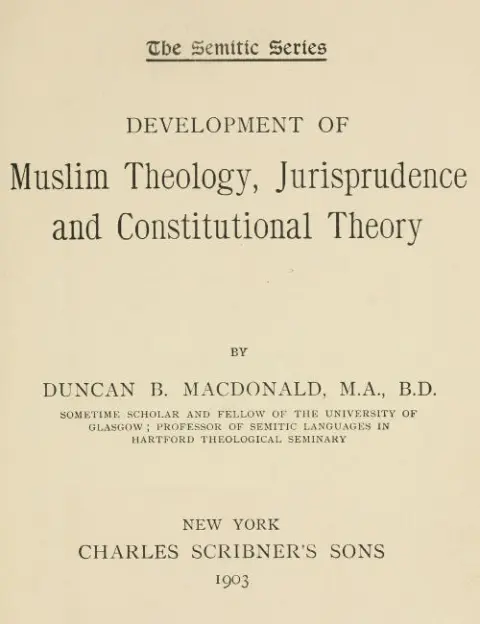
THE CLASSIC COLLECTION · 1903
"Development of Muslim Theology, Jurisprudence, and Constitutional Theory" by Duncan B. Macdonald is a scholarly work written in the early 20th century. This comprehensive analysis aims to bridge the gap in understanding the evolution of Muslim institutions, particularly focusing on theology, legal systems, and governance throughout Islamic history. The book is intended for both academic audiences and lay readers interested in Semitic studies. The opening of the text sets a foundational context for the book, explaining the urgent need for a coherent resource on Muslim legal and theological development. Macdonald reflects on the complexities of Islamic institutions and the interconnectedness of theology, jurisprudence, and political theory over time. He introduces the concept that the evolution of these areas cannot be considered in isolation, as they are intricately linked within the framework of Muslim civilization. The preface also acknowledges various scholars whose work has influenced the author's own understanding and approach, emphasizing the reliance on primary Arabic sources to ensure accuracy and authenticity in his discourse.
Introduction adapted from the source catalogue; source summaries may be automatically generated.
Free to read · English · 111,511 words · No account needed
MAKE TIME FOR A GOOD BOOK
On by default. Untick to stop anonymous reading totals. Each page counts after 10 seconds in view. How this works.
Anonymous counting is on unless you have switched it off.
Finally, it may be well to give some account of the constitutional question as it exists at the present day. The greatest of the Sultans of Islam is undoubtedly the Emperor of India. Under his rule are far more Muslims than fall to any other. But the theory of the Muslim State never contemplated the possibility of Muslims living under the rule of an unbeliever. For them, the world is divided into two parts, the one is Dar al-Islam, abode of Islam; and the other is Dar al-harb, abode of war. In the end, Dar al-harb must disappear into Dar al-Islam and the whole world be Muslim. These names indicate with sufficient clearness what the Muslim attitude is toward non-Muslims. It is still a moot point among canon lawyers, however, whether Jihad, or holy war, may be made, unprovoked, upon any Dar al-harb. One thing is certain, there must be a reasonable prospect of success to justify any such movement; the lives of Muslims must not be thrown away. Further, the necessity of the case—in India, especially—has brought up the doctrine that any country in which the peculiar usages of Islam are protected and its injunctions—even some of them—followed, must be regarded as Dar al-Islam and that Jihad within its borders is forbidden. We may doubt, however, if this doctrine would hold back the Indian Muslims to any extent if a good opportunity for a Jihad really presented itself. The Shi‘ites, it may be remarked, cannot enter upon a Jihad at all until the Hidden Imam returns and leads their armies.
[Sidenote: THEORIES OF THE KHALIFATE]
Again the two signs of sovereignty for Muslims are that the name of the sovereign should be on the coinage and that he should be prayed for in the Friday sermon (khutba). In India, the custom seems to be to pray for “the ruler of the age” without name; then each worshipper can apply it as he chooses. But there has crept in a custom in a few mosques of praying for the Ottoman Sultan as the Khalifa; the English government busies itself little with these things until compelled, and the custom will doubtless spread. The Ottoman Sultan is certainly next greatest to the Emperor of India and would seem, as a Muslim ruling Muslims, to have an unassailable position. But in his case also difficult and ambiguous constitutional questions can be raised. He has claimed the Khalifate, as we have seen, since 1538, but the claim is a shaky one and brings awkward responsibilities. As stated at the present day, it has five grounds. First, de facto right; the Ottoman Sultan won his title by the sword and holds it by the sword. Second, election; this form has been already described. Third, nomination by the last Abbasid Khalifa of Egypt; so Abu Bakr nominated Umar to succeed him, and precedent is everything in Islam. Fourth, possession and guardianship of the two Harams, or Sacred Cities, Mecca and al-Madina. Fifth, possession of some relics of the Prophet saved from the sack of Baghdad and delivered to Sultan Salim, on his conquest of Egypt, by the last Abbasid. But these all shatter against the fixed fact that absolutely accepted traditions from the Prophet assert that the Khalifa must be of the family of Quraysh; so long as there are two left of that tribe, one must be Khalifa and the other his helper. Still, here, as everywhere, the principal of Ijma, Agreement of the Muslim people, (see p. 105) comes in and must be reckoned with. These very traditions are probably an expression in concrete form of popular agreement. The Khalifate itself is confessedly based upon agreement. The canon lawyers state the case thus: The Imamites and Isma‘ilians hold that the appointment of a leader is incumbent upon God. There is only the difference that the Imamites say that a leader is necessary in order to maintain the laws unimpaired, while the Isma‘ilians regard him as essential in order to give instruction about God. The Kharijites, on the other hand, recognize no fundamental need of an Imam; he is only allowable. Some of them held that he should be appointed in time of public trouble to do away with the trouble, thus a kind of dictator; others, in time of peace, because only then can the people agree. The Mu‘tazilites and the Zaydites held that it was for man to appoint, but that the necessity was based on reason; men needed such a leader. Yet some Mu‘tazilites taught that the basis was partly reason and partly obedience to tradition. On the other hand, the Sunnites hold that the appointment of an Imam is incumbent upon men and that the basis is obedience to the tradition of the Agreement of the Muslim world from the earliest times. The community of Islam may have disputed over the individual to be appointed, but they never doubted that the maintenance of the faith in its purity required a leader, and that it was, therefore, incumbent on men to appoint one. The basis is Ijma, Agreement, not Scripture or tradition from Muhammad or analogy based on these two.
Your reading position is saved on this browser. Take it to another device with a library code. Reading pages adapt to text, rather than matching a printed edition.
BEHIND THE BOOK
This eBook is for the use of anyone anywhere in the United States and most other parts of the world at no cost and with almost no restrictions whatsoever. You may copy it, give it away or re-use it under the terms of the Project Gutenberg License included with this eBook or online at www.gutenberg.org. If you are not located in the United States, you will have to check the laws of the country where you are located before using this eBook. Read the source licence.
The original source file, including credits and licence, is retained by this library. Request an original-format copy at no charge. Please include the book title and Project Gutenberg identifier #59135.
KEEP YOUR CURIOSITY GOING
David Patterson (Spirit) Hatch

David Patterson (Spirit) Hatch

David Patterson (Spirit) Hatch
Cécile Tormay

Moritz Busch
John L. Ransom