
Last letters from the living dead man
David Patterson (Spirit) Hatch
THE CLASSIC COLLECTION · 1903
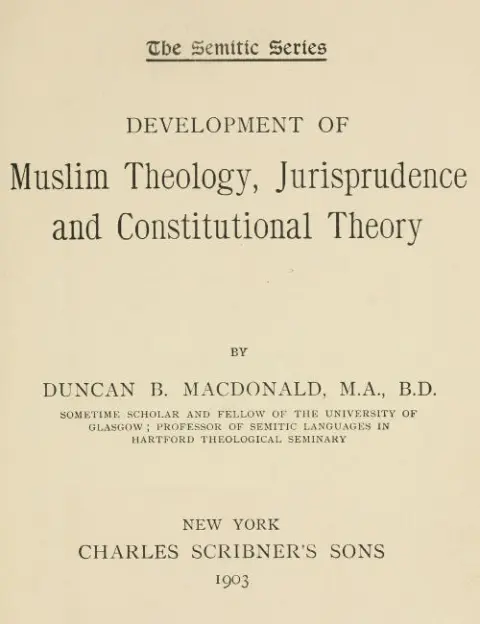
"Development of Muslim Theology, Jurisprudence, and Constitutional Theory" by Duncan B. Macdonald is a scholarly work written in the early 20th century. This comprehensive analysis aims to bridge the gap in understanding the evolution of Muslim institutions, particularly focusing on theology, legal systems, and governance throughout Islamic history. The book is intended for both academic audiences and lay readers interested in Semitic studies. The opening of the text sets a foundational context for the book, explaining the urgent need for a coherent resource on Muslim legal and theological development. Macdonald reflects on the complexities of Islamic institutions and the interconnectedness of theology, jurisprudence, and political theory over time. He introduces the concept that the evolution of these areas cannot be considered in isolation, as they are intricately linked within the framework of Muslim civilization. The preface also acknowledges various scholars whose work has influenced the author's own understanding and approach, emphasizing the reliance on primary Arabic sources to ensure accuracy and authenticity in his discourse.
Introduction adapted from the source catalogue; source summaries may be automatically generated.
Free to read · English · 111,511 words · No account needed
MAKE TIME FOR A GOOD BOOK
On by default. Untick to stop anonymous reading totals. Each page counts after 10 seconds in view. How this works.
Anonymous counting is on unless you have switched it off.
But only half of the work was done. Islam stood as firmly as ever and the conspiracy had only produced a schism in the faith and had not destroyed it. Ubayd Allah was in the awkward position, on the one hand, of ruling a people who were in great bulk fanatical Muslims and did not understand any jesting with their religion, and, on the other hand, of being head of a conspiracy to destroy that very religion. The Syrians and Arabs had apparently taken more degrees than the Egyptians and North Africans, and Ubayd Allah found himself between the devil and the deep sea. The Qarmatians in Arabia plundered the pilgrim caravans, stormed the holy city Mecca, and, most terrible of all, carried off the sacred black stone. When an enormous ransom was offered for the stone, they declined—they had orders not to send it back. Everyone understood that the orders were from Africa. So Ubayd Allah found it advisable to address them in a public letter, exhorting them to be better Muslims. The writing and reading of this letter must have been accompanied by mirth, at any rate no attention was paid to it by the Qarmatians. It was not till the time of the third Fatimid Khalifa that they were permitted to do business with that stone. Then they sent it back with the explanatory or apologetic remark that they had carried it off under orders and now sent it back under orders. Meanwhile the Fatimid dynasty was running its course in Egypt but without turning the people of Egypt from Islam. Yet it produced one strange personality and two sects, stranger even than the sect to which it itself owed its origin. The personality is that of al-Hakim Bi’amrillah, who still remains one of the greatest mysteries that are to be met with in history. In many ways he reminds us curiously of the madness of the Julian house; and, in truth, such a secret movement as that of which he was a part, carried on through generations from father to son, could not but leave a trace on the brain. We must remember that the Khalifa of the time was not always of necessity the head of the conspiracy, or even fully initiated into it. In the latter part of the Fatimid rule we find distinct traces of such a power behind the throne, consisting, as we may imagine, of descendants and pupils of those who had been fully initiated from the first and had passed through all the grades. In the case of al-Hakim, it is possible, even, to trace, to a certain extent, the development of his initiation. During the first part of his reign he was fanatically Muslim and Shi‘ite. He persecuted alternately the Christians and the Jews, and then the orthodox and the Shi‘ites. In the latter part, there was a change. He had, apparently, reached a point of philosophical indifference, for the persecutions of Christians and Jews ceased, and those who had been forced to embrace Islam were permitted to relapse. This last was without parallel, till in 1844 Lord Stratford de Redcliffe wrung from the Porte the concession that a Muslim who apostatized to Christianity should not be put to death. But, mingled with this indifference, there appeared a strange but regular development of Shi‘ite doctrine. Some of his followers began to proclaim openly that the deity was incarnate in him, and it was evident that he himself accepted and believed this. But the Egyptian populace would have none of it, and the too rash innovators had to flee. Some went to the Lebanon and there preached to the native mountain tribes. The results of their labors are the Druses of to-day, who worship al-Hakim still and expect his return to introduce the end of all things. Finally, al-Hakim vanished on the night of February 12, A.D. 1021, and left a mystery unread to this day. Whether he was murdered, and if so why, or vanished of free-will, and if so again why, we have no means of telling. Our guess will depend upon our reading of his character. So much is certain, that he was a ruler of the autocratic type, who introduced many reforms, most of which the people of his time could not in the least understand and therefore misrepresented as the mere whims of a tyrant, and many of which, from our ignorance, are still obscure to us. If we can imagine such a man of strong personality and desire for the good of his people but with a touch of madness in the brain, cast thus in the midst between his orthodox subjects and a wholly unbelieving inner government, we shall perhaps have the clew to the strange stories told of him.
Your reading position is saved on this browser. Take it to another device with a library code. Reading pages adapt to text, rather than matching a printed edition.
BEHIND THE BOOK
This eBook is for the use of anyone anywhere in the United States and most other parts of the world at no cost and with almost no restrictions whatsoever. You may copy it, give it away or re-use it under the terms of the Project Gutenberg License included with this eBook or online at www.gutenberg.org. If you are not located in the United States, you will have to check the laws of the country where you are located before using this eBook. Read the source licence.
The original source file, including credits and licence, is retained by this library. Request an original-format copy at no charge. Please include the book title and Project Gutenberg identifier #59135.
KEEP YOUR CURIOSITY GOING
David Patterson (Spirit) Hatch

David Patterson (Spirit) Hatch

David Patterson (Spirit) Hatch
Cécile Tormay

Moritz Busch
John L. Ransom