
Last letters from the living dead man
David Patterson (Spirit) Hatch
THE CLASSIC COLLECTION · 1903
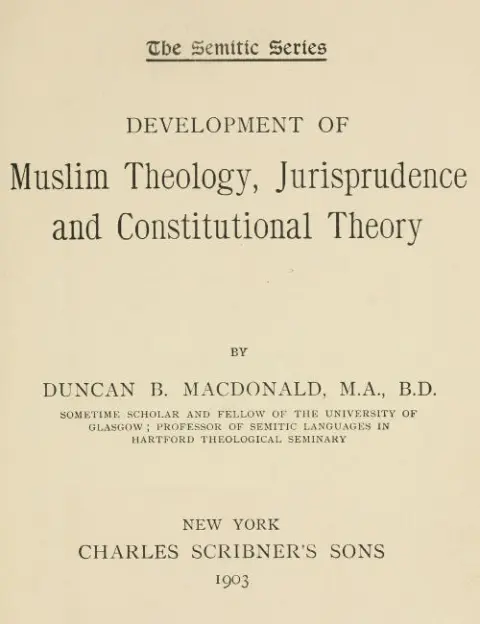
"Development of Muslim Theology, Jurisprudence, and Constitutional Theory" by Duncan B. Macdonald is a scholarly work written in the early 20th century. This comprehensive analysis aims to bridge the gap in understanding the evolution of Muslim institutions, particularly focusing on theology, legal systems, and governance throughout Islamic history. The book is intended for both academic audiences and lay readers interested in Semitic studies. The opening of the text sets a foundational context for the book, explaining the urgent need for a coherent resource on Muslim legal and theological development. Macdonald reflects on the complexities of Islamic institutions and the interconnectedness of theology, jurisprudence, and political theory over time. He introduces the concept that the evolution of these areas cannot be considered in isolation, as they are intricately linked within the framework of Muslim civilization. The preface also acknowledges various scholars whose work has influenced the author's own understanding and approach, emphasizing the reliance on primary Arabic sources to ensure accuracy and authenticity in his discourse.
Introduction adapted from the source catalogue; source summaries may be automatically generated.
Free to read · English · 111,511 words · No account needed
MAKE TIME FOR A GOOD BOOK
On by default. Untick to stop anonymous reading totals. Each page counts after 10 seconds in view. How this works.
Anonymous counting is on unless you have switched it off.
I‘jaz, 151
Al-‘Iji, 241, 269
Ijma‘, 57, 58, 72, 94, 101, 105, 209, 292, 328, 351
Ijmali, 316
Ikhtilaf, 116
Ikhtiyar, 192, 310, 339, 345
Ikhwan as-safa, 167, 169, 194, 196, 199
Iktisab, 280;
cf. kasb
Iktisabi, 309
Ila, 355
Ilhad, 314
Ilham, 281, 309
Iljam al-‘awamm‘an ‘ilm al-kalam of al-Ghazzali, 260
‘Illa, 107, 319, 337;
cf. ta‘lil
‘Ilm, 201, 294, 332
‘Ilwan, the Shaykh, 268
Imam, 26, 29, 31, 36-38, 41-43, 46, 54, 57, 142, 155, 165, 167, 188, 197, 212, 224, 286, 292, 293, 297-299, 311, 313, 318, 350
Imam al-Haramayn, 212, 213, 217, 230, 317
Imamites, 37, 57, 59, 116, 126, 142, 247
Iman, 126, 127, 292-296, 311, 312, 318, 350
Imata, 338
Imdadat, 330
Imtihan, 148;
cf. mihna
India, 51, 55, 56, 59, 61
India, Emperor of, 55
Indian Mu‘tazilism, 286
Injil, 304
In sha’ Allah, 272
Iqrar, 312, 354
Irada, 330
Al-‘Iraq, 209
‘Iraq, Arab, 44
Irda, 355
Irja, 292;
cf. Murji’ites
‘Isa; see Jesus
Islam, 7, 13-15, 19-27, 37, 40-48, 52-55, 58, 59, 68, 71-74, 118-120, 124, 130, 136, 141, 142, 149, 151-154, 158-161, 167, 173, 176, 177, 180-183, 186, 190, 191, 206, 212-215, 218, 226, 228, 230, 231, 233, 235, 238-244, 248, 261, 262, 270, 278, 282-284, 292, 296, 312
‘Isma, 247, 292, 314, 347
Isma‘il, 41, 42, 43
Isma‘ilians, 42, 44, 57, 59, 169, 170, 196
Isnad, 75, 78, 79
Ispahan, 195
Istawa, Istiwa, 186, 294, 301
Istidlali, 308
Istihsan, 87, 94, 96
Istislah, 87, 100, 101
Istita‘a, 310
Istiwa; see Istawa
I‘tazala ‘anna, 130
Ithna ‘Ashariya, 38
I‘tibar, 201, 341
I‘tibar ikhtira‘i, 342
I‘tibar intiza‘i, 342
I‘tidal, 221
I‘tikaf, 353
‘Itq, 357
Ittihad, 228, 277
Ja‘ala, 354
Jabarites, 292, 344
Jabr, 291, 344
Jacob, 350
Jadliya, 259
Ja‘far as-Sadiq, 42, 173
Al-Jafr, 249
Jahannam, 306
Al-Jahiliya, the Barbarism, or the Ignorance, 8, 74, 77, 173
Al-Jahiz, 160, 161
Jahl, 340
Jahm ibn Safwan, 126, 138, 146, 150
Jahmites, 294, 299
Ja’iz, 73, 316, 348
Jalal ad-Din ar-Rumi, 267
Jami‘, 80
Jarabub, 62
Jawhar, 159, 309
Jawhar ruhani, 231
Jerusalem, 14, 40, 42, 146, 226
Jesus, ‘Isa, 42, 146, 315, 345
Jews, 24, 47, 68, 70, 133, 134, 144, 194
Jibril, 292, 293, 335, 336
Jihad, 55, 63, 246, 356
Jinaya, 355
Jinn, Jinni, Jann, 76, 281, 283, 286, 299, 304, 305, 324
Jirm, 317, 320
Jism, 143, 309
Jizya, 15, 356
John of Damascus, 89, 131, 132, 137, 146
Al-Jubba‘i, 159, 160, 172, 188-190
Al-Junayd, 176, 177, 183, 187, 225, 282
Jurisprudentes, 85, 86
Juththa, 334
Al-Juwayni; see Imam al-Haramayn
Ka‘ba, 149, 268, 278
Kabira, 127, 296, 311, 349
Kafala, 354
Kafir, 295, 316, 328, 350;
cf. kufr, takfir
“Kalila and Dimna,” 150
Kahin, 314
Kalam, 147, 149, 151, 157, 175, 186, 188, 193, 200, 206, 208, 214, 216, 241, 242, 245, 276, 278, 286, 294, 309, 315, 335
Kalam Allah, 146
Kalam nafsi, hadith fi-n-nafs, 273, 336
Kalimata-sh-shahada, 300
Al-kalimatan, 30
Kallima-llahu Musa taklima, 149
Kamm munfasil, 325
Kamm muttasil, 325
Kant, 191, 200, 201
Al-Karabisi, 187
Karaha, 339
Karama, 174, 213, 228, 230, 274, 281, 282, 313
Karbala, 28
Karramites, 170, 191, 195, 291, 292
Kasb, 179, 192, 292;
cf. iktisab
Kashf, 120, 172, 179, 215, 269
Your reading position is saved on this browser. Take it to another device with a library code. Reading pages adapt to text, rather than matching a printed edition.
BEHIND THE BOOK
This eBook is for the use of anyone anywhere in the United States and most other parts of the world at no cost and with almost no restrictions whatsoever. You may copy it, give it away or re-use it under the terms of the Project Gutenberg License included with this eBook or online at www.gutenberg.org. If you are not located in the United States, you will have to check the laws of the country where you are located before using this eBook. Read the source licence.
The original source file, including credits and licence, is retained by this library. Request an original-format copy at no charge. Please include the book title and Project Gutenberg identifier #59135.
KEEP YOUR CURIOSITY GOING
David Patterson (Spirit) Hatch

David Patterson (Spirit) Hatch

David Patterson (Spirit) Hatch
Cécile Tormay

Moritz Busch
John L. Ransom