
Last letters from the living dead man
David Patterson (Spirit) Hatch
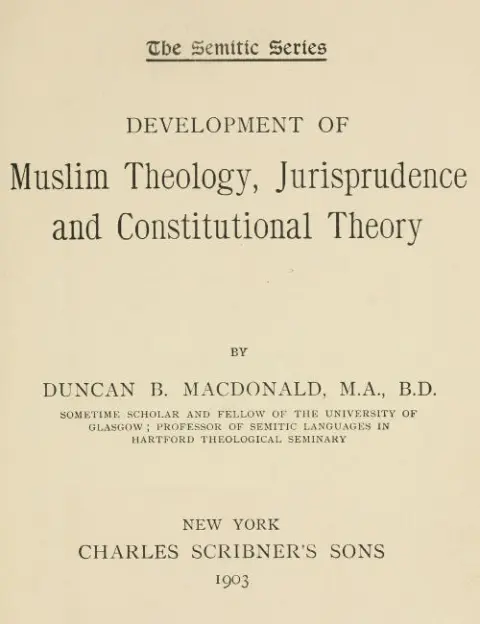
THE CLASSIC COLLECTION · 1903
"Development of Muslim Theology, Jurisprudence, and Constitutional Theory" by Duncan B. Macdonald is a scholarly work written in the early 20th century. This comprehensive analysis aims to bridge the gap in understanding the evolution of Muslim institutions, particularly focusing on theology, legal systems, and governance throughout Islamic history. The book is intended for both academic audiences and lay readers interested in Semitic studies. The opening of the text sets a foundational context for the book, explaining the urgent need for a coherent resource on Muslim legal and theological development. Macdonald reflects on the complexities of Islamic institutions and the interconnectedness of theology, jurisprudence, and political theory over time. He introduces the concept that the evolution of these areas cannot be considered in isolation, as they are intricately linked within the framework of Muslim civilization. The preface also acknowledges various scholars whose work has influenced the author's own understanding and approach, emphasizing the reliance on primary Arabic sources to ensure accuracy and authenticity in his discourse.
Introduction adapted from the source catalogue; source summaries may be automatically generated.
Free to read · English · 111,511 words · No account needed
MAKE TIME FOR A GOOD BOOK
On by default. Untick to stop anonymous reading totals. Each page counts after 10 seconds in view. How this works.
Anonymous counting is on unless you have switched it off.
[1] For Muslim eschatology reference may still be made to Sale’s introduction to the Qur’an, § 4. The punishment of the grave is what, in the case of unbelievers, follows the inquisition by the two angels Munkar and Nakir; see on them Lane’s Modern Egyptians, chap. xxviii; on the whole subject, see translations by Gautier and Wolff and tractate by Rüling (Bibliography, p. 367).
[2] This, one of the dividing questions between Sunnites and Shi‘ites, belongs to theology as well as law. See p. 314 and Goldziher, Zur Literaturgeschichte der Si‘a, p. 87.
[3] The Mu‘tazilites held that articles of sustenance of a forbidden nature, such as pork or wine, could not be called rizq in this technical sense; that God could not so use them. The orthodox retorted that a man might live his life out on forbidden things; had he then been independent of God as to his sustenance? The Mu‘tazilites defined rizq as “a possession which its possessor eats” and as “that from which one is not hindered from profiting”; the orthodox, as a name for that which God sends to man and the other animals and they eat it and profit by it.
[4] Some will run into the fire and find themselves immediately in Paradise; these would have been believers. Others will refuse, and will be treated as their parents.
[5] This is not the normal doctrine of Islam and the commentators have to explain this passage away. Consult in the chapters on theology, the whole Sufi development and especially the views of al-Ghazzali. Al-Mataridi was greatly influenced by Abu Hanifa, who was hostile to mystics. Notice, too, the philosophical basis and beginning of this creed.
[6] A sect of the Mu‘tazilites held that a man could have two ajals, one his end by a natural death appointed by God, the other his end by a violent death, not so appointed. The “Philosophers” are said to have held that one ajal would be when the mechanism of the body ceased to work through the failing of its essential moisture and heat, and another ajal might come through sicknesses and accident generally.
[7] See in bibliography, S. Keijzer, Précis, etc. Much help as to details of religious ritual and law will be found in Hughes’s Dictionary of Islam, Sachau’s Muhammedanisches Recht, Lane’s Modern Egyptians, and commentary to his translation of the Arabian Nights, Burton’s Pilgrimage, and Sell’s Faith of Islam.
Abadi, 300
Al-‘Abbas, 10, 32
‘Abbasids, 10, 32, 34, 39, 45, 50, 51, 53, 54, 56, 57, 91, 92-94, 97, 98, 132-135, 153, 154, 167, 169, 174
‘Abd, 294
‘Abd Allah, father of Muhammad, 350, f.
‘Abd Allah ibn az-Zubayr, 23, 25
‘Abd Allah ibn Maymun, 40, 42-44
Your reading position is saved on this browser. Take it to another device with a library code. Reading pages adapt to text, rather than matching a printed edition.
BEHIND THE BOOK
This eBook is for the use of anyone anywhere in the United States and most other parts of the world at no cost and with almost no restrictions whatsoever. You may copy it, give it away or re-use it under the terms of the Project Gutenberg License included with this eBook or online at www.gutenberg.org. If you are not located in the United States, you will have to check the laws of the country where you are located before using this eBook. Read the source licence.
The original source file, including credits and licence, is retained by this library. Request an original-format copy at no charge. Please include the book title and Project Gutenberg identifier #59135.
KEEP YOUR CURIOSITY GOING
David Patterson (Spirit) Hatch

David Patterson (Spirit) Hatch

David Patterson (Spirit) Hatch
Cécile Tormay

Moritz Busch
John L. Ransom