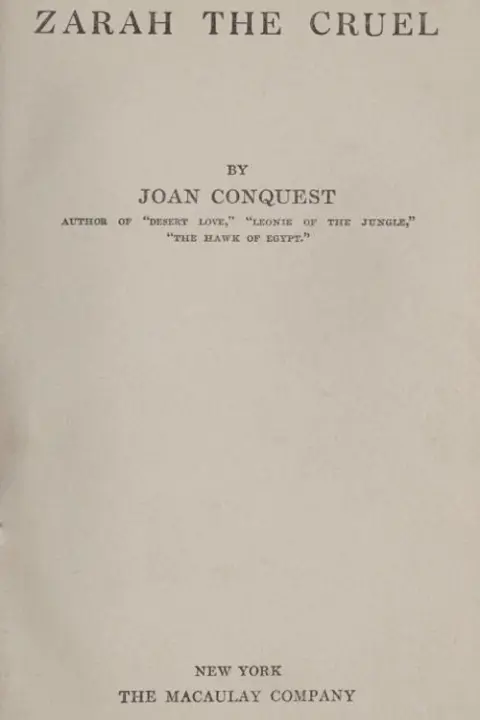
Zarah the Cruel
Joan Conquest
THE CLASSIC COLLECTION · 1920
"Desert Love" by Joan Conquest is a novel written in the early 20th century. The story revolves around Jill Carden, a young English woman embarking on a journey of self-discovery and adventure in the exotic setting of Egypt. With a background of privilege now stripped away, Jill is determined to seek a life filled with genuine love and experiences beyond the monotony of her previous existence. At the start of the book, Jill finds herself at a transit station in Ismailiah, Egypt, observing the vibrant mix of women in traditional dress and British soldiers preparing for their journey. Feeling bewildered and disconnected from her recent past, she reflects on her unorthodox upbringing and the loss of her father's wealth. As Jill's thoughts turn to her aspirations for love and adventure, she becomes intrigued by Hahmed, the Camel King, a formidable figure whose presence captivates her. Despite societal expectations, Jill chooses to break free from the constraints of her previous life, setting the stage for a thrilling and transformative romantic journey across the desert.
Introduction adapted from the source catalogue; source summaries may be automatically generated.
Free to read · English · 71,223 words · No account needed
MAKE TIME FOR A GOOD BOOK
On by default. Untick to stop anonymous reading totals. Each page counts after 10 seconds in view. How this works.
Anonymous counting is on unless you have switched it off.
Ten o'clock!--half-past!--eleven!
The usual noises of a night in an Egyptian town were at their height.
The distant and never-ceasing shuffling of slippered or naked feet on stone, or sand, made a dull accompaniment to the sharper notes of men's voices crying their wares of sticky sweetmeat or fruit, and the barking and growling of innumerable dogs.
Muffled ejaculations could be heard, little gurgles of laughter, which in Egypt, thanks be to Allah, do not degenerate into giggles, the swish of a whip in the shadow, followed by a woman's cry, and through all, above all, unfinished catches of music.
All kinds of humans, including tourists, writers, European officials and desert dilettanti, have affixed every kind of adjective to Egypt's music.
Ethereal, melancholy, wailing, plaintive, nebulous, and pathetic are but a few. Why--why try to tie a label to something which slips from the fingers even as they close about it? Why try to describe that which cannot be described? There is, or was, a certain line which in the heat of an Egyptian noon, or the stillness of an Egyptian night, when the first notes of a human voice, or stringed instrument, or rudely cut pipe-reed reach the ears, would creep out of some memory cell.
One loved the vagueness of those words:
"Out of the nowhere, into here!"
Loved the infinite space they opened up with their aloofness and indefiniteness, until, alas! they took concrete shape when chosen as title to the picture of a robust, Royal Academy, Fed-on-Virol looking babe, which doubtless, when trying to grab some passing Olympian butterfly, fell off the lap of the Gods into a sitting position upon Mother Earth.
Also, one thinks of that mist wraith which on a cloudless day stretched across some mountain's breast, lies lightly upon the air, with diaphanous ends coming out of and going into nothingness; for in just such manner does the music fall across an Egyptian day or night.
These catches of music have no end, and no beginning; they rise, linger a moment, and are gone, leaving behind them an indescribable loneliness of soul, and a longing to stretch one's hand back down the centuries to pluck their meaning from the past.
Under the sand, the granite, the marble, buried deep in the pyramids or merely covered by the earth of shallow graves, there must surely be many instruments of music wrought in gold or silver, studded in jewels, or cut out of humble wood; many strings still unbroken, and near them many whitened bones of dusky hands which, for all we know, at odd moments of day or night set those strings a-thrumming, or lift the reed pipes to ghostly lips.
Your reading position is saved on this browser. Take it to another device with a library code. Reading pages adapt to text, rather than matching a printed edition.
BEHIND THE BOOK
This eBook is for the use of anyone anywhere in the United States and most other parts of the world at no cost and with almost no restrictions whatsoever. You may copy it, give it away or re-use it under the terms of the Project Gutenberg License included with this eBook or online at www.gutenberg.org. If you are not located in the United States, you will have to check the laws of the country where you are located before using this eBook. Read the source licence.
The original source file, including credits and licence, is retained by this library. Request an original-format copy at no charge. Please include the book title and Project Gutenberg identifier #15242.
KEEP YOUR CURIOSITY GOING
Coulson Kernahan

Maurice Baring
Frances Wright
Cécile Tormay

Frederic Jesup Stimson

W. H. P. (William Henry Pope) Jarvis