THE CLASSIC COLLECTION✦My diaries, being a personal narrative of events 1888-1914, Part 2 (1900-1914)CLASSIC FREE BOOKS
My diaries, being a personal narrative of events 1888-1914, Part 2 (1900-1914)
Wilfrid Scawen Blunt
THE CLASSIC COLLECTION · 1913
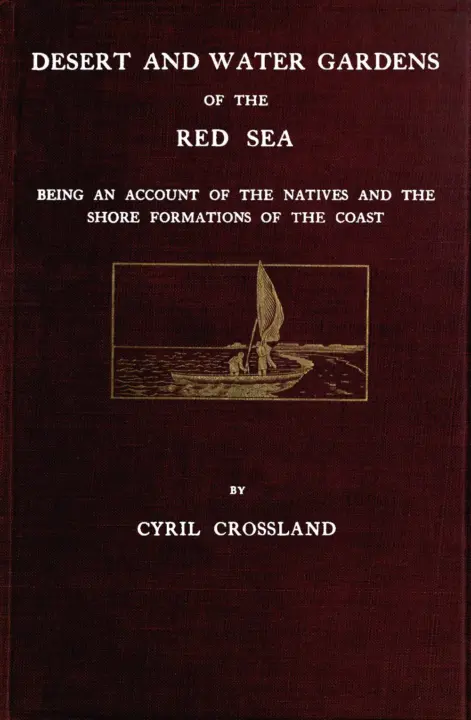
"Desert and Water Gardens of the Red Sea" by Cyril Crossland is a scientific publication written in the early 20th century. This work explores the little-known coast of the Red Sea, focusing on its native peoples and unique shore formations. Crossland, a marine biologist, aims to provide information not only about the geography and ecology of the area but also about its cultural context and the beauty of its natural landscapes. The opening of the book begins with a detailed description of the Red Sea coast as seen through the author's eyes during an arrival by sea. Crossland paints vivid imagery of the coast's sandstone cliffs, fringing reefs, and coral gardens. He reflects on his initial misconceptions about the region, highlighting the stark desert backdrop that houses sparse vegetation and unique flora emerging after winter rains. His account sets the stage for a deeper exploration of the geological and biological features of the area, as well as the intricate connection between the environment and the lives of the local peoples. Through this introduction, readers are drawn into a blend of scientific observation and personal experience, creating a rich tapestry that promises further insights into both the physical and cultural landscapes of the Red Sea.
Introduction adapted from the source catalogue; source summaries may be automatically generated.
Free to read · English · 55,869 words · No account needed
MAKE TIME FOR A GOOD BOOK
On by default. Untick to stop anonymous reading totals. Each page counts after 10 seconds in view. How this works.
Anonymous counting is on unless you have switched it off.
Reefs may shew other features, no one arrangement can be taken as typical of all. Instead of the smooth slope and rounded ridge which compose the reef edge on this coast and that of Zanzibar it is usual, in many oceanic reefs, for the growing edge to be cut into by deep and narrow fissures, up which the great breakers send violent torrents of water.
The land, or reef islands, may be either portions of the reef elevated above sea level, containing fossil corals in the positions in which they grow, or it may be partly formed of a mass of corals thrown up by storms backed generally by an accumulation of sand. The coral rock thus elevated may be, as in the Red Sea, but little different from the original material of which it was formed, but more generally it is much altered. The continual wetting by spray or rain and drying under the tropical sun has a very marked effect in hardening and consolidating elevated coral, or coral sand. The upper parts are dissolved, and as the water sinks into the porous corals and becomes supersaturated with lime, the latter is crystallised out, thus filling up all cavities with crystalline limestone. Thus in the end the highly porous heterogeneous limestone becomes a rock of exceeding hardness, crystalline and homogeneous. All the more delicate organisms are dissolved, only the largest remaining recognisable. At the same time as sea-water contains magnesium carbonate as well as limestone, and the former is less soluble than the latter, it tends to be deposited more quickly, so that it comes to replace the original limestone to some extent[54]. The alteration in the external appearance of the rock is very marked. Instead of the yellow, rather shapeless, cliffs of the Red Sea coast, in most other parts of the world, where tides supply spray and there is a considerable rainfall, we have coal-black rock with a very peculiar surface, all covered with sharp points and knife edges separating depressions left by the solution of the stone by water, hence the name “coral rag” applied to such rock. Where it forms the shore of a sheltered bay its homogeneity causes the undermining by the sea to go on to an astonishing extent before the unsupported piece falls away from the cliff to which it is attached. Such projections of the rocks which may be much longer than those shewn on Plate XXXV, also illustrate the hardness of this recrystallised material, for on striking one with a hammer a loud clear bell-like note is produced. Given the right conditions and we have the same peculiar result in the Red Sea and even in the Mediterranean. For instance, a considerable swell breaks at times on the narrow reef fringing the east side of the Tella Tella Kebir Islands, thus keeping the cliff behind it drenched with spray. In consequence the rock has become like that of Zanzibar and British East Africa. And generally, wherever the coral rock is exposed to spray it takes on these characters partially or completely, as is the case at the bases of all the cliffs along a narrow band just about sea level, where the rock is “’twixt wind and water.” Here the outer part is converted into a black, hard, and pitted crust, higher up it is harder than normal but above gradually passes into the slightly altered rock of the normal cliffs. Such a crust also covers the reef flats of the Red Sea, the reef within consisting, as before noted, of loose masses of coral bedded in with shells and sand. A portion of this crust is photographed on Plate XXXIII; the upper surface (Fig. 72) with its sections of contained shells has already been referred to. It is nearly smooth and very hard. The under side of the same fragment is shewn in the next figure and is seen to consist of an irregular mass of shells and coral branches lightly cemented to the crust, from between which the sand, which has not been consolidated, has fallen away. The formation of beach sandstone is practically the same process of cementation, by alternate solution and deposition of lime, taking place in a mass of shell and coral sand instead of larger fragments, the rock following exactly the curve of the sandbank, of which it is obviously a part which has been consolidated in situ.
Your reading position is saved on this browser. Take it to another device with a library code. Reading pages adapt to text, rather than matching a printed edition.
BEHIND THE BOOK
This eBook is for the use of anyone anywhere in the United States and most other parts of the world at no cost and with almost no restrictions whatsoever. You may copy it, give it away or re-use it under the terms of the Project Gutenberg License included with this eBook or online at www.gutenberg.org. If you are not located in the United States, you will have to check the laws of the country where you are located before using this eBook. Read the source licence.
The original source file, including credits and licence, is retained by this library. Request an original-format copy at no charge. Please include the book title and Project Gutenberg identifier #71230.
KEEP YOUR CURIOSITY GOING
Wilfrid Scawen Blunt
Wilfrid Scawen Blunt

E. W. (Edgar Watson) Howe
Francis Greenleaf Allinson & Anne C. E. (Anne Crosby Emery) Allinson
Cyrenus Cole

John Martineau